My Cart
Your Cart 0

    Your cart is empty.

  • Total (Amount) ₹0.00
Previous year question hub

Vapour Power and Refrigeration Cycles - Thermodynamic Cycles - Engineering Sciences Previous Year Questions

Practice Vapour Power and Refrigeration Cycles - Thermodynamic Cycles - Engineering Sciences previous year questions organised from real papers, with year-wise coverage and clear topic navigation.

16Papers
16Years
32Questions
1Topics

Vapour Power and Refrigeration Cycles question pattern

Every graph below is calculated only from this selection.

Questions by year

Compare question counts across years.

Difficulty distribution

How the classified questions are distributed by difficulty.

Medium 21 65.6%
Easy 11 34.4%

Question type distribution

MCQ, numerical, multiple-select and other formats found in these papers.

MCQ 19 59.4%
Numerical Answer Type (NAT) 8 25%
MSQ 2 6.3%
Fill in the blanks 2 6.3%
True / False 1 3.1%

Subject weightage

Top subjects by unique question coverage.

Engineering Sciences
32 Qs

Most asked topics

Top topics across the included previous year papers.

Thermodynamic Cycles
32 Qs

Subtopic coverage

Top subtopics inside this exact selection.

Vapour Power and Refrigeration Cycles
32 Qs

Paper coverage

Question coverage for the most populated papers. Every active PYP paper remains listed below.

Engineering Sciences (XE) 2026
1 Qs
Engineering Sciences (XE) 2024
2 Qs
Engineering Sciences (XE) 2023
2 Qs
Engineering Sciences (XE) 2022
1 Qs
Engineering Sciences (XE) 2020
1 Qs
Engineering Sciences (XE) 2019
3 Qs
Engineering Sciences (XE) 2018
1 Qs
Engineering Sciences (XE) 2017
1 Qs
Engineering Sciences (XE) 2015
1 Qs
Engineering Sciences (XE) 2014
1 Qs
Engineering Sciences (XE) 2013
4 Qs
Engineering Sciences (XE) 2011
1 Qs
Engineering Sciences (XE) 2010
3 Qs
Engineering Sciences (XE) 2009
5 Qs
Engineering Sciences (XE) 2008
3 Qs
Engineering Sciences (XE) 2007
2 Qs

Included previous year papers

Newest papers appear first. Search these papers or sort by year and name.

Paper nameYearPDFAttempt
Engineering Sciences (XE) 20262026
1 questions in this view
2026
Engineering Sciences (XE) 20242024
2 questions in this view
2024
Engineering Sciences (XE) 20232023
2 questions in this view
2023
Engineering Sciences (XE) 20222022
1 questions in this view
2022
Engineering Sciences (XE) 20202020
1 questions in this view
2020
Engineering Sciences (XE) 20192019
3 questions in this view
2019
Engineering Sciences (XE) 20182018
1 questions in this view
2018
Engineering Sciences (XE) 20172017
1 questions in this view
2017
Engineering Sciences (XE) 20152015
1 questions in this view
2015
Engineering Sciences (XE) 20142014
1 questions in this view
2014
Engineering Sciences (XE) 20132013
4 questions in this view
2013
Engineering Sciences (XE) 20112011
1 questions in this view
2011
Engineering Sciences (XE) 20102010
3 questions in this view
2010
Engineering Sciences (XE) 20092009
5 questions in this view
2009
Engineering Sciences (XE) 20082008
3 questions in this view
2008
Engineering Sciences (XE) 20072007
2 questions in this view
2007

All Vapour Power and Refrigeration Cycles previous year questions

Practice every matching question in batches of 20, with every available option.

1
2007 · Engineering Sciences · Thermodynamic Cycles · Vapour Power and Refrigeration Cycles
Engineering Sciences (XE) 2007
In an ideal vapour compression refrigeration system, the process in the condenser is
Open complete paper
2
2007 · Engineering Sciences · Thermodynamic Cycles · Vapour Power and Refrigeration Cycles
Engineering Sciences (XE) 2007
Steam enters an adiabatic turbine steadily at 450°C and 4.0 MPa and leaves at 50 kPa. The minimum possible dryness fraction of the steam at the turbine exit is approximately
Open complete paper
3
2008 · Engineering Sciences · Thermodynamic Cycles · Vapour Power and Refrigeration Cycles
Engineering Sciences (XE) 2008
The above mentioned device is a

Question diagram

Open complete paper
4
2008 · Engineering Sciences · Thermodynamic Cycles · Vapour Power and Refrigeration Cycles
Engineering Sciences (XE) 2008
In a thermal power plant operating on a Rankine cycle, steam having enthalpy \(h = 2995.1\) kJ/kg and entropy \(s = 6.5422\) kJ/kg °C is produced at 3 MPa and 300 °C and is fed to a turbine where it expands to a condenser pressure of 5 kPa, where \(h_f = 137.77\) kJ/kg, \(h_{fg} = 2561.6\) kJ/kg, \(s_f = 0.4763\) kJ/kg °C and \(s_{fg} = 8.3960\) kJ/kg °C. At the entrance to the condenser, the quality and enthalpy of steam, respectively are approximately:
Open complete paper
5
2008 · Engineering Sciences · Thermodynamic Cycles · Vapour Power and Refrigeration Cycles
Engineering Sciences (XE) 2008
If for the isentropic process $\frac{T_2}{T_1}=\left(\frac{P_2}{P_1}\right)^{\frac{\gamma-1}{\gamma}}$ and $\gamma=1.4$, the isentropic efficiency of the turbine is

Question diagram

Open complete paper
6
2009 · Engineering Sciences · Thermodynamic Cycles · Vapour Power and Refrigeration Cycles
Engineering Sciences (XE) 2009
The thermal efficiency of an ideal Rankine cycle is less than that of a Carnot cycle operating between the same maximum and minimum temperature limits, because
Open complete paper
7
2009 · Engineering Sciences · Thermodynamic Cycles · Vapour Power and Refrigeration Cycles
Engineering Sciences (XE) 2009
The quality of steam at the exit of the turbine after an isentropic expansion is

Question diagram

Open complete paper
8
2009 · Engineering Sciences · Thermodynamic Cycles · Vapour Power and Refrigeration Cycles
Engineering Sciences (XE) 2009
If the steam leaves the turbine as saturated vapour, the power produced by the turbine in kW is
Open complete paper
9
2009 · Engineering Sciences · Thermodynamic Cycles · Vapour Power and Refrigeration Cycles
Engineering Sciences (XE) 2009
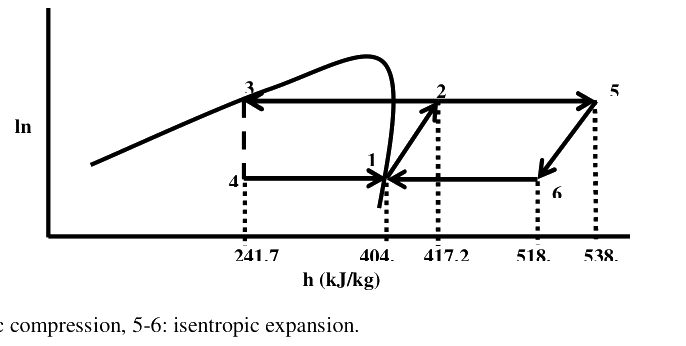
The refrigeration effect in kW is

Question diagram

Open complete paper
10
2009 · Engineering Sciences · Thermodynamic Cycles · Vapour Power and Refrigeration Cycles
Engineering Sciences (XE) 2009

The actual power input to the compressor in kW is

Open complete paper
11
2010 · Engineering Sciences · Thermodynamic Cycles · Vapour Power and Refrigeration Cycles
Engineering Sciences (XE) 2010
Determine the correctness or otherwise of the following Assertion [a] and the Reason [r]: Assertion: Carnot cycle is not used in vapour power cycles. Reason: Pumping of a two phase mixture is difficult
Open complete paper
12
2010 · Engineering Sciences · Thermodynamic Cycles · Vapour Power and Refrigeration Cycles
Engineering Sciences (XE) 2010
Work done by the turbine is
Open complete paper
13
2010 · Engineering Sciences · Thermodynamic Cycles · Vapour Power and Refrigeration Cycles
Engineering Sciences (XE) 2010

Heat addition in the boiler is

Open complete paper
14
2011 · Engineering Sciences · Thermodynamic Cycles · Vapour Power and Refrigeration Cycles
Engineering Sciences (XE) 2011
An ideal vapor compression refrigeration cycle uses R-134a as working fluid. The condenser pressure is 5 bar and evaporator pressure is 60 kPa. The refrigerant enters the compressor as saturated vapor and its specific enthalpy at the compressor exit is 267.98 kJ/kg. The other relevant data regarding R-134a are given below:
Pressure, bar\(h_f\), kJ/kg\(h_g\), kJ/kg\(s_f\), kJ/kg·K\(s_g\), kJ/kg·K
0.63.46224.720.01470.9520
571.33256.070.27230.9117

The COP of the cycle is approximately

Question diagram

Open complete paper
15
2013 · Engineering Sciences · Thermodynamic Cycles · Vapour Power and Refrigeration Cycles
Engineering Sciences (XE) 2013
If the required cooling is attained in 16 hours, the refrigeration plant capacity (in Tons) is
Open complete paper
16
2013 · Engineering Sciences · Thermodynamic Cycles · Vapour Power and Refrigeration Cycles
Engineering Sciences (XE) 2013

If the cooling is to be achieved in 8 hours, the power required (in Horse Power) to operate the plant having a Coefficient of Performance (COP) of 2.5 will be

Open complete paper
17
2013 · Engineering Sciences · Thermodynamic Cycles · Vapour Power and Refrigeration Cycles
Engineering Sciences (XE) 2013
What is the mass flow rate of the working fluid through the turbine, in kg/s, to first decimal place accuracy?

Question diagram

Open complete paper
18
2013 · Engineering Sciences · Thermodynamic Cycles · Vapour Power and Refrigeration Cycles
Engineering Sciences (XE) 2013
What is the power required to drive the compressor, to the nearest kW?
Open complete paper
19
2014 · Engineering Sciences · Thermodynamic Cycles · Vapour Power and Refrigeration Cycles
Engineering Sciences (XE) 2014
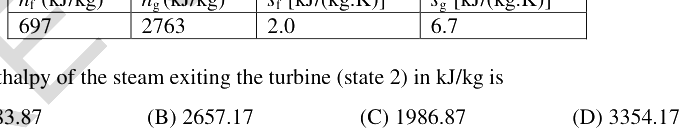
Steam is isentropically expanded in a turbine from 80 bar to 7 bar. At the inlet of the turbine (state 1) \(h_1\) is 3246 kJ/kg and \(s_1\) is 6.52 kJ/(kg.K).
Pressure = 7 bar
hf(kJ/kg)hg(kJ/kg)sf(kJ/(kg.K))sg(kJ/(kg.K))
69727632.06.7
The enthalpy of the steam exiting the turbine (state 2) in kJ/kg is

Question diagram

Open complete paper
20
2015 · Engineering Sciences · Thermodynamic Cycles · Vapour Power and Refrigeration Cycles
Engineering Sciences (XE) 2015
In an ideal Rankine cycle, increase in superheat of vapor at the exit of boiler leads to
(A) decrease in net work output from the cycle
(B) increase in cycle efficiency
(C) decrease in cycle efficiency
(D) decrease in quality of steam at the exit of the turbine
Open complete paper

Showing 20 of 32 questions