My Cart
Your Cart 0

    Your cart is empty.

  • Total (Amount) ₹0.00
Previous year question hub

Mechanics of Rigid Bodies - Engineering Sciences Previous Year Questions

Practice Mechanics of Rigid Bodies - Engineering Sciences previous year questions organised from real papers, with year-wise coverage and clear topic navigation.

20Papers
20Years
167Questions
1Topics

Mechanics of Rigid Bodies question pattern

Every graph below is calculated only from this selection.

Questions by year

Compare question counts across years.

Difficulty distribution

How the classified questions are distributed by difficulty.

Medium 115 68.9%
Easy 47 28.1%
Hard 5 3%

Question type distribution

MCQ, numerical, multiple-select and other formats found in these papers.

MCQ 111 66.5%
Numerical Answer Type (NAT) 49 29.3%
MSQ 4 2.4%
Fill in the blanks 3 1.8%

Subject weightage

Top subjects by unique question coverage.

Engineering Sciences
167 Qs

Most asked topics

Top topics across the included previous year papers.

Mechanics of Rigid Bodies
167 Qs

Subtopic coverage

Top subtopics inside this exact selection.

Particle and Rigid-body Dynamics
100 Qs
Statics, Trusses and Friction
67 Qs

Paper coverage

Question coverage for the most populated papers. Every active PYP paper remains listed below.

Engineering Sciences (XE) 2026
7 Qs
Engineering Sciences (XE) 2025
10 Qs
Engineering Sciences (XE) 2024
10 Qs
Engineering Sciences (XE) 2023
8 Qs
Engineering Sciences (XE) 2022
10 Qs
Engineering Sciences (XE) 2021
9 Qs
Engineering Sciences (XE) 2020
7 Qs
Engineering Sciences (XE) 2019
6 Qs
Engineering Sciences (XE) 2018
7 Qs
Engineering Sciences (XE) 2017
7 Qs
Engineering Sciences (XE) 2016
8 Qs
Engineering Sciences (XE) 2015
9 Qs
Engineering Sciences (XE) 2014
6 Qs
Engineering Sciences (XE) 2013
5 Qs
Engineering Sciences (XE) 2012
6 Qs
Engineering Sciences (XE) 2011
10 Qs
Engineering Sciences (XE) 2010
10 Qs
Engineering Sciences (XE) 2009
12 Qs
Engineering Sciences (XE) 2008
9 Qs
Engineering Sciences (XE) 2007
11 Qs

Browse by subtopics

Open a focused page built from the same verified paper data.

Included previous year papers

Newest papers appear first. Search these papers or sort by year and name.

Paper nameYearPDFAttempt
Engineering Sciences (XE) 20262026
7 questions in this view
2026
Engineering Sciences (XE) 20252025
10 questions in this view
2025
Engineering Sciences (XE) 20242024
10 questions in this view
2024
Engineering Sciences (XE) 20232023
8 questions in this view
2023
Engineering Sciences (XE) 20222022
10 questions in this view
2022
Engineering Sciences (XE) 20212021
9 questions in this view
2021
Engineering Sciences (XE) 20202020
7 questions in this view
2020
Engineering Sciences (XE) 20192019
6 questions in this view
2019
Engineering Sciences (XE) 20182018
7 questions in this view
2018
Engineering Sciences (XE) 20172017
7 questions in this view
2017
Engineering Sciences (XE) 20162016
8 questions in this view
2016
Engineering Sciences (XE) 20152015
9 questions in this view
2015
Engineering Sciences (XE) 20142014
6 questions in this view
2014
Engineering Sciences (XE) 20132013
5 questions in this view
2013
Engineering Sciences (XE) 20122012
6 questions in this view
2012
Engineering Sciences (XE) 20112011
10 questions in this view
2011
Engineering Sciences (XE) 20102010
10 questions in this view
2010
Engineering Sciences (XE) 20092009
12 questions in this view
2009
Engineering Sciences (XE) 20082008
9 questions in this view
2008
Engineering Sciences (XE) 20072007
11 questions in this view
2007

Sample previous year questions

A varied preview from the papers represented in this selection, with every available option.

1
2007 · Engineering Sciences · Mechanics of Rigid Bodies · Particle and Rigid-body Dynamics
Engineering Sciences (XE) 2007
A D flip-flop is converted to T flip-flop by connecting a logic circuit at the input as shown in the figure.
The logic circuit is
Open complete paper
2
2008 · Engineering Sciences · Mechanics of Rigid Bodies · Statics, Trusses and Friction
Engineering Sciences (XE) 2008

If three nonparallel forces are in equilibrium they

Open complete paper
3
2009 · Engineering Sciences · Mechanics of Rigid Bodies · Particle and Rigid-body Dynamics
Engineering Sciences (XE) 2009
Which of the following statements are true ?
P : In Case 1, the system moves to the left
Q : In Case 1, the system moves to the right
R : In Case 2, the system moves to the left
S : In Case 2, the system moves to the right
Open complete paper
4
2010 · Engineering Sciences · Mechanics of Rigid Bodies · Statics, Trusses and Friction
Engineering Sciences (XE) 2010
Three forces acting on a particle are given as
\(F_1 = (5\mathbf{i} + 6\mathbf{j})\) N, \(F_2 = (-\mathbf{i} + 4\mathbf{k})\) N and \(F_3 = (\mathbf{i} + 6\mathbf{j} + 16\mathbf{k})\) N,
where \(\mathbf{i}, \mathbf{j}, \mathbf{k}\) are the unit vectors along Cartesian coordinate axes. Which one of the following statements is true?
Open complete paper
5
2011 · Engineering Sciences · Mechanics of Rigid Bodies · Particle and Rigid-body Dynamics
Engineering Sciences (XE) 2011
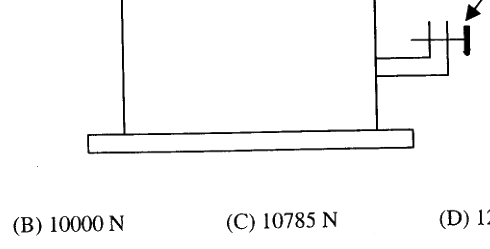
When a large tank containing water is placed on a weighing scale, a reading of 10000 N is obtained. The tank is fitted with an outlet pipe and a valve as shown. When the valve is opened, a jet of water with a velocity of 10 m/s issues out in the vertically upward direction. The diameter of the outlet pipe is 10 cm. Determine approximately the reading on the weighing scale at the instant the valve is opened and the water jet issues out. Density of water is 1000 kg/m³.

Question diagram

Open complete paper
6
2012 · Engineering Sciences · Mechanics of Rigid Bodies · Particle and Rigid-body Dynamics
Engineering Sciences (XE) 2012
The power (in kW) required to propel the boat is

Question diagram

Open complete paper