My Cart
Your Cart 0

    Your cart is empty.

  • Total (Amount) ₹0.00
Previous year question hub

Deflection, Energy Methods and Buckling - Mechanics of Deformable Bodies - Engineering Sciences Previous Year Questions

Practice Deflection, Energy Methods and Buckling - Mechanics of Deformable Bodies - Engineering Sciences previous year questions organised from real papers, with year-wise coverage and clear topic navigation.

20Papers
20Years
58Questions
1Topics

Deflection, Energy Methods and Buckling question pattern

Every graph below is calculated only from this selection.

Questions by year

Compare question counts across years.

Difficulty distribution

How the classified questions are distributed by difficulty.

Medium 49 84.5%
Easy 7 12.1%
Hard 2 3.4%
Question type distribution

MCQ, numerical, multiple-select and other formats found in these papers.

MCQ 42 72.4%
Numerical Answer Type (NAT) 16 27.6%

Subject weightage

Top subjects by unique question coverage.

Engineering Sciences
58 Qs

Most asked topics

Top topics across the included previous year papers.

Mechanics of Deformable Bodies
58 Qs

Subtopic coverage

Top subtopics inside this exact selection.

Deflection, Energy Methods and Buckling
58 Qs

Paper coverage

Question coverage for the most populated papers. Every active PYP paper remains listed below.

Engineering Sciences (XE) 2026
2 Qs
Engineering Sciences (XE) 2025
2 Qs
Engineering Sciences (XE) 2024
2 Qs
Engineering Sciences (XE) 2023
2 Qs
Engineering Sciences (XE) 2022
2 Qs
Engineering Sciences (XE) 2021
1 Qs
Engineering Sciences (XE) 2020
3 Qs
Engineering Sciences (XE) 2019
2 Qs
Engineering Sciences (XE) 2018
4 Qs
Engineering Sciences (XE) 2017
3 Qs
Engineering Sciences (XE) 2016
4 Qs
Engineering Sciences (XE) 2015
3 Qs
Engineering Sciences (XE) 2014
4 Qs
Engineering Sciences (XE) 2013
5 Qs
Engineering Sciences (XE) 2012
6 Qs
Engineering Sciences (XE) 2011
2 Qs
Engineering Sciences (XE) 2010
2 Qs
Engineering Sciences (XE) 2009
2 Qs
Engineering Sciences (XE) 2008
2 Qs
Engineering Sciences (XE) 2007
5 Qs

Included previous year papers

Newest papers appear first. Search these papers or sort by year and name.

Paper nameYearPDFAttempt
Engineering Sciences (XE) 20262026
2 questions in this view
2026
Engineering Sciences (XE) 20252025
2 questions in this view
2025
Engineering Sciences (XE) 20242024
2 questions in this view
2024
Engineering Sciences (XE) 20232023
2 questions in this view
2023
Engineering Sciences (XE) 20222022
2 questions in this view
2022
Engineering Sciences (XE) 20212021
1 questions in this view
2021
Engineering Sciences (XE) 20202020
3 questions in this view
2020
Engineering Sciences (XE) 20192019
2 questions in this view
2019
Engineering Sciences (XE) 20182018
4 questions in this view
2018
Engineering Sciences (XE) 20172017
3 questions in this view
2017
Engineering Sciences (XE) 20162016
4 questions in this view
2016
Engineering Sciences (XE) 20152015
3 questions in this view
2015
Engineering Sciences (XE) 20142014
4 questions in this view
2014
Engineering Sciences (XE) 20132013
5 questions in this view
2013
Engineering Sciences (XE) 20122012
6 questions in this view
2012
Engineering Sciences (XE) 20112011
2 questions in this view
2011
Engineering Sciences (XE) 20102010
2 questions in this view
2010
Engineering Sciences (XE) 20092009
2 questions in this view
2009
Engineering Sciences (XE) 20082008
2 questions in this view
2008
Engineering Sciences (XE) 20072007
5 questions in this view
2007

All Deflection, Energy Methods and Buckling previous year questions

Practice every matching question in batches of 20, with every available option.

1
2007 · Engineering Sciences · Mechanics of Deformable Bodies · Deflection, Energy Methods and Buckling
Engineering Sciences (XE) 2007
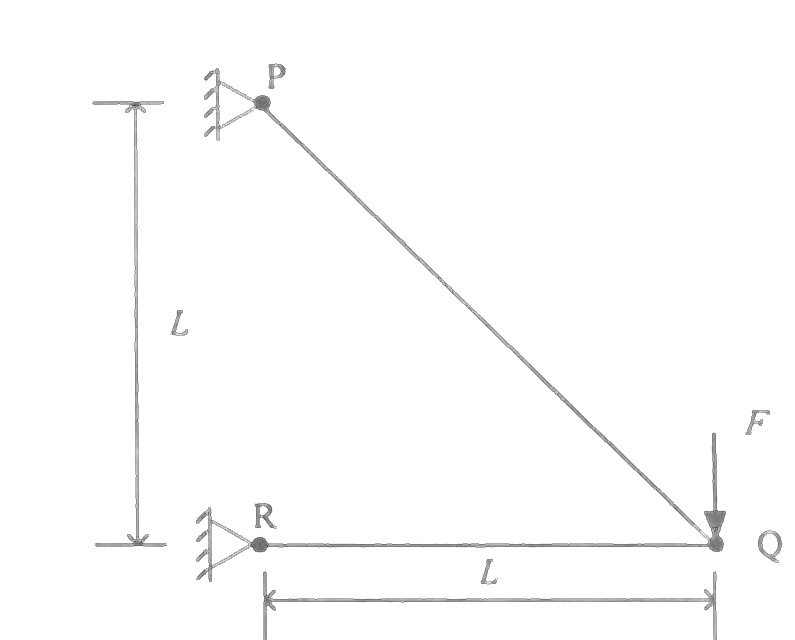
The vertical deflection at point Q is
Open complete paper
2
2007 · Engineering Sciences · Mechanics of Deformable Bodies · Deflection, Energy Methods and Buckling
Engineering Sciences (XE) 2007

The horizontal deflection at point Q is

Open complete paper
3
2007 · Engineering Sciences · Mechanics of Deformable Bodies · Deflection, Energy Methods and Buckling
Engineering Sciences (XE) 2007
A block of mass m is released at rest from a point P of a rough circular path of radius r as shown in the figure. There is a spring of stiffness k at the other end of the path. (acceleration due to gravity = g)

The maximum spring deflection is
Open complete paper
4
2007 · Engineering Sciences · Mechanics of Deformable Bodies · Deflection, Energy Methods and Buckling
Engineering Sciences (XE) 2007
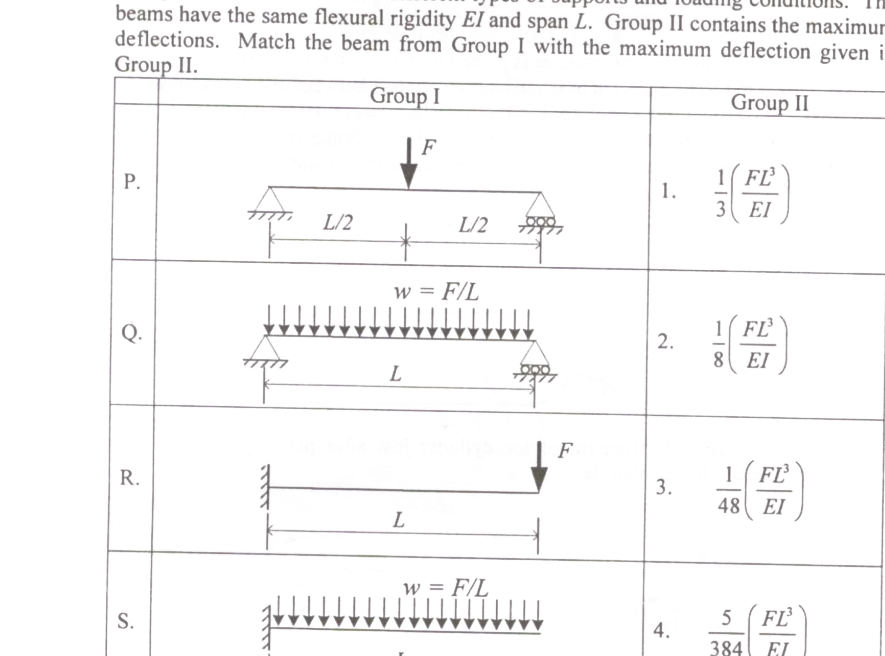
Group I contains beams with different types of supports and loading conditions. The beams have the same flexural rigidity EI and span L. Group II contains the maximum deflections. Match the beam from Group I with the maximum deflection given in Group II.

Question diagram

Open complete paper
5
2007 · Engineering Sciences · Mechanics of Deformable Bodies · Deflection, Energy Methods and Buckling
Engineering Sciences (XE) 2007
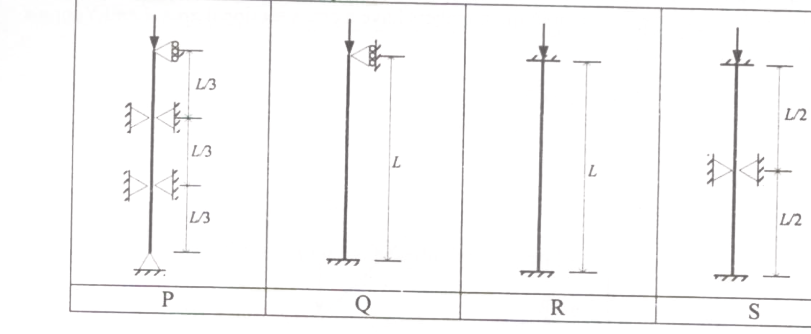
The figure below shows 4 long columns with different support conditions but the same flexural rigidity EI. Let P, Q, R, and S be the values of their critical buckling load as shown below the respective columns.

P, Q, R and S can be arranged in increasing order as

Question diagram

Open complete paper
6
2008 · Engineering Sciences · Mechanics of Deformable Bodies · Deflection, Energy Methods and Buckling
Engineering Sciences (XE) 2008

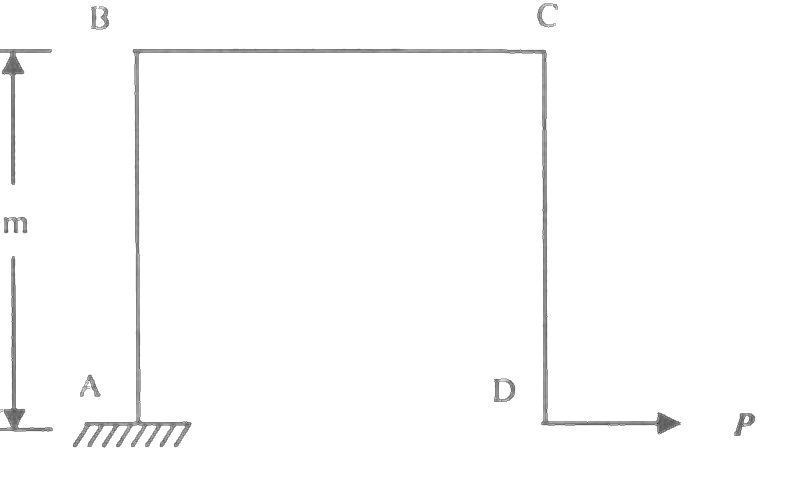
The horizontal displacement at D of the frame shown in figure is (neglect axial strain energy and assume EI to be constant throughout)

Open complete paper
7
2008 · Engineering Sciences · Mechanics of Deformable Bodies · Deflection, Energy Methods and Buckling
Engineering Sciences (XE) 2008

The slope and deflection at the free end of a variable cross section cantilever beam subjected to a bending moment at the free end as shown in the figure is

Open complete paper
8
2009 · Engineering Sciences · Mechanics of Deformable Bodies · Deflection, Energy Methods and Buckling
Engineering Sciences (XE) 2009
A simply supported beam of span L and flexural rigidity EI carries a uniformly distributed load w/unit length. The deflection at the mid span of the beam is
Open complete paper
9
2009 · Engineering Sciences · Mechanics of Deformable Bodies · Deflection, Energy Methods and Buckling
Engineering Sciences (XE) 2009
An L-shaped elastic member with flexural rigidity EI is loaded as shown below : Total strain energy in the member due to bending is:
Open complete paper
10
2010 · Engineering Sciences · Mechanics of Deformable Bodies · Deflection, Energy Methods and Buckling
Engineering Sciences (XE) 2010

The buckling load of a slender column clamped at both the ends is 4000 N. The column is subjected to an axial compression. During the course of service, one of the ends gets detached from the clamp and becomes free end. The absolute percentage change in the buckling load due to the change in the end condition is

Open complete paper
11
2010 · Engineering Sciences · Mechanics of Deformable Bodies · Deflection, Energy Methods and Buckling
Engineering Sciences (XE) 2010

The deflection due to bending at point B is

Open complete paper
12
2011 · Engineering Sciences · Mechanics of Deformable Bodies · Deflection, Energy Methods and Buckling
Engineering Sciences (XE) 2011

The Euler buckling load for a long slender column with fixed-fixed end conditions is 10000 N. If the end conditions are changed to fixed-free, the Euler buckling load (in N) would be

Open complete paper
13
2011 · Engineering Sciences · Mechanics of Deformable Bodies · Deflection, Energy Methods and Buckling
Engineering Sciences (XE) 2011

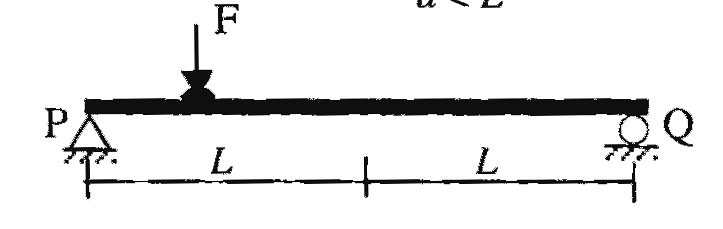
For the beam shown, if the maximum deflection occurs at a distance x from support P, which one of the following is TRUE?

Open complete paper
14
2012 · Engineering Sciences · Mechanics of Deformable Bodies · Deflection, Energy Methods and Buckling
Engineering Sciences (XE) 2012
For the beam-column configurations shown in figure, the minimum Euler buckling load is obtained for the case (Young’s modulus and second moment of cross-sectional area are as indicated)
Open complete paper
15
2012 · Engineering Sciences · Mechanics of Deformable Bodies · Deflection, Energy Methods and Buckling
Engineering Sciences (XE) 2012
Consider a simply supported beam loaded either by a uniformly distributed transverse load or by a concentrated transverse load applied at the center such that the maximum bending stress in both cases is the same. The ratio of the strain energy for the two cases is
Open complete paper
16
2012 · Engineering Sciences · Mechanics of Deformable Bodies · Deflection, Energy Methods and Buckling
Engineering Sciences (XE) 2012
The vertical deflection at the ends is
Open complete paper
17
2012 · Engineering Sciences · Mechanics of Deformable Bodies · Deflection, Energy Methods and Buckling
Engineering Sciences (XE) 2012
The value of the additional end moment M (in N.m) required to obtain an upward deflection of 1 mm at the free end, is (moment is positive in counterclockwise direction)
Open complete paper
18
2012 · Engineering Sciences · Mechanics of Deformable Bodies · Deflection, Energy Methods and Buckling
Engineering Sciences (XE) 2012
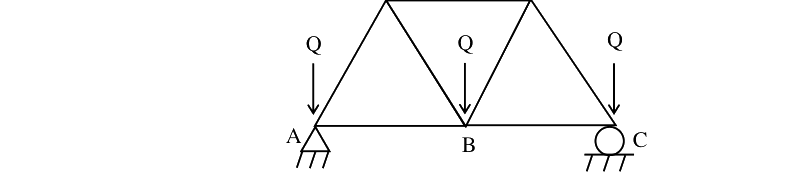
A small railway bridge is constructed from identical steel truss members, each of length \(l\), cross-sectional area \(A\) and Young’s modulus \(E\). A train stops on the bridge. The loads applied by the train on the truss on one side of the bridge may be assumed to act at pins A, B and C, as shown. The displacement of the support C due to this loading is

Question diagram

Open complete paper
19
2012 · Engineering Sciences · Mechanics of Deformable Bodies · Deflection, Energy Methods and Buckling
Engineering Sciences (XE) 2012
If the deflection at the free-end (under load P, with end moment M=0) is measured as δ = 5 mm, the flexural rigidity EI for the beam is (in N m²)
Open complete paper
20
2013 · Engineering Sciences · Mechanics of Deformable Bodies · Deflection, Energy Methods and Buckling
Engineering Sciences (XE) 2013
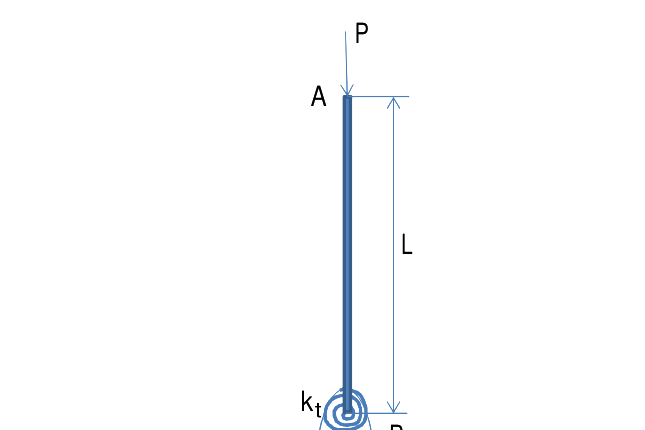
A rigid bar AB is hinged at B through a torsional spring with spring constant \(k_t\). For small rotations of the bar AB about B, the critical load \(P_{cr}\) is given by

Question diagram

Open complete paper

Showing 20 of 57 questions