My Cart
Your Cart 0

    Your cart is empty.

  • Total (Amount) ₹0.00
Previous year question hub

Thermal operations - Food Engineering - Engineering Sciences Previous Year Questions

Practice Thermal operations - Food Engineering - Engineering Sciences previous year questions organised from real papers, with year-wise coverage and clear topic navigation.

14Papers
14Years
29Questions
1Topics

Thermal operations question pattern

Every graph below is calculated only from this selection.

Questions by year

Compare question counts across years.

Difficulty distribution

How the classified questions are distributed by difficulty.

Easy 16 55.2%
Medium 13 44.8%

Question type distribution

MCQ, numerical, multiple-select and other formats found in these papers.

MCQ 21 72.4%
Numerical Answer Type (NAT) 6 20.7%
MSQ 2 6.9%

Subject weightage

Top subjects by unique question coverage.

Engineering Sciences
29 Qs

Most asked topics

Top topics across the included previous year papers.

Food Engineering
29 Qs

Subtopic coverage

Top subtopics inside this exact selection.

Thermal operations
29 Qs

Paper coverage

Question coverage for the most populated papers. Every active PYP paper remains listed below.

Engineering Sciences (XE) 2025
2 Qs
Engineering Sciences (XE) 2023
2 Qs
Engineering Sciences (XE) 2022
4 Qs
Engineering Sciences (XE) 2020
2 Qs
Engineering Sciences (XE) 2019
1 Qs
Engineering Sciences (XE) 2018
1 Qs
Engineering Sciences (XE) 2016
2 Qs
Engineering Sciences (XE) 2015
2 Qs
Engineering Sciences (XE) 2013
1 Qs
Engineering Sciences (XE) 2012
1 Qs
Engineering Sciences (XE) 2011
1 Qs
Engineering Sciences (XE) 2010
3 Qs
Engineering Sciences (XE) 2009
3 Qs
Engineering Sciences (XE) 2008
4 Qs

Included previous year papers

Newest papers appear first. Search these papers or sort by year and name.

Paper nameYearPDFAttempt
Engineering Sciences (XE) 20252025
2 questions in this view
2025
Engineering Sciences (XE) 20232023
2 questions in this view
2023
Engineering Sciences (XE) 20222022
4 questions in this view
2022
Engineering Sciences (XE) 20202020
2 questions in this view
2020
Engineering Sciences (XE) 20192019
1 questions in this view
2019
Engineering Sciences (XE) 20182018
1 questions in this view
2018
Engineering Sciences (XE) 20162016
2 questions in this view
2016
Engineering Sciences (XE) 20152015
2 questions in this view
2015
Engineering Sciences (XE) 20132013
1 questions in this view
2013
Engineering Sciences (XE) 20122012
1 questions in this view
2012
Engineering Sciences (XE) 20112011
1 questions in this view
2011
Engineering Sciences (XE) 20102010
3 questions in this view
2010
Engineering Sciences (XE) 20092009
3 questions in this view
2009
Engineering Sciences (XE) 20082008
4 questions in this view
2008

All Thermal operations previous year questions

Practice every matching question in batches of 20, with every available option.

1
2008 · Engineering Sciences · Food Engineering · Thermal operations
Engineering Sciences (XE) 2008
Following operations are adopted for cleaning in place (CIP) of equipment
P: Cold water rinse; Q: Hot water rinse; R: Alkali cleaning; S: Acid cleaning
The correct sequence of CIP for equipment used in UHT processing of milk is
Open complete paper
2
2008 · Engineering Sciences · Food Engineering · Thermal operations
Engineering Sciences (XE) 2008
Match the items in Group I with the most appropriate items in Group II

Group IGroup II
(P) Disc centrifuge(1) Separation of solid phase in milk by coagulation
(Q) Multiple effect evaporator(2) Aseptic packaging of milk
(R) UHT processing(3) Separation of liquid phases in milk
(S) Homogenization(4) Dispersion of one of the liquid phases in milk
(5) Concentration of milk
Open complete paper
3
2008 · Engineering Sciences · Food Engineering · Thermal operations
Engineering Sciences (XE) 2008
A medium acid food is sterilized at 100°C in a can to reduce the number of heat resistant organism (\( D_{120} = 0.2 \) min, \( z = 10°C \)) from an initial count of 10000 per can to a probability of survival of 1 in million. \( D_{100} \) value of this organism is
Open complete paper
4
2008 · Engineering Sciences · Food Engineering · Thermal operations
Engineering Sciences (XE) 2008
A medium acid food is sterilized at 100°C in a can to reduce the number of heat resistant organism (\( D_{120} = 0.2 \) min, \( z = 10°C \)) from an initial count of 10000 per can to a probability of survival of 1 in million. The total processing time is
Open complete paper
5
2009 · Engineering Sciences · Food Engineering · Thermal operations
Engineering Sciences (XE) 2009

The most suitable evaporator for concentration of fruit juices is

Open complete paper
6
2009 · Engineering Sciences · Food Engineering · Thermal operations
Engineering Sciences (XE) 2009

A method in which continuous electric current is passed through food to heat it rapidly while maintaining quality is called

Open complete paper
7
2009 · Engineering Sciences · Food Engineering · Thermal operations
Engineering Sciences (XE) 2009
The TDT value (minutes) at 110 °C is
Open complete paper
8
2010 · Engineering Sciences · Food Engineering · Thermal operations
Engineering Sciences (XE) 2010

Shelf-life of fish can be extended by chilling as it

Open complete paper
9
2010 · Engineering Sciences · Food Engineering · Thermal operations
Engineering Sciences (XE) 2010
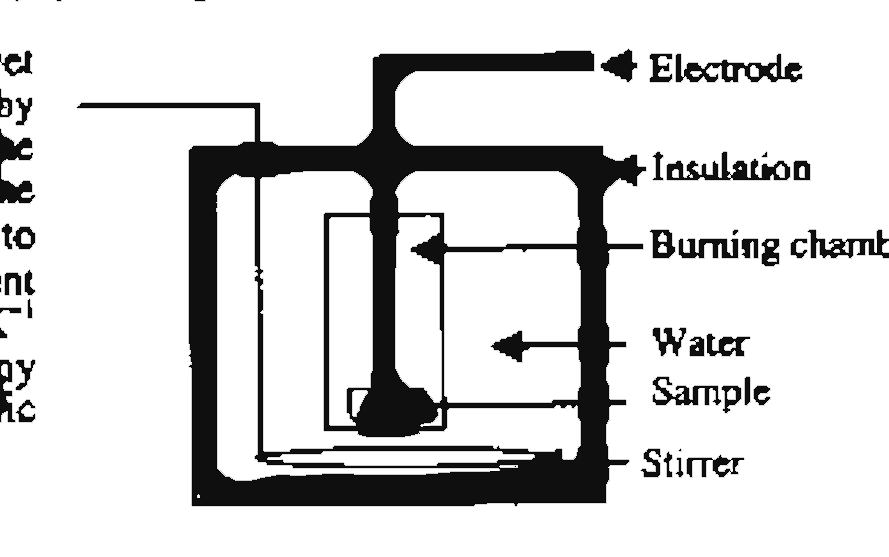
9.5 g of corn flakes containing 5% moisture (wet basis) is oxidized completely to CO2 and H2O by ignition in a Bomb Calorimeter (as shown in the figure). The combustion increases the temperature of 2500 g of water from 15°C to 27°C. Assume that the heat capacity and latent heat of vaporization of water are 4.187 kJ kg-1 K-1 and 2257 kJ kg-1, respectively. Neglect any sensible heat gain by water vapour. The calorific value of the flake is
Open complete paper
10
2010 · Engineering Sciences · Food Engineering · Thermal operations
Engineering Sciences (XE) 2010
D0 value of a bacterium is determined by using two thin walled glass capillary tubes filled with same bacterial suspension in distilled water. The sealed capillaries are dipped in an oil bath maintained at 121°C and kept for 60 s and 135 s, respectively. These capillaries are cooled immediately in ice water. Number of survivors remained in the respective tubes are 2000 and 300.
The processing time (in minutes) to kill 99.999% of the bacteria in any food at 121°C will be
Open complete paper
11
2011 · Engineering Sciences · Food Engineering · Thermal operations
Engineering Sciences (XE) 2011
The Fo value, based on 12D concept using the Do value of the above organism and a most likely spore load in the product of 100, will be
Open complete paper
12
2012 · Engineering Sciences · Food Engineering · Thermal operations
Engineering Sciences (XE) 2012
Thermal death time (TDT) of Clostridium botulinum at 121 °C is 2.78 min with a z-value of 10 °C. The TDT of the microorganism at 116 °C (in min) is
Open complete paper
13
2013 · Engineering Sciences · Food Engineering · Thermal operations
Engineering Sciences (XE) 2013
Thermal death of viable spores of Bacillus subtilis in a food sample follows a first order kinetics with a specific death rate constant of 0.23 min-1 at 100 °C. The time (in minutes) required to kill 99% of spores in the food sample at 100 °C will be
Open complete paper
14
2015 · Engineering Sciences · Food Engineering · Thermal operations
Engineering Sciences (XE) 2015
Multiple effect evaporation leads to
Open complete paper
15
2015 · Engineering Sciences · Food Engineering · Thermal operations
Engineering Sciences (XE) 2015
Which one of the following is NOT a component of an evaporator?
Open complete paper
16
2016 · Engineering Sciences · Food Engineering · Thermal operations
Engineering Sciences (XE) 2016
The D121 and Z values for C. botulinum spores in canned food are 0.2 min and 10 °C respectively. Total time required in min, to reduce the spores from 10⁵ to 10³ at 111 °C is _____.
Open complete paper
17
2016 · Engineering Sciences · Food Engineering · Thermal operations
Engineering Sciences (XE) 2016
A fruit juice with a negligible boiling point rise is being evaporated using saturated steam at 121.1 °C in a triple effect evaporator having equal area in each effect. The pressure of the vapor in the last effect is 25.6 kPa absolute and the corresponding saturation temperature is 65.7 °C. The heat transfer coefficients are U1 = 2760, U2 = 1875 and U3 = 1350 W m-2 K-1. The boiling point (°C) in the first effect is __.
Open complete paper
18
2018 · Engineering Sciences · Food Engineering · Thermal operations
Engineering Sciences (XE) 2018
Apple juice of 10% total solids (TS) is being concentrated in a single effect evaporator working with a surface condenser to 40% TS under a vacuum of 20 kPa. After some time the vacuum pump stops but the evaporation process continued. Choose the combination of possible implications from the following.
(P) Product quality is affected
(Q) Substantial increase in thermal energy requirement
(R) Decrease in the rate of evaporation
Open complete paper
19
2019 · Engineering Sciences · Food Engineering · Thermal operations
Engineering Sciences (XE) 2019
Sticking of powder to wall of the chamber during spray drying of fruit juice is due to ____.
Open complete paper
20
2020 · Engineering Sciences · Food Engineering · Thermal operations
Engineering Sciences (XE) 2020
During extrusion cooking, food materials are generally subjected to a combination of
Open complete paper

Showing 20 of 29 questions