My Cart
Your Cart 0

    Your cart is empty.

  • Total (Amount) ₹0.00
Previous year question hub

Stability Analysis and Root Locus - Control Systems - Electronics & Communication Engineering Previous Year Questions

Practice Stability Analysis and Root Locus - Control Systems - Electronics & Communication Engineering previous year questions organised from real papers, with year-wise coverage and clear topic navigation.

23Papers
17Years
44Questions
1Topics

Stability Analysis and Root Locus question pattern

Every graph below is calculated only from this selection.

Questions by year

Compare question counts across years.

Difficulty distribution

How the classified questions are distributed by difficulty.

Medium 35 79.5%
Easy 5 11.4%
Hard 4 9.1%
Question type distribution

MCQ, numerical, multiple-select and other formats found in these papers.

MCQ 31 70.5%
Numerical Answer Type (NAT) 11 25%
MSQ 1 2.3%
Fill in the blanks 1 2.3%

Subject weightage

Top subjects by unique question coverage.

Electronics & Communication Engineering
44 Qs

Most asked topics

Top topics across the included previous year papers.

Control Systems
44 Qs

Subtopic coverage

Top subtopics inside this exact selection.

Stability Analysis and Root Locus
44 Qs

Paper coverage

Question coverage for the most populated papers. Every active PYP paper remains listed below.

Electronics and Communication Engineering (EC) 2026
1 Qs
Electronics & Communication Engineering (EC) 2025
4 Qs
Electronics & Communication Engineering (EC) 2024
1 Qs
Electronics & Communication Engineering (EC) 2023
1 Qs
Electronics & Communication Engineering (EC) 2022
2 Qs
Electronics & Communication Engineering (EC) 2021
2 Qs
Electronics & Communication Engineering (EC) 2020
3 Qs
Electronics & Communication Engineering (EC) 2019
1 Qs
Electronics & Communication Engineering (EC) 2018
2 Qs
Electronics & Communication Engineering (EC) 2017 [Session 1]
3 Qs
Electronics & Communication Engineering (EC) 2017
2 Qs
Electronics & Communication Engineering (EC) 2017 [Session 2]
2 Qs
Electronics & Communication Engineering (EC) 2016 [Session 1]
2 Qs
Electronics & Communication Engineering (EC) 2016 [Session 2]
2 Qs
Electronics & Communication Engineering (EC) 2016 [Session 3]
2 Qs
Electronics & Communication Engineering (EC) 2014 [Session 1]
2 Qs
Electronics & Communication Engineering (EC) 2014 [Session 4]
2 Qs
Electronics & Communication Engineering (EC) 2014 [Session 3]
1 Qs
Electronics & Communication Engineering (EC) 2012
1 Qs
Electronics & Communication Engineering (EC) 2011
2 Qs
Electronics & Communication Engineering (EC) 2009
2 Qs
Electronics & Communication Engineering (EC) 2008
2 Qs
Electronics & Communication Engineering (EC) 2007
2 Qs

Included previous year papers

Newest papers appear first. Search these papers or sort by year and name.

Paper nameYearPDFAttempt
Electronics and Communication Engineering (EC) 20262026
1 questions in this view
2026
Electronics & Communication Engineering (EC) 20252025
4 questions in this view
2025
Electronics & Communication Engineering (EC) 20242024
1 questions in this view
2024
Electronics & Communication Engineering (EC) 20232023
1 questions in this view
2023
Electronics & Communication Engineering (EC) 20222022
2 questions in this view
2022
Electronics & Communication Engineering (EC) 20212021
2 questions in this view
2021
Electronics & Communication Engineering (EC) 20202020
3 questions in this view
2020
Electronics & Communication Engineering (EC) 20192019
1 questions in this view
2019
Electronics & Communication Engineering (EC) 20182018
2 questions in this view
2018
Electronics & Communication Engineering (EC) 20172017
2 questions in this view
2017
Electronics & Communication Engineering (EC) 2017 [Session 1]2017
3 questions in this view
2017
Electronics & Communication Engineering (EC) 2017 [Session 2]2017
2 questions in this view
2017
Electronics & Communication Engineering (EC) 2016 [Session 1]2016
2 questions in this view
2016
Electronics & Communication Engineering (EC) 2016 [Session 2]2016
2 questions in this view
2016
Electronics & Communication Engineering (EC) 2016 [Session 3]2016
2 questions in this view
2016
Electronics & Communication Engineering (EC) 2014 [Session 1]2014
2 questions in this view
2014
Electronics & Communication Engineering (EC) 2014 [Session 3]2014
1 questions in this view
2014
Electronics & Communication Engineering (EC) 2014 [Session 4]2014
2 questions in this view
2014
Electronics & Communication Engineering (EC) 20122012
1 questions in this view
2012
Electronics & Communication Engineering (EC) 20112011
2 questions in this view
2011
Electronics & Communication Engineering (EC) 20092009
2 questions in this view
2009
Electronics & Communication Engineering (EC) 20082008
2 questions in this view
2008
Electronics & Communication Engineering (EC) 20072007
2 questions in this view
2007

All Stability Analysis and Root Locus previous year questions

Practice every matching question in batches of 20, with every available option.

1
2007 · Electronics & Communication Engineering · Control Systems · Stability Analysis and Root Locus
Electronics & Communication Engineering (EC) 2007
If the closed-loop transfer function of a control system is \(T(s) = \frac{s-5}{(s+2)(s+3)}\), then it is
Open complete paper
2
2007 · Electronics & Communication Engineering · Control Systems · Stability Analysis and Root Locus
Electronics & Communication Engineering (EC) 2007
A unity feedback control system has an open-loop transfer function \(G(s) = \frac{K}{s(s^2+7s+12)}\). The gain \(K\) for which \(s = -1 + j1\) will lie on the root locus of this system is
Open complete paper
3
2008 · Electronics & Communication Engineering · Control Systems · Stability Analysis and Root Locus
Electronics & Communication Engineering (EC) 2008
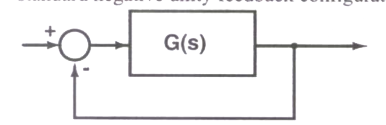
A certain system has transfer function \[G(s)=\frac{s+8}{s^2+\alpha s-4}\] where \(\alpha\) is a parameter. Consider the standard negative unity feedback configuration as shown below.\n\nWhich of the following statements is true?

Question diagram

Open complete paper
4
2008 · Electronics & Communication Engineering · Control Systems · Stability Analysis and Root Locus
Electronics & Communication Engineering (EC) 2008
The number of open right half plane poles of \[G(s)=\frac{10}{s^5+2s^4+3s^3+6s^2+5s+3}\] is

Question diagram

Open complete paper
5
2009 · Electronics & Communication Engineering · Control Systems · Stability Analysis and Root Locus
Electronics & Communication Engineering (EC) 2009
The feedback configuration and the pole-zero locations of \(G(s) = \frac{s^2 - 2s + 2}{s^2 + 2s + 2}\) are shown below. The root locus for negative values of \(k\), i.e., for \(-\infty < k < 0\), has breakaway/ break-in points and angle of departure at pole P (with respect to the positive real axis) equal to

Question diagram

Open complete paper
6
2009 · Electronics & Communication Engineering · Control Systems · Stability Analysis and Root Locus
Electronics & Communication Engineering (EC) 2009

The gain and phase margins of G(s) for closed loop stability are

Open complete paper
7
2011 · Electronics & Communication Engineering · Control Systems · Stability Analysis and Root Locus
Electronics & Communication Engineering (EC) 2011

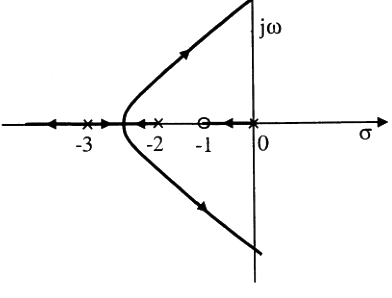
The root locus plot for a system is given below. The open loop transfer function corresponding to this plot is given by

Question diagram

Open complete paper
8
2011 · Electronics & Communication Engineering · Control Systems · Stability Analysis and Root Locus
Electronics & Communication Engineering (EC) 2011
The gain margin of the system under closed loop unity negative feedback is
Open complete paper
9
2012 · Electronics & Communication Engineering · Control Systems · Stability Analysis and Root Locus
Electronics & Communication Engineering (EC) 2012

The feedback system shown below oscillates at 2 rad/s when

Question diagram

Open complete paper
10
2014 · Electronics & Communication Engineering · Control Systems · Stability Analysis and Root Locus
Electronics & Communication Engineering (EC) 2014 [Session 1]
Consider the feedback system shown in the figure. The Nyquist plot of \(G(s)\) is also shown. Which one of the following conclusions is correct?
Open complete paper
11
2014 · Electronics & Communication Engineering · Control Systems · Stability Analysis and Root Locus
Electronics & Communication Engineering (EC) 2014 [Session 1]
The phase margin in degrees of \(G(s) = \frac{10}{(s+0.1)(s+1)(s+10)}\) calculated using the asymptotic Bode plot is ______.
Open complete paper
12
2014 · Electronics & Communication Engineering · Control Systems · Stability Analysis and Root Locus
Electronics & Communication Engineering (EC) 2014 [Session 3]
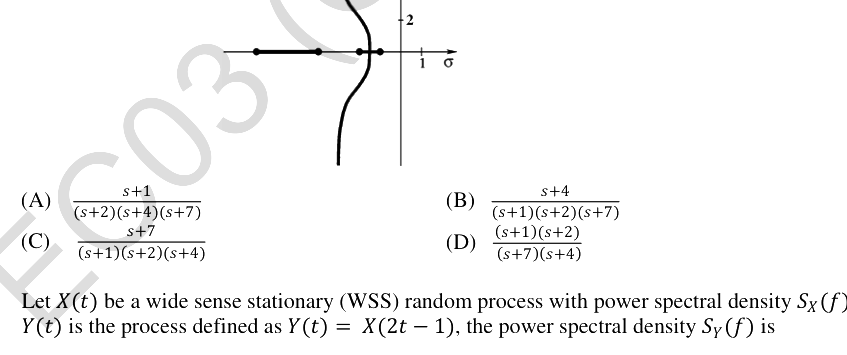
In the root locus plot shown in the figure, the pole/zero marks and the arrows have been removed. Which one of the following transfer functions has this root locus?

Question diagram

Open complete paper
13
2014 · Electronics & Communication Engineering · Control Systems · Stability Analysis and Root Locus
Electronics & Communication Engineering (EC) 2014 [Session 4]
Consider a transfer function \(G_p(s) = \frac{ps^2+3ps-2}{s^2+(3+p)s+(2-p)}\) with \(p\) a positive real parameter. The maximum value of \(p\) until which \(G_p\) remains stable is ________.
Open complete paper
14
2014 · Electronics & Communication Engineering · Control Systems · Stability Analysis and Root Locus
Electronics & Communication Engineering (EC) 2014 [Session 4]
The characteristic equation of a unity negative feedback system is \(1 + KG(s) = 0\). The open loop transfer function \(G(s)\) has one pole at 0 and two poles at -1. The root locus of the system for varying \(K\) is shown in the figure. The constant damping ratio line, for \(\xi=0.5\), intersects the root locus at point A. The distance from the origin to point A is given as 0.5. The value of \(K\) at point A is ________.
Open complete paper
15
2016 · Electronics & Communication Engineering · Control Systems · Stability Analysis and Root Locus
Electronics & Communication Engineering (EC) 2016 [Session 1]
A closed-loop control system is stable if the Nyquist plot of the corresponding open-loop transfer function
Open complete paper
16
2016 · Electronics & Communication Engineering · Control Systems · Stability Analysis and Root Locus
Electronics & Communication Engineering (EC) 2016 [Session 1]
The open-loop transfer function of a unity-feedback control system is \( G(s) = \frac{K}{s^2+5s+5} \) The value of K at the breakaway point of the feedback control system's root-locus plot is __________
Open complete paper
17
2016 · Electronics & Communication Engineering · Control Systems · Stability Analysis and Root Locus
Electronics & Communication Engineering (EC) 2016 [Session 2]
The number and direction of encirclements around the point \( -1 + j0 \) in the complex plane by the Nyquist plot of \( G(s) = \frac{1-s}{4+2s} \) is
Open complete paper
18
2016 · Electronics & Communication Engineering · Control Systems · Stability Analysis and Root Locus
Electronics & Communication Engineering (EC) 2016 [Session 2]
In the feedback system shown below \(G(s) = \frac{1}{(s+1)(s+2)(s+3)}\) . The positive value of \(k\) for which the gain margin of the loop is exactly 0 dB and the phase margin of the loop is exactly zero degree is ______
Open complete paper
19
2016 · Electronics & Communication Engineering · Control Systems · Stability Analysis and Root Locus
Electronics & Communication Engineering (EC) 2016 [Session 3]
The first two rows in the Routh table for the characteristic equation of a certain closed-loop control system are given as
\(s^3\)1\((2K + 3)\)
\(s^2\)\(2K\)4

The range of \(K\) for which the system is stable is
Open complete paper
20
2016 · Electronics & Communication Engineering · Control Systems · Stability Analysis and Root Locus
Electronics & Communication Engineering (EC) 2016 [Session 3]
The forward-path transfer function and the feedback-path transfer function of a single loop negative feedback control system are given as
\[G(s) = \frac{K(s+2)}{s^2 + 2s + 2} \quad \text{and} \quad H(s) = 1,\]
respectively. If the variable parameter \(K\) is real positive, then the location of the breakaway point on the root locus diagram of the system is __________
Open complete paper

Showing 20 of 44 questions