My Cart
Your Cart 0

    Your cart is empty.

  • Total (Amount) ₹0.00
Previous year question hub

Random Processes - Communications - Electronics & Communication Engineering Previous Year Questions

Practice Random Processes - Communications - Electronics & Communication Engineering previous year questions organised from real papers, with year-wise coverage and clear topic navigation.

8Papers
8Years
10Questions
1Topics

Random Processes question pattern

Every graph below is calculated only from this selection.

Questions by year

Compare question counts across years.

Difficulty distribution

How the classified questions are distributed by difficulty.

Medium 7 70%
Easy 3 30%

Question type distribution

MCQ, numerical, multiple-select and other formats found in these papers.

MCQ 7 70%
Numerical Answer Type (NAT) 2 20%
MSQ 1 10%

Subject weightage

Top subjects by unique question coverage.

Electronics & Communication Engineering
10 Qs

Most asked topics

Top topics across the included previous year papers.

Communications
10 Qs

Subtopic coverage

Top subtopics inside this exact selection.

Random Processes
10 Qs

Paper coverage

Question coverage for the most populated papers. Every active PYP paper remains listed below.

Electronics & Communication Engineering (EC) 2023
1 Qs
Electronics & Communication Engineering (EC) 2019
1 Qs
Electronics & Communication Engineering (EC) 2018
1 Qs
Electronics & Communication Engineering (EC) 2012
1 Qs
Electronics & Communication Engineering (EC) 2011
1 Qs
Electronics & Communication Engineering (EC) 2009
1 Qs
Electronics & Communication Engineering (EC) 2008
1 Qs
Electronics & Communication Engineering (EC) 2007
3 Qs

Included previous year papers

Newest papers appear first. Search these papers or sort by year and name.

Paper nameYearPDFAttempt
Electronics & Communication Engineering (EC) 20232023
1 questions in this view
2023
Electronics & Communication Engineering (EC) 20192019
1 questions in this view
2019
Electronics & Communication Engineering (EC) 20182018
1 questions in this view
2018
Electronics & Communication Engineering (EC) 20122012
1 questions in this view
2012
Electronics & Communication Engineering (EC) 20112011
1 questions in this view
2011
Electronics & Communication Engineering (EC) 20092009
1 questions in this view
2009
Electronics & Communication Engineering (EC) 20082008
1 questions in this view
2008
Electronics & Communication Engineering (EC) 20072007
3 questions in this view
2007

All Random Processes previous year questions

Practice every matching question in batches of 20, with every available option.

1
2007 · Electronics & Communication Engineering · Communications · Random Processes
Electronics & Communication Engineering (EC) 2007

If \(R(\tau)\) is the autocorrelation function of a real, wide-sense stationary random process, then which of the following is NOT true?

Open complete paper
2
2007 · Electronics & Communication Engineering · Communications · Random Processes
Electronics & Communication Engineering (EC) 2007

If \(S(f)\) is the power spectral density of a real, wide-sense stationary random process, then which of the following is ALWAYS true?

Open complete paper
3
2007 · Electronics & Communication Engineering · Communications · Random Processes
Electronics & Communication Engineering (EC) 2007
The values of a and b are

Question diagram

Open complete paper
4
2008 · Electronics & Communication Engineering · Communications · Random Processes
Electronics & Communication Engineering (EC) 2008
Noise with double-sided power spectral density of K over all frequencies is passed through a RC low pass filter with 3 dB cut-off frequency of fc. The noise power at the filter output is

Question diagram

Open complete paper
5
2009 · Electronics & Communication Engineering · Communications · Random Processes
Electronics & Communication Engineering (EC) 2009

If the power spectral density of stationary random process is a sinc-squared function of frequency, the shape of its autocorrelation is

Open complete paper
6
2011 · Electronics & Communication Engineering · Communications · Random Processes
Electronics & Communication Engineering (EC) 2011
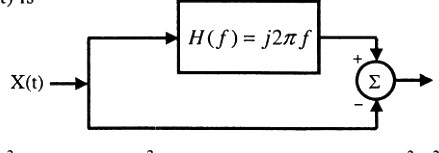
X(t) is a stationary random process with autocorrelation function $R_X(\tau) = \exp(-\pi\tau^2)$. This process is passed through the system shown below. The power spectral density of the output process Y(t) is

Question diagram

Open complete paper
7
2012 · Electronics & Communication Engineering · Communications · Random Processes
Electronics & Communication Engineering (EC) 2012
The power spectral density of a real process \(X(t)\) for positive frequencies is shown below. The values of \(E[X^2(t)]\) and \(|E[X(t)]|\), respectively, are

Question diagram

Open complete paper
8
2018 · Electronics & Communication Engineering · Communications · Random Processes
Electronics & Communication Engineering (EC) 2018
A random variable \(X\) takes values \(-0.5\) and \(0.5\) with probabilities \(\frac{1}{4}\) and \(\frac{3}{4}\), respectively. The noisy observation of \(X\) is \(Y = X + Z\), where \(Z\) has uniform probability density over the interval \((-1, 1)\). \(X\) and \(Z\) are independent. If the MAP rule based detector outputs \(\hat{X}\) as

\[ \hat{X} = \begin{cases} -0.5, & Y < \alpha \\ 0.5, & Y \ge \alpha, \end{cases} \]

then the value of \(\alpha\) (accurate to two decimal places) is ________.
Open complete paper
9
2019 · Electronics & Communication Engineering · Communications · Random Processes
Electronics & Communication Engineering (EC) 2019
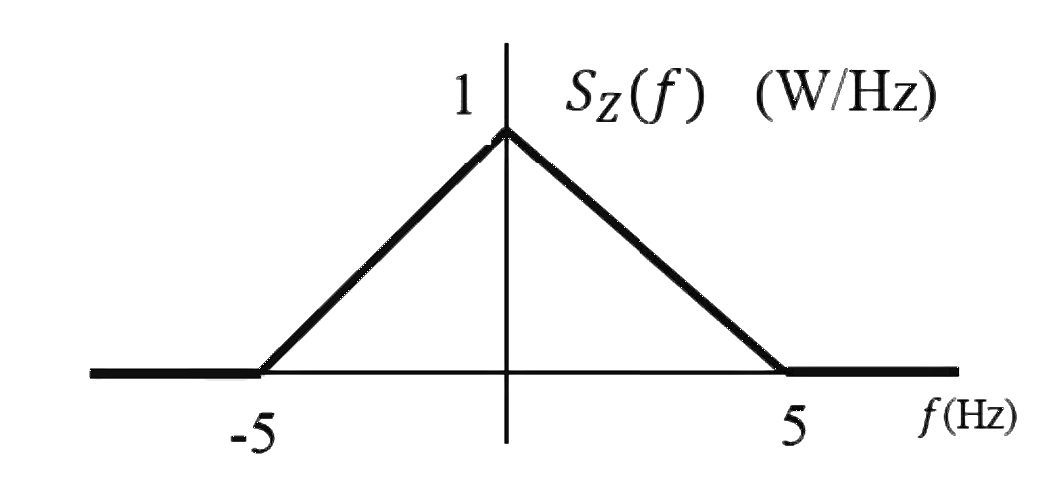
Let a random process Y(t) be described as Y(t) = h(t) * X(t) + Z(t), where X(t) is a white noise process with power spectral density S_X(f) = 5 W/Hz. The filter h(t) has a magnitude response given by |H(f)| = 0.5 for -5 ≤ f ≤ 5, and zero elsewhere. Z(t) is a stationary random process, uncorrelated with X(t), with power spectral density as shown in the figure. The power in Y(t), in watts, is equal to ___________ W (rounded off to two decimal places).
Open complete paper
10
2023 · Electronics & Communication Engineering · Communications · Random Processes
Electronics & Communication Engineering (EC) 2023

For a real signal, which of the following is/are valid power spectral density/densities?

Open complete paper