My Cart
Your Cart 0

    Your cart is empty.

  • Total (Amount) ₹0.00
Previous year question hub

Highway Pavements - Transportation Engineering - Civil Engineering Previous Year Questions

Practice Highway Pavements - Transportation Engineering - Civil Engineering previous year questions organised from real papers, with year-wise coverage and clear topic navigation.

24Papers
19Years
47Questions
1Topics

Highway Pavements question pattern

Every graph below is calculated only from this selection.

Questions by year

Compare question counts across years.

Difficulty distribution

How the classified questions are distributed by difficulty.

Medium 29 61.7%
Easy 18 38.3%

Question type distribution

MCQ, numerical, multiple-select and other formats found in these papers.

MCQ 28 59.6%
Numerical Answer Type (NAT) 11 23.4%
Fill in the blanks 4 8.5%
MSQ 4 8.5%

Subject weightage

Top subjects by unique question coverage.

Civil Engineering
47 Qs

Most asked topics

Top topics across the included previous year papers.

Transportation Engineering
47 Qs

Subtopic coverage

Top subtopics inside this exact selection.

Highway Pavements
47 Qs

Paper coverage

Question coverage for the most populated papers. Every active PYP paper remains listed below.

Civil Engineering (CE) 2026
3 Qs
Civil Engineering (CE) 2026
1 Qs
Civil Engineering (CE) 2025 [Session 2]
3 Qs
Civil Engineering (CE) 2025 [Session 1]
1 Qs
Civil Engineering (CE) 2024 [Session 2]
3 Qs
Civil Engineering (CE) 2024 [Session 1]
1 Qs
Civil Engineering (CE) 2023 [Session 2]
2 Qs
Civil Engineering (CE) 2022 [Session 2]
1 Qs
Civil Engineering (CE) 2021 [Session 2]
1 Qs
Civil Engineering (CE) 2020 [Session 2]
1 Qs
Civil Engineering (CE) 2019 [Session 2]
2 Qs
Civil Engineering (CE) 2018 [Session 2]
2 Qs
Civil Engineering (CE) 2017 [Session 2]
2 Qs
Civil Engineering (CE) 2016 [Session 1]
1 Qs
Civil Engineering (CE) 2016 [Session 2]
1 Qs
Civil Engineering (CE) 2014 [Session 1]
2 Qs
Civil Engineering (CE) 2014 [Session 2]
2 Qs
Civil Engineering (CE) 2013
4 Qs
Civil Engineering (CE) 2012
3 Qs
Civil Engineering (CE) 2011
1 Qs
Civil Engineering (CE) 2010
2 Qs
Civil Engineering (CE) 2009
3 Qs
Civil Engineering (CE) 2008
1 Qs
Civil Engineering (CE) 2007
4 Qs

Included previous year papers

Newest papers appear first. Search these papers or sort by year and name.

Paper nameYearPDFAttempt
Civil Engineering (CE) 20262026
1 questions in this view
2026
Civil Engineering (CE) 20262026
3 questions in this view
2026
Civil Engineering (CE) 2025 [Session 1]2025
1 questions in this view
2025
Civil Engineering (CE) 2025 [Session 2]2025
3 questions in this view
2025
Civil Engineering (CE) 2024 [Session 1]2024
1 questions in this view
2024
Civil Engineering (CE) 2024 [Session 2]2024
3 questions in this view
2024
Civil Engineering (CE) 2023 [Session 2]2023
2 questions in this view
2023
Civil Engineering (CE) 2022 [Session 2]2022
1 questions in this view
2022
Civil Engineering (CE) 2021 [Session 2]2021
1 questions in this view
2021
Civil Engineering (CE) 2020 [Session 2]2020
1 questions in this view
2020
Civil Engineering (CE) 2019 [Session 2]2019
2 questions in this view
2019
Civil Engineering (CE) 2018 [Session 2]2018
2 questions in this view
2018
Civil Engineering (CE) 2017 [Session 2]2017
2 questions in this view
2017
Civil Engineering (CE) 2016 [Session 1]2016
1 questions in this view
2016
Civil Engineering (CE) 2016 [Session 2]2016
1 questions in this view
2016
Civil Engineering (CE) 2014 [Session 1]2014
2 questions in this view
2014
Civil Engineering (CE) 2014 [Session 2]2014
2 questions in this view
2014
Civil Engineering (CE) 20132013
4 questions in this view
2013
Civil Engineering (CE) 20122012
3 questions in this view
2012
Civil Engineering (CE) 20112011
1 questions in this view
2011
Civil Engineering (CE) 20102010
2 questions in this view
2010
Civil Engineering (CE) 20092009
3 questions in this view
2009
Civil Engineering (CE) 20082008
1 questions in this view
2008
Civil Engineering (CE) 20072007
4 questions in this view
2007

All Highway Pavements previous year questions

Practice every matching question in batches of 20, with every available option.

1
2007 · Civil Engineering · Transportation Engineering · Highway Pavements
Civil Engineering (CE) 2007
The extra widening required for a two-lane national highway at a horizontal curve of 300 m radius, considering a wheel base of 8 m and a design speed of 100 kmph is
Open complete paper
2
2007 · Civil Engineering · Transportation Engineering · Highway Pavements
Civil Engineering (CE) 2007
The width of the expansion joint is 20 mm in a cement concrete pavement. The laying temperature is 20°C and the maximum slab temperature in summer is 60°C. The coefficient of thermal expansion of concrete is 10×10⁻⁶ mm/mm/°C and the joint filler compresses up to 50% of the thickness. The spacing between expansion joints should be
Open complete paper
3
2007 · Civil Engineering · Transportation Engineering · Highway Pavements
Civil Engineering (CE) 2007
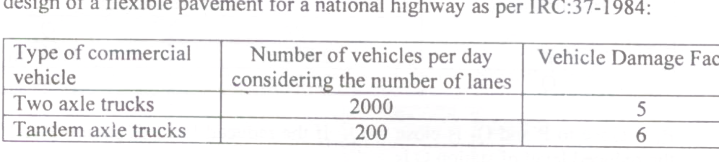
The following data pertains to the number of commercial vehicles per day for the design of a flexible pavement for a national highway as per IRC:37-1984:
Type of commercial vehicleNumber of vehicles per day considering the number of lanesVehicle Damage Factor
Two axle trucks20005
Tandem axle trucks2006
Assuming a traffic growth factor of 7.5 % per annum for both the types of vehicles, the cumulative number of standard axle load repetitions (in million) for a design life of ten years is

Question diagram

Open complete paper
4
2007 · Civil Engineering · Transportation Engineering · Highway Pavements
Civil Engineering (CE) 2007
Two straight lines intersect at an angle of 60°. The radius of a curve joining the two straight lines is 600 m. The length of long chord and mid-ordinates in metres of the curve are
Open complete paper
5
2014 · Civil Engineering · Transportation Engineering · Highway Pavements
Civil Engineering (CE) 2014 [Session 1]
The following statements are related to temperature stresses developed in concrete pavement slabs with free edges (without any restraint):
P. The temperature stresses will be zero during both day and night times if the pavement slab is considered weightless
Q. The temperature stresses will be compressive at the bottom of the slab during night time if the self-weight of the pavement slab is considered
R. The temperature stresses will be compressive at the bottom of the slab during day time if the self-weight of the pavement slab is considered
The TRUE statement(s) is(are)
Open complete paper
6
2014 · Civil Engineering · Transportation Engineering · Highway Pavements
Civil Engineering (CE) 2014 [Session 1]
A traffic survey conducted on a road yields an average daily traffic count of 5000 vehicles. The axle load distribution on the same road is given in the following table:
Axle load (tonnes)Frequency of traffic (%)
1810
1420
1035
815
620

The design period of the road is 15 years, the yearly traffic growth rate is 7.5% and the load safety factor (LSF) is 1.3. If the vehicle damage factor (VDF) is calculated from the above data, the design traffic (in million standard axle load, MSA) is ____________
Open complete paper
7
2014 · Civil Engineering · Transportation Engineering · Highway Pavements
Civil Engineering (CE) 2014 [Session 2]
A road is being designed for a speed of 110 km/hr on a horizontal curve with a super elevation of 8%. If the coefficient of side friction is 0.10, the minimum radius of the curve (in m) required for safe vehicular movement is
Open complete paper
8
2014 · Civil Engineering · Transportation Engineering · Highway Pavements
Civil Engineering (CE) 2014 [Session 2]
In a Marshall sample, the bulk specific gravity of mix and aggregates are 2.324 and 2.546 respectively. The sample includes 5% of bitumen (by total weight of mix) of specific gravity 1.10. The theoretical maximum specific gravity of mix is 2.441. The void filled with bitumen (VFB) in the Marshall sample (in %) is __________
Open complete paper
9
2016 · Civil Engineering · Transportation Engineering · Highway Pavements
Civil Engineering (CE) 2016 [Session 1]
A two lane, one-way road with radius of 50 m is predominantly carrying lorries with wheelbase of 5 m. The speed of lorries is restricted to be between 60 kmph and 80 kmph. The mechanical widening and psychological widening required at 60 kmph are designated as \(w_{me,60}\) and \(w_{ps,60}\), respectively. The mechanical widening and psychological widening required at 80 kmph are designated as \(w_{me,80}\) and \(w_{ps,80}\), respectively. The correct values of \(w_{me,60}\), \(w_{ps,60}\), \(w_{me,80}\), \(w_{ps,80}\), respectively are
Open complete paper
10
2016 · Civil Engineering · Transportation Engineering · Highway Pavements
Civil Engineering (CE) 2016 [Session 2]
In the context of the IRC 58-2011 guidelines for rigid pavement design, consider the following pair of statements.

I: Radius of relative stiffness is directly related to modulus of elasticity of concrete and inversely related to Poisson's ratio
II: Radius of relative stiffness is directly related to thickness of slab and modulus of subgrade reaction.

Which one of the following combinations is correct?
Open complete paper
11
2017 · Civil Engineering · Transportation Engineering · Highway Pavements
Civil Engineering (CE) 2017 [Session 2]

While aligning a hill road with a ruling gradient of 6%, a horizontal curve of radius 50 m is encountered. The grade compensation (in percentage, up to two decimal places) to be provided for this case would be __________

Open complete paper
12
2017 · Civil Engineering · Transportation Engineering · Highway Pavements
Civil Engineering (CE) 2017 [Session 2]
The radii of relative stiffness of the rigid pavements P and Q are denoted by lP and lQ, respectively. The geometric and material properties of the concrete slab and underlying soil are given below:
PavementConcreteSoil
Length of SlabBreadth of SlabThickness of SlabModulus of ElasticityPoisson's RatioSubgrade Reaction Modulus
PLBhEμK
QLB0.5hEμ2K
The ratio (up to one decimal place) of lP/lQ is __________
Open complete paper
13
2018 · Civil Engineering · Transportation Engineering · Highway Pavements
Civil Engineering (CE) 2018 [Session 2]

As per IRC:37-2012, in order to control subgrade rutting in flexible pavements, the parameter to be considered is

Open complete paper
14
2018 · Civil Engineering · Transportation Engineering · Highway Pavements
Civil Engineering (CE) 2018 [Session 2]

A 7.5 m wide two-lane road on a plain terrain is to be laid along a horizontal curve of radius 510 m. For a design speed of 100 kmph, super-elevation is provided as per IRC: 73-1980. Consider acceleration due to gravity as 9.81 m/s2. The level difference between the inner and outer edges of the road (in m, up to three decimal places) is ______

Open complete paper
15
2019 · Civil Engineering · Transportation Engineering · Highway Pavements
Civil Engineering (CE) 2019 [Session 2]

Structural failures considered in the mechanistic method of bituminous pavement design are

Open complete paper
16
2019 · Civil Engineering · Transportation Engineering · Highway Pavements
Civil Engineering (CE) 2019 [Session 2]
A flexible pavement has the following class of loads during a particular hour of the day. i. 80 buses with 2-axles (each axle load of 40 kN). ii. 160 trucks with 2-axles (front and rear axle loads of 40 kN and 80 kN, respectively) The equivalent standard axle load repetitions for this vehicle combination as per IRC:37-2012 would be
Open complete paper
17
2020 · Civil Engineering · Transportation Engineering · Highway Pavements
Civil Engineering (CE) 2020 [Session 2]
For an axle load of 15 tonne on a road, the Vehicle Damage Factor (round off to two decimal places), in terms of the standard axle load of 8 tonne, is __________.
Open complete paper
18
2021 · Civil Engineering · Transportation Engineering · Highway Pavements
Civil Engineering (CE) 2021 [Session 2]

The softening point of bitumen has the same unit as that of

Open complete paper
19
2022 · Civil Engineering · Transportation Engineering · Highway Pavements
Civil Engineering (CE) 2022 [Session 2]
A parabolic vertical crest curve connects two road segments with grades +1.0% and -2.0%. If a 200 m stopping sight distance is needed for a driver at a height of 1.2 m to avoid an obstacle of height 0.15 m, then the minimum curve length should be __________ m. (round off to the nearest integer)
Open complete paper
20
2023 · Civil Engineering · Transportation Engineering · Highway Pavements
Civil Engineering (CE) 2023 [Session 2]

As per the Indian Roads Congress guidelines (IRC 86: 2018), extra widening depends on which of the following parameters?

Open complete paper

Showing 20 of 47 questions