My Cart
Your Cart 0

    Your cart is empty.

  • Total (Amount) ₹0.00
Previous year question hub

Site Investigation, Earth Pressure and Slope Stability - Geotechnical Engineering - Civil Engineering Previous Year Questions

Practice Site Investigation, Earth Pressure and Slope Stability - Geotechnical Engineering - Civil Engineering previous year questions organised from real papers, with year-wise coverage and clear topic navigation.

24Papers
19Years
36Questions
1Topics

Site Investigation, Earth Pressure and Slope Stability question pattern

Every graph below is calculated only from this selection.

Questions by year

Compare question counts across years.

Difficulty distribution

How the classified questions are distributed by difficulty.

Medium 19 52.8%
Easy 15 41.7%
Hard 2 5.6%
Question type distribution

MCQ, numerical, multiple-select and other formats found in these papers.

MCQ 24 66.7%
Numerical Answer Type (NAT) 9 25%
Fill in the blanks 2 5.6%
MSQ 1 2.8%

Subject weightage

Top subjects by unique question coverage.

Civil Engineering
36 Qs

Most asked topics

Top topics across the included previous year papers.

Geotechnical Engineering
36 Qs

Subtopic coverage

Top subtopics inside this exact selection.

Site Investigation, Earth Pressure and Slope Stability
36 Qs

Paper coverage

Question coverage for the most populated papers. Every active PYP paper remains listed below.

Civil Engineering (CE) 2026
4 Qs
Civil Engineering (CE) 2026
1 Qs
Civil Engineering (CE) 2025 [Session 2]
1 Qs
Civil Engineering (CE) 2024 [Session 1]
1 Qs
Civil Engineering (CE) 2024 [Session 2]
1 Qs
Civil Engineering (CE) 2023 [Session 2]
2 Qs
Civil Engineering (CE) 2022 [Session 2]
2 Qs
Civil Engineering (CE) 2021 [Session 2]
2 Qs
Civil Engineering (CE) 2020 [Session 2]
2 Qs
Civil Engineering (CE) 2019 [Session 2]
2 Qs
Civil Engineering (CE) 2018 [Session 2]
1 Qs
Civil Engineering (CE) 2017 [Session 2]
1 Qs
Civil Engineering (CE) 2016 [Session 1]
2 Qs
Civil Engineering (CE) 2016 [Session 2]
1 Qs
Civil Engineering (CE) 2015 [Session 1]
1 Qs
Civil Engineering (CE) 2015 [Session 2]
1 Qs
Civil Engineering (CE) 2014 [Session 2]
2 Qs
Civil Engineering (CE) 2014 [Session 1]
1 Qs
Civil Engineering (CE) 2013
2 Qs
Civil Engineering (CE) 2012
1 Qs
Civil Engineering (CE) 2010
1 Qs
Civil Engineering (CE) 2009
1 Qs
Civil Engineering (CE) 2008
1 Qs
Civil Engineering (CE) 2007
2 Qs

Included previous year papers

Newest papers appear first. Search these papers or sort by year and name.

Paper nameYearPDFAttempt
Civil Engineering (CE) 20262026
4 questions in this view
2026
Civil Engineering (CE) 20262026
1 questions in this view
2026
Civil Engineering (CE) 2025 [Session 2]2025
1 questions in this view
2025
Civil Engineering (CE) 2024 [Session 1]2024
1 questions in this view
2024
Civil Engineering (CE) 2024 [Session 2]2024
1 questions in this view
2024
Civil Engineering (CE) 2023 [Session 2]2023
2 questions in this view
2023
Civil Engineering (CE) 2022 [Session 2]2022
2 questions in this view
2022
Civil Engineering (CE) 2021 [Session 2]2021
2 questions in this view
2021
Civil Engineering (CE) 2020 [Session 2]2020
2 questions in this view
2020
Civil Engineering (CE) 2019 [Session 2]2019
2 questions in this view
2019
Civil Engineering (CE) 2018 [Session 2]2018
1 questions in this view
2018
Civil Engineering (CE) 2017 [Session 2]2017
1 questions in this view
2017
Civil Engineering (CE) 2016 [Session 1]2016
2 questions in this view
2016
Civil Engineering (CE) 2016 [Session 2]2016
1 questions in this view
2016
Civil Engineering (CE) 2015 [Session 1]2015
1 questions in this view
2015
Civil Engineering (CE) 2015 [Session 2]2015
1 questions in this view
2015
Civil Engineering (CE) 2014 [Session 1]2014
1 questions in this view
2014
Civil Engineering (CE) 2014 [Session 2]2014
2 questions in this view
2014
Civil Engineering (CE) 20132013
2 questions in this view
2013
Civil Engineering (CE) 20122012
1 questions in this view
2012
Civil Engineering (CE) 20102010
1 questions in this view
2010
Civil Engineering (CE) 20092009
1 questions in this view
2009
Civil Engineering (CE) 20082008
1 questions in this view
2008
Civil Engineering (CE) 20072007
2 questions in this view
2007

All Site Investigation, Earth Pressure and Slope Stability previous year questions

Practice every matching question in batches of 20, with every available option.

1
2007 · Civil Engineering · Geotechnical Engineering · Site Investigation, Earth Pressure and Slope Stability
Civil Engineering (CE) 2007
The number of blows observed in a Standard Penetration Test (SPT) for different penetration depths are given as follows:
Penetration of samplerNumber of blows
0 – 150 mm6
150 – 300 mm8
300 – 450 mm10
The observed N value is
Open complete paper
2
2007 · Civil Engineering · Geotechnical Engineering · Site Investigation, Earth Pressure and Slope Stability
Civil Engineering (CE) 2007
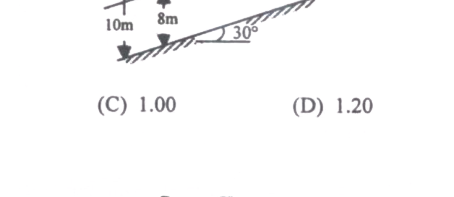
The factor of safety of an infinite soil slope shown in the figure having the properties c=0, φ=35°, γdry=16 kN/m³ and γsat=20 kN/m³ is approximately equal to

Question diagram

Open complete paper
3
2014 · Civil Engineering · Geotechnical Engineering · Site Investigation, Earth Pressure and Slope Stability
Civil Engineering (CE) 2014 [Session 1]
The degree of disturbance of the sample collected by the sampler is expressed by a term called the “area ratio”. If the outer diameter and inner diameter of the sampler are \( D_o \) and \( D_i \) respectively, the area ratio is given by
Open complete paper
4
2014 · Civil Engineering · Geotechnical Engineering · Site Investigation, Earth Pressure and Slope Stability
Civil Engineering (CE) 2014 [Session 2]
An infinitely long slope is made up of a c-φ soil having the properties: cohesion (c) = 20 kPa, and dry unit weight (γd) = 16 kN/m3. The angle of inclination and critical height of the slope are 40° and 5 m, respectively. To maintain the limiting equilibrium, the angle of internal friction of the soil (in degrees) is __________
Open complete paper
5
2014 · Civil Engineering · Geotechnical Engineering · Site Investigation, Earth Pressure and Slope Stability
Civil Engineering (CE) 2014 [Session 2]
Group I enlists in-situ field tests carried out for soil exploration, while Group II provides a list of parameters for sub-soil strength characterization. Match the type of tests with the characterization parameters.
Open complete paper
6
2015 · Civil Engineering · Geotechnical Engineering · Site Investigation, Earth Pressure and Slope Stability
Civil Engineering (CE) 2015 [Session 1]

Which of the following statements is TRUE for degree of disturbance of collected soil sample?

Open complete paper
7
2015 · Civil Engineering · Geotechnical Engineering · Site Investigation, Earth Pressure and Slope Stability
Civil Engineering (CE) 2015 [Session 2]
A 6 m high retaining wall having a smooth vertical back face retains a layered horizontal backfill. Top 3 m thick layer of the backfill is sand having an angle of internal friction, φ = 30° while the bottom layer is 3 m thick clay with cohesion, c = 20 kPa. Assume unit weight for both sand and clay as 18 kN/m³. The total active earth pressure per unit length of the wall (in kN/m) is:
Open complete paper
8
2016 · Civil Engineering · Geotechnical Engineering · Site Investigation, Earth Pressure and Slope Stability
Civil Engineering (CE) 2016 [Session 1]
A vertical cut is to be made in a soil mass having cohesion c, angle of internal friction ϕ, and unit weight γ. Considering Ka and Kp as the coefficients of active and passive earth pressures, respectively, the maximum depth of unsupported excavation is
Open complete paper
9
2016 · Civil Engineering · Geotechnical Engineering · Site Investigation, Earth Pressure and Slope Stability
Civil Engineering (CE) 2016 [Session 1]
A homogeneous gravity retaining wall supporting a cohesionless backfill is shown in the figure. The lateral active earth pressure at the bottom of the wall is 40 kPa.

The minimum weight of the wall (expressed in kN per m length) required to prevent it from overturning about its toe (Point P) is

Question diagram

Open complete paper
10
2016 · Civil Engineering · Geotechnical Engineering · Site Investigation, Earth Pressure and Slope Stability
Civil Engineering (CE) 2016 [Session 2]
The soil profile at a site consists of a 5 m thick sand layer underlain by a c-φ soil as shown in figure. The water table is found 1 m below the ground level. The entire soil mass is retained by a concrete retaining wall and is in the active state. The back of the wall is smooth and vertical. The total active earth pressure (expressed in kN/m²) at point A as per Rankine’s theory is __________
Open complete paper
11
2017 · Civil Engineering · Geotechnical Engineering · Site Investigation, Earth Pressure and Slope Stability
Civil Engineering (CE) 2017 [Session 2]
Consider a rigid retaining wall with partially submerged cohesionless backfill with a surcharge. Which one of the following diagrams closely represents the Rankine’s active earth pressure distribution against this wall?
Open complete paper
12
2018 · Civil Engineering · Geotechnical Engineering · Site Investigation, Earth Pressure and Slope Stability
Civil Engineering (CE) 2018 [Session 2]
A 3 m high vertical earth retaining wall retains a dry granular backfill with angle of internal friction of 30° and unit weight of 20 kN/m³. If the wall is prevented from yielding (no movement), the total horizontal thrust (in kN per unit length) on the wall is
Open complete paper
13
2019 · Civil Engineering · Geotechnical Engineering · Site Investigation, Earth Pressure and Slope Stability
Civil Engineering (CE) 2019 [Session 2]
An earthen dam of height \(H\) is made of cohesive soil whose cohesion and unit weight are \(c\) and \(\gamma\) respectively. If the factor of safety against cohesion is \(F_c\), the Taylor's stability number (\(S_n\)) is
Open complete paper
14
2019 · Civil Engineering · Geotechnical Engineering · Site Investigation, Earth Pressure and Slope Stability
Civil Engineering (CE) 2019 [Session 2]
The dimensions of a soil sampler are given in the table.
ParameterCutting edgeSampling tube
Inside diameter (mm)8086
Outside diameter (mm)10090

For this sampler, the outside clearance ratio (in percent, round off to 2 decimal places) is ____________
Open complete paper
15
2020 · Civil Engineering · Geotechnical Engineering · Site Investigation, Earth Pressure and Slope Stability
Civil Engineering (CE) 2020 [Session 2]
A 10 m high slope of dry clay soil (unit weight = 20 kN/m³), with a slope angle of 45° and the circular slip surface, is shown in the figure (not drawn to the scale). The weight of the slip wedge is denoted by W. The undrained unit cohesion (cu) is 60 kPa.
The factor of safety of the slope against slip failure, is

Question diagram

Open complete paper
16
2020 · Civil Engineering · Geotechnical Engineering · Site Investigation, Earth Pressure and Slope Stability
Civil Engineering (CE) 2020 [Session 2]
A 5 m high vertical wall has a saturated clay backfill. The saturated unit weight and cohesion of clay are 18 kN/m³ and 20 kPa, respectively. The angle of internal friction of clay is zero. In order to prevent development of tension zone, the height of the wall is required to be increased. Dry sand is used as backfill above the clay for the increased portion of the wall. The unit weight and angle of internal friction of sand are 16 kN/m³ and 30°, respectively. Assume that the back of the wall is smooth and top of the backfill is horizontal. To prevent the development of tension zone, the minimum height (in m, round off to one decimal place) by which the wall has to be raised, is __________.
Open complete paper
17
2021 · Civil Engineering · Geotechnical Engineering · Site Investigation, Earth Pressure and Slope Stability
Civil Engineering (CE) 2021 [Session 2]

The most appropriate triaxial test to assess the long-term stability of an excavated clay slope is

Open complete paper
18
2021 · Civil Engineering · Geotechnical Engineering · Site Investigation, Earth Pressure and Slope Stability
Civil Engineering (CE) 2021 [Session 2]
The internal (\(d_i\)) and external (\(d_o\)) diameters of a Shelby sampler are 48 mm and 52 mm, respectively. The area ratio (\(A_r\)) of the sampler (in %, round off to two decimal places) is __________
Open complete paper
19
2022 · Civil Engineering · Geotechnical Engineering · Site Investigation, Earth Pressure and Slope Stability
Civil Engineering (CE) 2022 [Session 2]
Read the following statements:
(P) While designing a shallow footing in sandy soil, monsoon season is considered for critical design in terms of bearing capacity.
(Q) For slope stability of an earthen dam, sudden drawdown is never a critical condition.
(R) In a sandy sea beach, quicksand condition can arise only if the critical hydraulic gradient exceeds the existing hydraulic gradient.
(S) The active earth thrust on a rigid retaining wall supporting homogeneous cohesionless backfill will reduce with the lowering of water table in the backfill.
Which one of the following combinations is correct?
Open complete paper
20
2022 · Civil Engineering · Geotechnical Engineering · Site Investigation, Earth Pressure and Slope Stability
Civil Engineering (CE) 2022 [Session 2]
The inside diameter of a sampler tube is 50 mm. The inside diameter of the cutting edge is kept such that the Inside Clearance Ratio (ICR) is 1.0 % to minimize the friction on the sample as the sampler tube enters into the soil.
The inside diameter (in mm) of the cutting edge is _____. (round off to two decimal places)
Open complete paper

Showing 20 of 36 questions