My Cart
Your Cart 0

    Your cart is empty.

  • Total (Amount) ₹0.00
Previous year question hub

Shallow and Deep Foundations - Geotechnical Engineering - Civil Engineering Previous Year Questions

Practice Shallow and Deep Foundations - Geotechnical Engineering - Civil Engineering previous year questions organised from real papers, with year-wise coverage and clear topic navigation.

24Papers
19Years
50Questions
1Topics

Shallow and Deep Foundations question pattern

Every graph below is calculated only from this selection.

Questions by year

Compare question counts across years.

Difficulty distribution

How the classified questions are distributed by difficulty.

Medium 37 74%
Easy 9 18%
Hard 4 8%

Question type distribution

MCQ, numerical, multiple-select and other formats found in these papers.

MCQ 29 58%
Numerical Answer Type (NAT) 19 38%
Fill in the blanks 1 2%
MSQ 1 2%

Subject weightage

Top subjects by unique question coverage.

Civil Engineering
50 Qs

Most asked topics

Top topics across the included previous year papers.

Geotechnical Engineering
50 Qs

Subtopic coverage

Top subtopics inside this exact selection.

Shallow and Deep Foundations
50 Qs

Paper coverage

Question coverage for the most populated papers. Every active PYP paper remains listed below.

Civil Engineering (CE) 2026
3 Qs
Civil Engineering (CE) 2026
3 Qs
Civil Engineering (CE) 2025 [Session 1]
2 Qs
Civil Engineering (CE) 2025 [Session 2]
2 Qs
Civil Engineering (CE) 2024 [Session 2]
2 Qs
Civil Engineering (CE) 2024 [Session 1]
1 Qs
Civil Engineering (CE) 2023 [Session 2]
2 Qs
Civil Engineering (CE) 2022 [Session 2]
1 Qs
Civil Engineering (CE) 2021 [Session 2]
1 Qs
Civil Engineering (CE) 2019 [Session 2]
2 Qs
Civil Engineering (CE) 2018 [Session 2]
2 Qs
Civil Engineering (CE) 2017 [Session 2]
1 Qs
Civil Engineering (CE) 2016 [Session 2]
2 Qs
Civil Engineering (CE) 2015 [Session 1]
1 Qs
Civil Engineering (CE) 2015 [Session 2]
1 Qs
Civil Engineering (CE) 2014 [Session 2]
3 Qs
Civil Engineering (CE) 2014 [Session 1]
2 Qs
Civil Engineering (CE) 2013
3 Qs
Civil Engineering (CE) 2012
1 Qs
Civil Engineering (CE) 2011
3 Qs
Civil Engineering (CE) 2010
2 Qs
Civil Engineering (CE) 2009
4 Qs
Civil Engineering (CE) 2008
4 Qs
Civil Engineering (CE) 2007
2 Qs

Included previous year papers

Newest papers appear first. Search these papers or sort by year and name.

Paper nameYearPDFAttempt
Civil Engineering (CE) 20262026
3 questions in this view
2026
Civil Engineering (CE) 20262026
3 questions in this view
2026
Civil Engineering (CE) 2025 [Session 1]2025
2 questions in this view
2025
Civil Engineering (CE) 2025 [Session 2]2025
2 questions in this view
2025
Civil Engineering (CE) 2024 [Session 1]2024
1 questions in this view
2024
Civil Engineering (CE) 2024 [Session 2]2024
2 questions in this view
2024
Civil Engineering (CE) 2023 [Session 2]2023
2 questions in this view
2023
Civil Engineering (CE) 2022 [Session 2]2022
1 questions in this view
2022
Civil Engineering (CE) 2021 [Session 2]2021
1 questions in this view
2021
Civil Engineering (CE) 2019 [Session 2]2019
2 questions in this view
2019
Civil Engineering (CE) 2018 [Session 2]2018
2 questions in this view
2018
Civil Engineering (CE) 2017 [Session 2]2017
1 questions in this view
2017
Civil Engineering (CE) 2016 [Session 2]2016
2 questions in this view
2016
Civil Engineering (CE) 2015 [Session 1]2015
1 questions in this view
2015
Civil Engineering (CE) 2015 [Session 2]2015
1 questions in this view
2015
Civil Engineering (CE) 2014 [Session 1]2014
2 questions in this view
2014
Civil Engineering (CE) 2014 [Session 2]2014
3 questions in this view
2014
Civil Engineering (CE) 20132013
3 questions in this view
2013
Civil Engineering (CE) 20122012
1 questions in this view
2012
Civil Engineering (CE) 20112011
3 questions in this view
2011
Civil Engineering (CE) 20102010
2 questions in this view
2010
Civil Engineering (CE) 20092009
4 questions in this view
2009
Civil Engineering (CE) 20082008
4 questions in this view
2008
Civil Engineering (CE) 20072007
2 questions in this view
2007

All Shallow and Deep Foundations previous year questions

Practice every matching question in batches of 20, with every available option.

1
2007 · Civil Engineering · Geotechnical Engineering · Shallow and Deep Foundations
Civil Engineering (CE) 2007
The bearing capacity of a rectangular footing of plan dimensions 1.5 m × 3 m resting on the surface of a sand deposit was estimated as 600 kN/m² when the water table is far below the base of the footing. The bearing capacities in kN/m² when the water level rises to depths of 3 m, 1.5 m and 0.5 m below the base of the footing are
Open complete paper
2
2007 · Civil Engineering · Geotechnical Engineering · Shallow and Deep Foundations
Civil Engineering (CE) 2007
What is the ultimate capacity in kN of the pile group shown in the figure assuming the group to fail as a single block?

Question diagram

Open complete paper
3
2014 · Civil Engineering · Geotechnical Engineering · Shallow and Deep Foundations
Civil Engineering (CE) 2014 [Session 1]
The action of negative skin friction on the pile is to
Open complete paper
4
2014 · Civil Engineering · Geotechnical Engineering · Shallow and Deep Foundations
Civil Engineering (CE) 2014 [Session 1]
Group I contains representative load-settlement curves for different modes of bearing capacity failures of sandy soil. Group II enlists the various failure characteristics. Match the load-settlement curves with the corresponding failure characteristics.

Group I
P. Curve J
Q. Curve K
R. Curve L

Group II
1. No apparent heaving of soil around the footing
2. Rankine’s passive zone develops imperfectly
3. Well defined slip surface extends to ground surface
Open complete paper
5
2014 · Civil Engineering · Geotechnical Engineering · Shallow and Deep Foundations
Civil Engineering (CE) 2014 [Session 2]
The contact pressure for a rigid footing resting on clay at the centre and the edges are respectively
Open complete paper
6
2014 · Civil Engineering · Geotechnical Engineering · Shallow and Deep Foundations
Civil Engineering (CE) 2014 [Session 2]
A single vertical friction pile of diameter 500 mm and length 20 m is subjected to a vertical compressive load. The pile is embedded in a homogeneous sandy stratum where: angle of internal friction (φ) = 30°, dry unit weight (γd) = 20 kN/m3 and angle of wall friction (δ) = 2φ/3. Considering the coefficient of lateral earth pressure (K) = 2.7 and the bearing capacity factor (Nq) = 25, the ultimate bearing capacity of the pile (in kN) is __________
Open complete paper
7
2014 · Civil Engineering · Geotechnical Engineering · Shallow and Deep Foundations
Civil Engineering (CE) 2014 [Session 2]
A circular raft foundation of 20 m diameter and 1.6 m thick is provided for a tank that applies a bearing pressure of 110 kPa on sandy soil with Young's modulus, Es' = 30 MPa and Poisson's ratio, vs = 0.3. The raft is made of concrete (Ec = 30 GPa and vc = 0.15). Considering the raft as rigid, the elastic settlement (in mm) is
Open complete paper
8
2015 · Civil Engineering · Geotechnical Engineering · Shallow and Deep Foundations
Civil Engineering (CE) 2015 [Session 1]
A square footing (2 m x 2 m) is subjected to an inclined point load, \(P\) as shown in the figure below. The water table is located well below the base of the footing. Considering one-way eccentricity, the net safe load carrying capacity of the footing for a factor of safety of 3.0 is _______________ kN.
The following factors may be used:
Bearing capacity factors: \(N_q = 33.3, N_\gamma = 37.16\); Shape factors: \(F_{qs} = F_{\gamma s} = 1.314\); Depth factors: \(F_{qd} = F_{\gamma d} = 1.113\); Inclination factors: \(F_{qi} = 0.444, F_{\gamma i} = 0.02\)

Question diagram

Open complete paper
9
2015 · Civil Engineering · Geotechnical Engineering · Shallow and Deep Foundations
Civil Engineering (CE) 2015 [Session 2]
A pile of diameter 0.4 m is fully embedded in a clay stratum having 5 layers, each 5 m thick as shown in the figure below. Assume a constant unit weight of soil as 18 kN/m³ for all the layers. Using λ-method (λ = 0.15 for 25 m embedment length) and neglecting the end bearing component, the ultimate pile capacity (in kN) is __________.

Question diagram

Open complete paper
10
2016 · Civil Engineering · Geotechnical Engineering · Shallow and Deep Foundations
Civil Engineering (CE) 2016 [Session 2]
A strip footing is resting on the surface of a purely clayey soil deposit. If the width of the footing is doubled, the ultimate bearing capacity of the soil
Open complete paper
11
2016 · Civil Engineering · Geotechnical Engineering · Shallow and Deep Foundations
Civil Engineering (CE) 2016 [Session 2]
A 4 m wide strip footing is founded at a depth of 1.5 m below the ground surface in a c-φ soil as shown in the figure. The water table is at a depth of 5.5 m below ground surface. The soil properties are: c' = 35 kN/m², φ' = 28.63°, γsat = 19 kN/m³, γbulk = 17 kN/m³ and γw = 9.81 kN/m³. The values of bearing capacity factors for different φ' are given below.
φ'NcNqNγ
15°12.94.42.5
20°17.77.45.0
25°25.112.79.7
30°37.222.519.7

Using Terzaghi's bearing capacity equation and a factor of safety Fs = 2.5, the net safe bearing capacity (expressed in kN/m²) for local shear failure of the soil is _____
Open complete paper
12
2017 · Civil Engineering · Geotechnical Engineering · Shallow and Deep Foundations
Civil Engineering (CE) 2017 [Session 2]

The plate load test was conducted on a clayey strata by using a plate of 0.3 m × 0.3 m dimensions, and the ultimate load per unit area for the plate was found to be 180 kPa. The ultimate bearing capacity (in kPa) of a 2 m wide square footing would be

Open complete paper
13
2018 · Civil Engineering · Geotechnical Engineering · Shallow and Deep Foundations
Civil Engineering (CE) 2018 [Session 2]
The contact pressure and settlement distribution for a footing are shown in the figure.
The figure corresponds to a

Question diagram

Open complete paper
14
2018 · Civil Engineering · Geotechnical Engineering · Shallow and Deep Foundations
Civil Engineering (CE) 2018 [Session 2]
A group of nine piles in a 3 × 3 square pattern is embedded in a soil strata comprising dense sand underlying recently filled clay layer, as shown in the figure. The perimeter of an individual pile is 126 cm. The size of pile group is 240 cm × 240 cm. The recently filled clay has undrained shear strength of 15 kPa and unit weight of 16 kN/m³.

The negative frictional load (in kN, up to two decimal places) acting on the pile group is ______

Question diagram

Open complete paper
15
2019 · Civil Engineering · Geotechnical Engineering · Shallow and Deep Foundations
Civil Engineering (CE) 2019 [Session 2]
A timber pile of length 8 m and diameter 0.2 m is driven with a 20 kN drop hammer, falling freely from a height of 1.5 m. The total penetration of the pile in the last 5 blows is 40 mm. Use the Engineering News Record expression. Assume a factor of safety of 6 and empirical factor (allowing reduction in the theoretical set, due to energy losses) of 2.5 cm. The safe load carrying capacity of the pile (in kN, round off to 2 decimal places) is ____________
Open complete paper
16
2019 · Civil Engineering · Geotechnical Engineering · Shallow and Deep Foundations
Civil Engineering (CE) 2019 [Session 2]
A square footing of 2 m sides rests on the surface of a homogeneous soil bed having the properties: cohesion c = 24 kPa, angle of internal friction \(\phi\) = 25°, and unit weight \(\gamma\) = 18 kN/m³. Terzaghi’s bearing capacity factors for \(\phi\) = 25° are \(N_c\) = 25.1, \(N_q\) = 12.7, \(N_\gamma\) = 9.7, \(N'_c\) = 14.8, \(N'_q\) = 5.6, and \(N'_\gamma\) = 3.2. The ultimate bearing capacity of the foundation (in kPa, round off to 2 decimal places) is ____________
Open complete paper
17
2021 · Civil Engineering · Geotechnical Engineering · Shallow and Deep Foundations
Civil Engineering (CE) 2021 [Session 2]
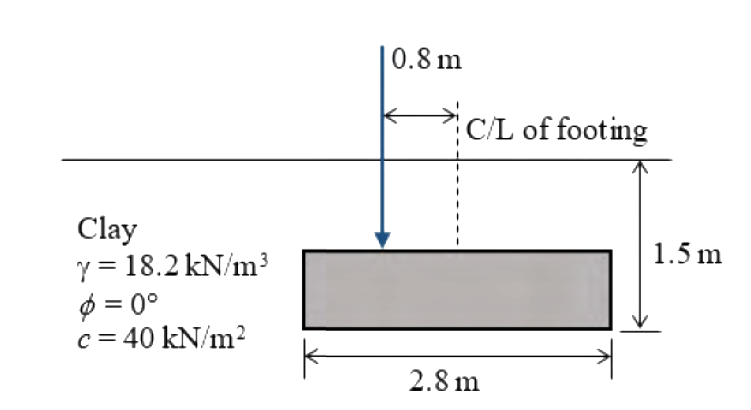
A rectangular footing of size 2.8 m × 3.5 m is embedded in a clay layer and a vertical load is placed with an eccentricity of 0.8 m as shown in the figure (not to scale). Take Bearing capacity factors: Nc = 5.14, Nq = 1.0, and Nγ = 0.0; Shape factors: sc = 1.16, sq = 1.0 and sγ = 1.0; Depth factors: dc = 1.1, dq = 1.0 and dγ = 1.0; and Inclination factors: ic = 1.0 and iq = 1.0 and iγ = 1.0.
Using Meyerhoff's method, the load (in kN, round off to two decimal places) that can be applied on the footing with a factor of safety of 2.5 is _____

Question diagram

Open complete paper
18
2022 · Civil Engineering · Geotechnical Engineering · Shallow and Deep Foundations
Civil Engineering (CE) 2022 [Session 2]
A group of total 16 piles are arranged in a square grid format. The center-to-center spacing (s) between adjacent piles is 3 m. The diameter (d) and length of embedment of each pile are 1 m and 20 m, respectively. The design capacity of each pile is 1000 kN in the vertical downward direction. The pile group efficiency (ηg) is given by
\[ \eta_g = 1 - \frac{\theta}{90} \left[ \frac{(n-1)m + (m-1)n}{mn} \right] \]
where m and n are number of rows and columns in the plan grid of pile arrangement, and θ = tan-1(d/s).
The design value of the pile group capacity (in kN) in the vertical downward direction is __________. (round off to the nearest integer)
Open complete paper
19
2023 · Civil Engineering · Geotechnical Engineering · Shallow and Deep Foundations
Civil Engineering (CE) 2023 [Session 2]
A square footing is to be designed to carry a column load of 500 kN which is resting on a soil stratum having the following average properties: bulk unit weight = 19 kN/m³; angle of internal friction = 0° and cohesion = 25 kPa. Considering the depth of the footing as 1 m and adopting Meyerhof's bearing capacity theory with a factor of safety of 3, the width of the footing (in m) is __________ (round off to one decimal place).
[Assume the applicable shape and depth factor values as unity; ground water level at greater depth.]
Open complete paper
20
2023 · Civil Engineering · Geotechnical Engineering · Shallow and Deep Foundations
Civil Engineering (CE) 2023 [Session 2]
A circular pile of diameter 0.6 m and length 8 m was constructed in a cohesive soil stratum having the following properties: bulk unit weight = 19 kN/m³; angle of internal friction = 0° and cohesion = 25 kPa.
The allowable load the pile can carry with a factor of safety of 3 is __________ kN (round off to one decimal place).
[Adopt: Adhesion factor, \(\alpha = 1.0\) and Bearing capacity factor, \(N_c = 9.0\)]
Open complete paper

Showing 20 of 50 questions