My Cart
Your Cart 0

    Your cart is empty.

  • Total (Amount) ₹0.00
Previous year question hub

Seepage and Effective Stress - Geotechnical Engineering - Civil Engineering Previous Year Questions

Practice Seepage and Effective Stress - Geotechnical Engineering - Civil Engineering previous year questions organised from real papers, with year-wise coverage and clear topic navigation.

22Papers
18Years
38Questions
1Topics

Seepage and Effective Stress question pattern

Every graph below is calculated only from this selection.

Questions by year

Compare question counts across years.

Difficulty distribution

How the classified questions are distributed by difficulty.

Medium 29 76.3%
Easy 9 23.7%

Question type distribution

MCQ, numerical, multiple-select and other formats found in these papers.

MCQ 25 65.8%
Numerical Answer Type (NAT) 10 26.3%
Fill in the blanks 2 5.3%
MSQ 1 2.6%

Subject weightage

Top subjects by unique question coverage.

Civil Engineering
38 Qs

Most asked topics

Top topics across the included previous year papers.

Geotechnical Engineering
38 Qs

Subtopic coverage

Top subtopics inside this exact selection.

Seepage and Effective Stress
38 Qs

Paper coverage

Question coverage for the most populated papers. Every active PYP paper remains listed below.

Civil Engineering (CE) 2026
1 Qs
Civil Engineering (CE) 2025 [Session 1]
2 Qs
Civil Engineering (CE) 2025 [Session 2]
2 Qs
Civil Engineering (CE) 2024 [Session 1]
1 Qs
Civil Engineering (CE) 2024 [Session 2]
1 Qs
Civil Engineering (CE) 2023 [Session 2]
2 Qs
Civil Engineering (CE) 2022 [Session 2]
1 Qs
Civil Engineering (CE) 2020 [Session 2]
1 Qs
Civil Engineering (CE) 2019 [Session 2]
1 Qs
Civil Engineering (CE) 2018 [Session 2]
2 Qs
Civil Engineering (CE) 2017 [Session 2]
1 Qs
Civil Engineering (CE) 2016 [Session 2]
3 Qs
Civil Engineering (CE) 2016 [Session 1]
2 Qs
Civil Engineering (CE) 2015 [Session 1]
1 Qs
Civil Engineering (CE) 2014 [Session 1]
2 Qs
Civil Engineering (CE) 2014 [Session 2]
1 Qs
Civil Engineering (CE) 2013
3 Qs
Civil Engineering (CE) 2012
2 Qs
Civil Engineering (CE) 2011
2 Qs
Civil Engineering (CE) 2010
2 Qs
Civil Engineering (CE) 2008
2 Qs
Civil Engineering (CE) 2007
3 Qs

Included previous year papers

Newest papers appear first. Search these papers or sort by year and name.

Paper nameYearPDFAttempt
Civil Engineering (CE) 20262026
1 questions in this view
2026
Civil Engineering (CE) 2025 [Session 1]2025
2 questions in this view
2025
Civil Engineering (CE) 2025 [Session 2]2025
2 questions in this view
2025
Civil Engineering (CE) 2024 [Session 1]2024
1 questions in this view
2024
Civil Engineering (CE) 2024 [Session 2]2024
1 questions in this view
2024
Civil Engineering (CE) 2023 [Session 2]2023
2 questions in this view
2023
Civil Engineering (CE) 2022 [Session 2]2022
1 questions in this view
2022
Civil Engineering (CE) 2020 [Session 2]2020
1 questions in this view
2020
Civil Engineering (CE) 2019 [Session 2]2019
1 questions in this view
2019
Civil Engineering (CE) 2018 [Session 2]2018
2 questions in this view
2018
Civil Engineering (CE) 2017 [Session 2]2017
1 questions in this view
2017
Civil Engineering (CE) 2016 [Session 1]2016
2 questions in this view
2016
Civil Engineering (CE) 2016 [Session 2]2016
3 questions in this view
2016
Civil Engineering (CE) 2015 [Session 1]2015
1 questions in this view
2015
Civil Engineering (CE) 2014 [Session 1]2014
2 questions in this view
2014
Civil Engineering (CE) 2014 [Session 2]2014
1 questions in this view
2014
Civil Engineering (CE) 20132013
3 questions in this view
2013
Civil Engineering (CE) 20122012
2 questions in this view
2012
Civil Engineering (CE) 20112011
2 questions in this view
2011
Civil Engineering (CE) 20102010
2 questions in this view
2010
Civil Engineering (CE) 20082008
2 questions in this view
2008
Civil Engineering (CE) 20072007
3 questions in this view
2007

All Seepage and Effective Stress previous year questions

Practice every matching question in batches of 20, with every available option.

1
2007 · Civil Engineering · Geotechnical Engineering · Seepage and Effective Stress
Civil Engineering (CE) 2007
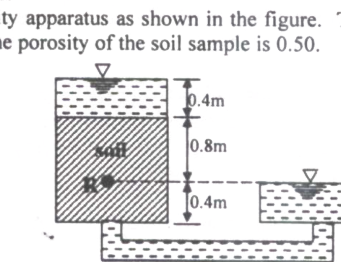
The total head, elevation head and pressure head in metres of water at the point R shown in the figure are

Question diagram

Open complete paper
2
2007 · Civil Engineering · Geotechnical Engineering · Seepage and Effective Stress
Civil Engineering (CE) 2007
What are the discharge velocity and seepage velocity through the soil sample?
Open complete paper
3
2007 · Civil Engineering · Geotechnical Engineering · Seepage and Effective Stress
Civil Engineering (CE) 2007
What is the change in the effective stress in kN/m² at mid-depth of the clay layer due to the lowering of the water table?
Open complete paper
4
2014 · Civil Engineering · Geotechnical Engineering · Seepage and Effective Stress
Civil Engineering (CE) 2014 [Session 1]
A long slope is formed in a soil with shear strength parameters: \( c' = 0 \) and \( \phi' = 34^\circ \). A firm stratum lies below the slope and it is assumed that the water table may occasionally rise to the surface, with seepage taking place parallel to the slope. Use \( \gamma_{sat} = 18 \text{ kN/m}^3 \) and \( \gamma_w = 10 \text{ kN/m}^3 \). The maximum slope angle (in degrees) to ensure a factor of safety of 1.5, assuming a potential failure surface parallel to the slope, would be
Open complete paper
5
2014 · Civil Engineering · Geotechnical Engineering · Seepage and Effective Stress
Civil Engineering (CE) 2014 [Session 1]
The flow net constructed for the dam is shown in the figure below. Taking the coefficient of permeability as $3.8 \times 10^{-6} \text{ m/s}$, the quantity of flow (in $\text{cm}^3/\text{s}$) under the dam per meter of dam is ________
Open complete paper
6
2014 · Civil Engineering · Geotechnical Engineering · Seepage and Effective Stress
Civil Engineering (CE) 2014 [Session 2]
Water is flowing at a steady rate through a homogeneous and saturated horizontal soil strip of 10 m length. The strip is being subjected to a constant water head (H) of 5 m at the beginning and 1 m at the end. If the governing equation of flow in the soil strip is \(\frac{d^2 H}{dx^2} = 0\) (where x is the distance along the soil strip), the value of H (in m) at the middle of the strip is ______________
Open complete paper
7
2015 · Civil Engineering · Geotechnical Engineering · Seepage and Effective Stress
Civil Engineering (CE) 2015 [Session 1]

Which of the following statements is TRUE for the relation between discharge velocity and seepage velocity?

Open complete paper
8
2016 · Civil Engineering · Geotechnical Engineering · Seepage and Effective Stress
Civil Engineering (CE) 2016 [Session 1]
A seepage flow condition is shown in the figure. The saturated unit weight of the soil \(\gamma_{sat} = 18\) kN/m³. Using unit weight of water, \(\gamma_w = 9.81\) kN/m³, the effective vertical stress (expressed in kN/m²) on plane X-X is __________

Question diagram

Open complete paper
9
2016 · Civil Engineering · Geotechnical Engineering · Seepage and Effective Stress
Civil Engineering (CE) 2016 [Session 1]
Seepage is occurring through a porous media shown in the figure. The hydraulic conductivity values (k₁, k₂, k₃) are in m/day.

The seepage discharge (m³/day per m) through the porous media at section PQ is

Question diagram

Open complete paper
10
2016 · Civil Engineering · Geotechnical Engineering · Seepage and Effective Stress
Civil Engineering (CE) 2016 [Session 2]
The relationship between the specific gravity of sand (G) and the hydraulic gradient (i) to initiate quick condition in the sand layer having porosity of 30% is
Open complete paper
11
2016 · Civil Engineering · Geotechnical Engineering · Seepage and Effective Stress
Civil Engineering (CE) 2016 [Session 2]
The seepage occurring through an earthen dam is represented by a flownet comprising of 10 equipotential drops and 20 flow channels. The coefficient of permeability of the soil is 3 mm/min and the head loss is 5 m. The rate of seepage (expressed in cm³/s per m length of the dam) through the earthen dam is __________
Open complete paper
12
2016 · Civil Engineering · Geotechnical Engineering · Seepage and Effective Stress
Civil Engineering (CE) 2016 [Session 2]
A tracer takes 100 days to travel from Well-1 to Well-2 which are 100 m apart. The elevation of water surface in Well-2 is 3 m below that in Well-1. Assuming porosity equal to 15%, the coefficient of permeability (expressed in m/day) is
Open complete paper
13
2017 · Civil Engineering · Geotechnical Engineering · Seepage and Effective Stress
Civil Engineering (CE) 2017 [Session 2]
A sheet pile has an embedment depth of 12 m in a homogeneous soil stratum. The coefficient of permeability of soil is \( 10^{-6} \) m/s. Difference in the water levels between the two sides of the sheet pile is 4 m. The flow net is constructed with five number of flow lines and eleven number of equipotential lines. The quantity of seepage (in \( cm^3/s \) per m, up to one decimal place) under the sheet pile is ________
Open complete paper
14
2018 · Civil Engineering · Geotechnical Engineering · Seepage and Effective Stress
Civil Engineering (CE) 2018 [Session 2]

A flownet below a dam consists of 24 equipotential drops and 7 flow channels. The difference between the upstream and downstream water levels is 6 m. The length of the flow line adjacent to the toe of the dam at exit is 1 m. The specific gravity and void ratio of the soil below the dam are 2.70 and 0.70, respectively. The factor of safety against piping is

Open complete paper
15
2018 · Civil Engineering · Geotechnical Engineering · Seepage and Effective Stress
Civil Engineering (CE) 2018 [Session 2]
Three soil specimens (Soil 1, Soil 2 and Soil 3), each 150 mm long and 100 mm diameter, are placed in series in a constant head flow set-up as shown in the figure. Suitable screens are provided at the boundaries of the specimens to keep them intact. The values of coefficient of permeability of Soil 1, Soil 2 and Soil 3 are 0.01, 0.003 and 0.03 cm/s, respectively.

The value of h in the set-up is

Question diagram

Open complete paper
16
2019 · Civil Engineering · Geotechnical Engineering · Seepage and Effective Stress
Civil Engineering (CE) 2019 [Session 2]
An anisotropic soil deposit has coefficient of permeability in vertical and horizontal directions as \(k_z\) and \(k_x\), respectively. For constructing a flow net, the horizontal dimension of the problem's geometry is transformed by a multiplying factor of
Open complete paper
17
2020 · Civil Engineering · Geotechnical Engineering · Seepage and Effective Stress
Civil Engineering (CE) 2020 [Session 2]
Permeability tests were carried out on the samples collected from two different layers as shown in the figure (not drawn to the scale). The relevant horizontal (kh) and vertical (kv) coefficients of permeability are indicated for each layer.
The ratio of the equivalent horizontal to vertical coefficients of permeability, is

Question diagram

Open complete paper
18
2022 · Civil Engineering · Geotechnical Engineering · Seepage and Effective Stress
Civil Engineering (CE) 2022 [Session 2]
A soil sample is underlying a water column of height \(h_1\) as shown in the figure. The vertical effective stresses at points A, B, and C are \(\sigma'_A\), \(\sigma'_B\), and \(\sigma'_C\), respectively. Let \(\gamma_{sat}\) and \(\gamma'\) be the saturated and submerged unit weights of the soil sample, respectively, and \(\gamma_w\) be the unit weight of water. Which one of the following expressions correctly represents the sum \((\sigma'_A + \sigma'_B + \sigma'_C)\)?

Question diagram

Open complete paper
19
2023 · Civil Engineering · Geotechnical Engineering · Seepage and Effective Stress
Civil Engineering (CE) 2023 [Session 2]
A vertical sheet pile wall is installed in an anisotropic soil having coefficient of horizontal permeability, \(k_H\) and coefficient of vertical permeability, \(k_V\). In order to draw the flow net for the isotropic condition, the embedment depth of the wall should be scaled by a factor of ________, without changing the horizontal scale.
Open complete paper
20
2023 · Civil Engineering · Geotechnical Engineering · Seepage and Effective Stress
Civil Engineering (CE) 2023 [Session 2]
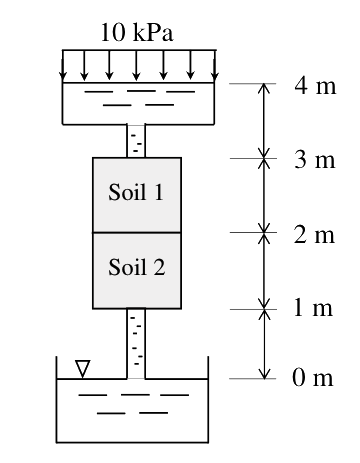
For the flow setup shown in the figure (not to scale), the hydraulic conductivities of the two soil samples, Soil 1 and Soil 2, are 10 mm/s and 1 mm/s, respectively. Assume the unit weight of water as 10 kN/m³ and ignore the velocity head. At steady state, what is the total head (in m, rounded off to two decimal places) at any point located at the junction of the two samples? __________

Question diagram

Open complete paper

Showing 20 of 38 questions