My Cart
Your Cart 0

    Your cart is empty.

  • Total (Amount) ₹0.00
Previous year question hub

Compaction and Consolidation - Geotechnical Engineering - Civil Engineering Previous Year Questions

Practice Compaction and Consolidation - Geotechnical Engineering - Civil Engineering previous year questions organised from real papers, with year-wise coverage and clear topic navigation.

21Papers
19Years
29Questions
1Topics

Compaction and Consolidation question pattern

Every graph below is calculated only from this selection.

Questions by year

Compare question counts across years.

Difficulty distribution

How the classified questions are distributed by difficulty.

Medium 16 55.2%
Easy 11 37.9%
Hard 2 6.9%

Question type distribution

MCQ, numerical, multiple-select and other formats found in these papers.

MCQ 14 48.3%
Numerical Answer Type (NAT) 14 48.3%
Fill in the blanks 1 3.4%

Subject weightage

Top subjects by unique question coverage.

Civil Engineering
29 Qs

Most asked topics

Top topics across the included previous year papers.

Geotechnical Engineering
29 Qs

Subtopic coverage

Top subtopics inside this exact selection.

Compaction and Consolidation
29 Qs

Paper coverage

Question coverage for the most populated papers. Every active PYP paper remains listed below.

Civil Engineering (CE) 2026
1 Qs
Civil Engineering (CE) 2025 [Session 2]
1 Qs
Civil Engineering (CE) 2024 [Session 1]
2 Qs
Civil Engineering (CE) 2022 [Session 2]
1 Qs
Civil Engineering (CE) 2021 [Session 2]
3 Qs
Civil Engineering (CE) 2020 [Session 2]
2 Qs
Civil Engineering (CE) 2019 [Session 2]
1 Qs
Civil Engineering (CE) 2018 [Session 2]
1 Qs
Civil Engineering (CE) 2017 [Session 2]
1 Qs
Civil Engineering (CE) 2016 [Session 2]
2 Qs
Civil Engineering (CE) 2016 [Session 1]
1 Qs
Civil Engineering (CE) 2015 [Session 1]
1 Qs
Civil Engineering (CE) 2015 [Session 2]
1 Qs
Civil Engineering (CE) 2014 [Session 1]
1 Qs
Civil Engineering (CE) 2013
1 Qs
Civil Engineering (CE) 2012
2 Qs
Civil Engineering (CE) 2011
1 Qs
Civil Engineering (CE) 2010
2 Qs
Civil Engineering (CE) 2009
1 Qs
Civil Engineering (CE) 2008
2 Qs
Civil Engineering (CE) 2007
1 Qs

Included previous year papers

Newest papers appear first. Search these papers or sort by year and name.

Paper nameYearPDFAttempt
Civil Engineering (CE) 20262026
1 questions in this view
2026
Civil Engineering (CE) 2025 [Session 2]2025
1 questions in this view
2025
Civil Engineering (CE) 2024 [Session 1]2024
2 questions in this view
2024
Civil Engineering (CE) 2022 [Session 2]2022
1 questions in this view
2022
Civil Engineering (CE) 2021 [Session 2]2021
3 questions in this view
2021
Civil Engineering (CE) 2020 [Session 2]2020
2 questions in this view
2020
Civil Engineering (CE) 2019 [Session 2]2019
1 questions in this view
2019
Civil Engineering (CE) 2018 [Session 2]2018
1 questions in this view
2018
Civil Engineering (CE) 2017 [Session 2]2017
1 questions in this view
2017
Civil Engineering (CE) 2016 [Session 1]2016
1 questions in this view
2016
Civil Engineering (CE) 2016 [Session 2]2016
2 questions in this view
2016
Civil Engineering (CE) 2015 [Session 1]2015
1 questions in this view
2015
Civil Engineering (CE) 2015 [Session 2]2015
1 questions in this view
2015
Civil Engineering (CE) 2014 [Session 1]2014
1 questions in this view
2014
Civil Engineering (CE) 20132013
1 questions in this view
2013
Civil Engineering (CE) 20122012
2 questions in this view
2012
Civil Engineering (CE) 20112011
1 questions in this view
2011
Civil Engineering (CE) 20102010
2 questions in this view
2010
Civil Engineering (CE) 20092009
1 questions in this view
2009
Civil Engineering (CE) 20082008
2 questions in this view
2008
Civil Engineering (CE) 20072007
1 questions in this view
2007

All Compaction and Consolidation previous year questions

Practice every matching question in batches of 20, with every available option.

1
2007 · Civil Engineering · Geotechnical Engineering · Compaction and Consolidation
Civil Engineering (CE) 2007
What is the compression of the clay layer in mm due to the lowering of the water table?
Open complete paper
2
2014 · Civil Engineering · Geotechnical Engineering · Compaction and Consolidation
Civil Engineering (CE) 2014 [Session 1]
The following data are given for the laboratory sample.

$\sigma_0' = 175 \text{ kPa}$ ; $e_0 = 1.1$ ; $\sigma_0' + \Delta \sigma_0' = 300 \text{ kPa}$ ; $e = 0.9$

If thickness of the clay specimen is 25 mm, the value of coefficient of volume compressibility is ________ $\times 10^{-4} \text{ m}^2/\text{kN}$
Open complete paper
3
2015 · Civil Engineering · Geotechnical Engineering · Compaction and Consolidation
Civil Engineering (CE) 2015 [Session 1]
A 20 m thick clay layer is sandwiched between a silty sand layer and a gravelly sand layer. The layer experiences 30 mm settlement in 2 years.
Given:
\[ T_v = \begin{cases} \left( \frac{\pi}{4} \left( \frac{U}{100} \right)^2 \right) & \text{for } U \leq 60\% \\ \left( 1.781 - 0.933 \log_{10}(100 - U) \right) & \text{for } U > 60\% \end{cases} \]
where \(T_v\) is the time factor and \(U\) is the degree of consolidation in %.
If the coefficient of consolidation of the layer is 0.003 cm²/s, the deposit will experience a total of 50 mm settlement in the next _______________ years.
Open complete paper
4
2015 · Civil Engineering · Geotechnical Engineering · Compaction and Consolidation
Civil Engineering (CE) 2015 [Session 2]
A 4 m thick layer of normally consolidated clay has an average void ratio of 1.30. Its compression index is 0.6 and coefficient of consolidation is 1 m²/yr. If the increase in vertical pressure due to foundation load on the clay layer is equal to the existing effective overburden pressure, the change in the thickness of the clay layer is __________ mm
Open complete paper
5
2016 · Civil Engineering · Geotechnical Engineering · Compaction and Consolidation
Civil Engineering (CE) 2016 [Session 1]
An undisturbed soil sample was taken from the middle of a clay layer (i.e., 1.5 m below GL), as shown in figure. The water table was at the top of clay layer. Laboratory test results are as follows:
Natural water content of clay : 25%
Preconsolidation pressure of clay : 60 kPa
Compression index of clay : 0.50
Recompression index of clay : 0.05
Specific gravity of clay : 2.70
Bulk unit weight of sand : 17 kN/m³

A compacted fill of 2.5 m height with unit weight of 20 kN/m³ is placed at the ground level.

Assuming unit weight of water as 10 kN/m³, the ultimate consolidation settlement (expressed in mm) of the clay layer is __________

Question diagram

Open complete paper
6
2016 · Civil Engineering · Geotechnical Engineering · Compaction and Consolidation
Civil Engineering (CE) 2016 [Session 2]
The results of a consolidation test on an undisturbed soil, sampled at a depth of 10 m below the ground level are as follows:

Saturated unit weight : \( 16\ kN/m^3 \)
Pre-consolidation pressure : \( 90\ kPa \)

The water table was encountered at the ground level. Assuming the unit weight of water as \( 10\ kN/m^3 \), the over-consolidation ratio of the soil is
Open complete paper
7
2016 · Civil Engineering · Geotechnical Engineering · Compaction and Consolidation
Civil Engineering (CE) 2016 [Session 2]
OMC-SP and MDD-SP denote the optimum moisture content and maximum dry density obtained from standard Proctor compaction test, respectively. OMC-MP and MDD-MP denote the optimum moisture content and maximum dry density obtained from the modified Proctor compaction test, respectively. Which one of the following is correct?
Open complete paper
8
2017 · Civil Engineering · Geotechnical Engineering · Compaction and Consolidation
Civil Engineering (CE) 2017 [Session 2]
Let \(G\) be the specific gravity of soil solids, \(w\) the water content in the soil sample, \(\gamma_w\) the unit weight of water, and \(\gamma_d\) the dry unit weight of the soil. The equation for the zero air voids line in a compaction test plot is
Open complete paper
9
2018 · Civil Engineering · Geotechnical Engineering · Compaction and Consolidation
Civil Engineering (CE) 2018 [Session 2]
The compression curve (void ratio, e vs. effective stress, \(\sigma_v'\)) for a certain clayey soil is a straight line in a semi-logarithmic plot and it passes through the points (e = 1.2; \(\sigma_v'\) = 50 kPa) and (e = 0.6; \(\sigma_v'\) = 800 kPa). The compression index (up to two decimal places) of the soil is ______
Open complete paper
10
2019 · Civil Engineering · Geotechnical Engineering · Compaction and Consolidation
Civil Engineering (CE) 2019 [Session 2]
Construction of a new building founded on a clayey soil was completed in January 2010. In January 2014, the average consolidation settlement of the foundation in clay was recorded as 10 mm. The ultimate consolidation settlement was estimated in design as 40 mm. Considering double drainage to occur at the clayey soil site, the expected consolidation settlement in January 2019 (in mm, round off to the nearest integer) will be ______
Open complete paper
11
2020 · Civil Engineering · Geotechnical Engineering · Compaction and Consolidation
Civil Engineering (CE) 2020 [Session 2]
A one-dimensional consolidation test is carried out on a standard 19 mm thick clay sample. The oedometer’s deflection gauge indicates a reading of 2.1 mm, just before removal of the load, without allowing any swelling. The void ratio is 0.62 at this stage. The initial void ratio (round off to two decimal places) of the standard specimen is __________.
Open complete paper
12
2020 · Civil Engineering · Geotechnical Engineering · Compaction and Consolidation
Civil Engineering (CE) 2020 [Session 2]
A footing of size 2 m × 2 m transferring a pressure of 200 kN/m², is placed at a depth of 1.5 m below the ground as shown in the figure (not drawn to the scale). The clay stratum is normally consolidated. The clay has specific gravity of 2.65 and compression index of 0.3. Considering 2:1 (vertical to horizontal) method of load distribution and \(\gamma_w = 10\) kN/m³, the primary consolidation settlement (in mm, round off to two decimal places) of the clay stratum is __________.

Question diagram

Open complete paper
13
2021 · Civil Engineering · Geotechnical Engineering · Compaction and Consolidation
Civil Engineering (CE) 2021 [Session 2]
A clay layer of thickness \(H\) has a preconsolidation pressure \(p_c\) and an initial void ratio \(e_0\). The initial effective overburden stress at the mid-height of the layer is \(p_0\). At the same location, the increment in effective stress due to applied external load is \(\Delta p\). The compression and swelling indices of the clay are \(C_c\) and \(C_s\), respectively. If \(p_0 < p_c < (p_0 + \Delta p)\), then the correct expression to estimate the consolidation settlement \(s_c\) of the clay layer is
Open complete paper
14
2021 · Civil Engineering · Geotechnical Engineering · Compaction and Consolidation
Civil Engineering (CE) 2021 [Session 2]
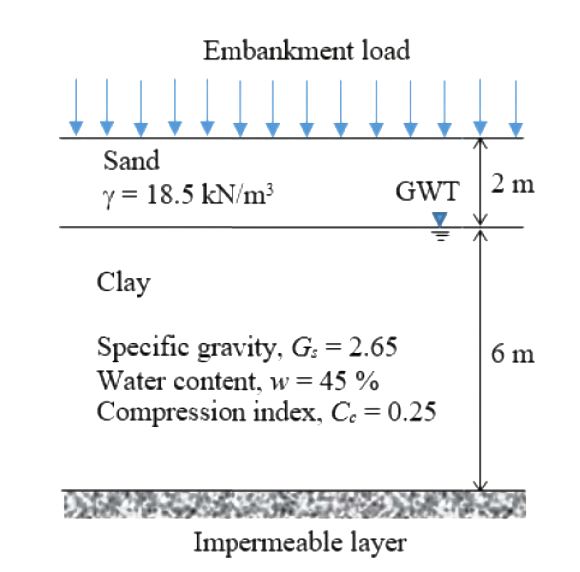
The soil profile at a road construction site is as shown in figure (not to scale). A large embankment is to be constructed at the site. The ground water table (GWT) is located at the surface of the clay layer, and the capillary rise in the sandy soil is negligible. The effective stress at the middle of the clay layer after the application of the embankment loading is 180 kN/m². Take unit weight of water, γw = 9.81 kN/m³. The primary consolidation settlement (in m, round off to two decimal places) of the clay layer resulting from this loading will be ______

Question diagram

Open complete paper
15
2021 · Civil Engineering · Geotechnical Engineering · Compaction and Consolidation
Civil Engineering (CE) 2021 [Session 2]

The void ratio of a clay soil sample M decreased from 0.575 to 0.510 when the applied pressure is increased from 120 kPa to 180 kPa. For the same increment in pressure, the void ratio of another clay soil sample N decreases from 0.600 to 0.550. If the ratio of hydraulic conductivity of sample M to sample N is 0.125, then the ratio of coefficient of consolidation of sample M to sample N (round off to three decimal places) is ________

Open complete paper
16
2022 · Civil Engineering · Geotechnical Engineering · Compaction and Consolidation
Civil Engineering (CE) 2022 [Session 2]

A saturated compressible clay layer of thickness h is sandwiched between two sand layers, as shown in the figure. Initially, the total vertical stress and pore water pressure at point P, which is located at the mid-depth of the clay layer, were 150 kPa and 25 kPa, respectively. Construction of a building caused an additional total vertical stress of 100 kPa at P. When the vertical effective stress at P is 175 kPa, the percentage of consolidation in the clay layer at P is __________. (in integer)

Question diagram

Open complete paper
17
2024 · Civil Engineering · Geotechnical Engineering · Compaction and Consolidation
Civil Engineering (CE) 2024 [Session 1]
An embankment is constructed with soil by maintaining the degree of saturation as 75% during compaction. The specific gravity of soil is 2.68 and the moisture content is 17% during compaction. Consider the unit weight of water as \( 10 \, \text{kN/m}^3 \). The dry unit weight (in \( \text{kN/m}^3 \)) of the compacted soil is __________ (rounded off to 2 decimal places).
Open complete paper
18
2024 · Civil Engineering · Geotechnical Engineering · Compaction and Consolidation
Civil Engineering (CE) 2024 [Session 1]
The total primary consolidation settlement (\(S_c\)) of a building constructed on a 10 m thick saturated clay layer is estimated to be 50 mm. After 300 days of the construction of the building, primary consolidation settlement was reported as 10 mm. The additional time (in days) required to achieve 50% of \(S_c\) will be __________ (rounded off to the nearest integer).
Open complete paper
19
2025 · Civil Engineering · Geotechnical Engineering · Compaction and Consolidation
Civil Engineering (CE) 2025 [Session 2]
A 6 m thick clay stratum has drainage at both its top and bottom surface due to the presence of sand strata. The time to complete 50% consolidation is 2 years. The coefficient of volume change (*m*v) is 1.51×10⁻³ m²/kN and unit weight of water is 9.81 kN/m³.
The coefficient of permeability (in m/year) is ______ (*round off to three decimal places*).
Open complete paper
20
2008 · Civil Engineering · Geotechnical Engineering · Compaction and Consolidation
Civil Engineering (CE) 2008
Compaction by vibratory roller is the best method of compaction in case of
Open complete paper

Showing 20 of 29 questions