My Cart
Your Cart 0

    Your cart is empty.

  • Total (Amount) ₹0.00
Previous year question hub

Stereochemistry - Organic Chemistry - Chemistry Previous Year Questions

Practice Stereochemistry - Organic Chemistry - Chemistry previous year questions organised from real papers, with year-wise coverage and clear topic navigation.

15Papers
15Years
33Questions
1Topics

Stereochemistry question pattern

Every graph below is calculated only from this selection.

Questions by year

Compare question counts across years.

Difficulty distribution

How the classified questions are distributed by difficulty.

Medium 19 57.6%
Hard 10 30.3%
Easy 4 12.1%

Question type distribution

MCQ, numerical, multiple-select and other formats found in these papers.

MCQ 22 66.7%
MSQ 5 15.2%
Numerical Answer Type (NAT) 4 12.1%
Fill in the blanks 2 6.1%

Subject weightage

Top subjects by unique question coverage.

Chemistry
33 Qs

Most asked topics

Top topics across the included previous year papers.

Organic Chemistry
33 Qs

Subtopic coverage

Top subtopics inside this exact selection.

Stereochemistry
33 Qs

Paper coverage

Question coverage for the most populated papers. Every active PYP paper remains listed below.

Chemistry (CY) 2026
2 Qs
Chemistry (CY) 2025
3 Qs
Chemistry (CY) 2024
3 Qs
Chemistry (CY) 2023
2 Qs
Chemistry (CY) 2020
1 Qs
Chemistry (CY) 2019
3 Qs
Chemistry (CY) 2018
2 Qs
Chemistry (CY) 2017
2 Qs
Chemistry (CY) 2016
3 Qs
Chemistry (CY) 2015
2 Qs
Chemistry (CY) 2013
1 Qs
Chemistry (CY) 2010
3 Qs
Chemistry (CY) 2009
1 Qs
Chemistry (CY) 2008
2 Qs
Chemistry (CY) 2007
3 Qs

Included previous year papers

Newest papers appear first. Search these papers or sort by year and name.

Paper nameYearPDFAttempt
Chemistry (CY) 20262026
2 questions in this view
2026
Chemistry (CY) 20252025
3 questions in this view
2025
Chemistry (CY) 20242024
3 questions in this view
2024
Chemistry (CY) 20232023
2 questions in this view
2023
Chemistry (CY) 20202020
1 questions in this view
2020
Chemistry (CY) 20192019
3 questions in this view
2019
Chemistry (CY) 20182018
2 questions in this view
2018
Chemistry (CY) 20172017
2 questions in this view
2017
Chemistry (CY) 20162016
3 questions in this view
2016
Chemistry (CY) 20152015
2 questions in this view
2015
Chemistry (CY) 20132013
1 questions in this view
2013
Chemistry (CY) 20102010
3 questions in this view
2010
Chemistry (CY) 20092009
1 questions in this view
2009
Chemistry (CY) 20082008
2 questions in this view
2008
Chemistry (CY) 20072007
3 questions in this view
2007

All Stereochemistry previous year questions

Practice every matching question in batches of 20, with every available option.

1
2008 · Chemistry · Organic Chemistry · Stereochemistry
Chemistry (CY) 2008

The number of optically active stereoisomers possible for 1,3-cyclohexanediol in its chair conformation is

Open complete paper
2
2008 · Chemistry · Organic Chemistry · Stereochemistry
Chemistry (CY) 2008
In the following reaction,
D-Glyceraldehyde + HCN → X + Y (2 diastereomers)
The absolute configurations of the chiral centres in X and Y are
Open complete paper
3
2009 · Chemistry · Organic Chemistry · Stereochemistry
Chemistry (CY) 2009
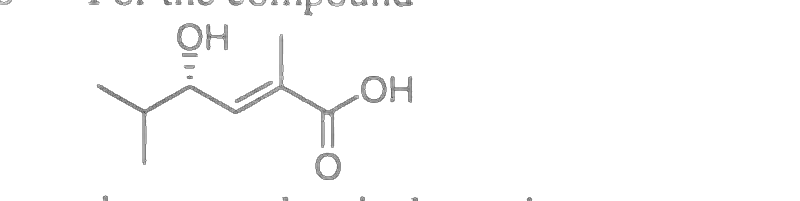
For the compound [image] the stereochemical notations are
Open complete paper
4
2013 · Chemistry · Organic Chemistry · Stereochemistry
Chemistry (CY) 2013

The maximum number of stereoisomers possible for the compound given below is ______.

Open complete paper
5
2016 · Chemistry · Organic Chemistry · Stereochemistry
Chemistry (CY) 2016

Ring flipping of the compound in the following conformation leads to

Open complete paper
6
2016 · Chemistry · Organic Chemistry · Stereochemistry
Chemistry (CY) 2016

The compound in 'R' configuration is

Open complete paper
7
2016 · Chemistry · Organic Chemistry · Stereochemistry
Chemistry (CY) 2016
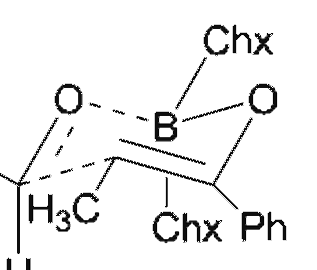
The favourable transition state leading to the formation of the product in the following reaction, is
Reaction: Ph-CO-CH(B(Chx)2)-CH3 (i) PhCHO, -78 °C (ii) H2O2, NaOH → Ph-CO-CH(OH)-CH(Ph)-CH3, Chx = cyclohexyl
Open complete paper
8
2019 · Chemistry · Organic Chemistry · Stereochemistry
Chemistry (CY) 2019
In the following reaction, the stereochemistry of the major product is predicted by the
Open complete paper
9
2019 · Chemistry · Organic Chemistry · Stereochemistry
Chemistry (CY) 2019
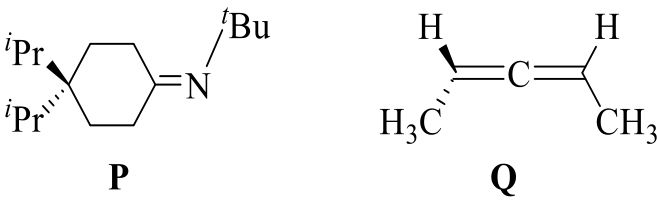
Among the following compounds, the number of compounds that DO NOT exhibit optical activity at room temperature is __________.
Open complete paper
10
2019 · Chemistry · Organic Chemistry · Stereochemistry
Chemistry (CY) 2019
The specific rotation of optically pure (R)-2-bromobutane is −112.00. A given sample of 2-bromobutane exhibited a specific rotation of −82.88. The percentage of (S)-(+)-enantiomer present in this sample is ______.
Open complete paper
11
2023 · Chemistry · Organic Chemistry · Stereochemistry
Chemistry (CY) 2023
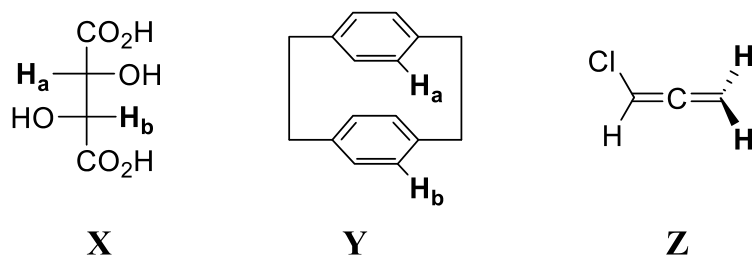
The topicity relationship of Ha and Hb in X, Y and Z are, respectively,

Source question diagram

Open complete paper
12
2023 · Chemistry · Organic Chemistry · Stereochemistry
Chemistry (CY) 2023

The stereoisomer(s) of G giving the depicted product is(are)

Open complete paper
13
2024 · Chemistry · Organic Chemistry · Stereochemistry
Chemistry (CY) 2024

Among the following, the chiral compound is

Source question diagram

Open complete paper
14
2024 · Chemistry · Organic Chemistry · Stereochemistry
Chemistry (CY) 2024

The correct statement(s) for decalin is (are)

Open complete paper
15
2024 · Chemistry · Organic Chemistry · Stereochemistry
Chemistry (CY) 2024

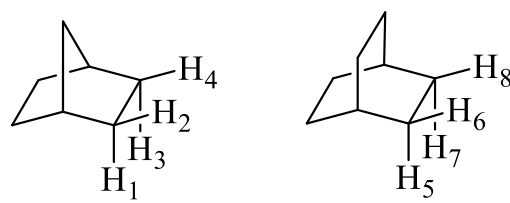
The correct statement(s) about the relationship for the H-atoms in the following compounds is (are):

Source question diagram

Open complete paper
16
2025 · Chemistry · Organic Chemistry · Stereochemistry
Chemistry (CY) 2025

The specific rotation of enantiomerically pure (S)-2-butanol is +14°. The specific rotation of enantiomeric mixture of 2-butanol obtained from an asymmetric reduction of 2-butanone is found to be +7°. The percentage of (R)-2-butanol present in the reaction mixture is ____ (in integer).

Open complete paper
17
2025 · Chemistry · Organic Chemistry · Stereochemistry
Chemistry (CY) 2025
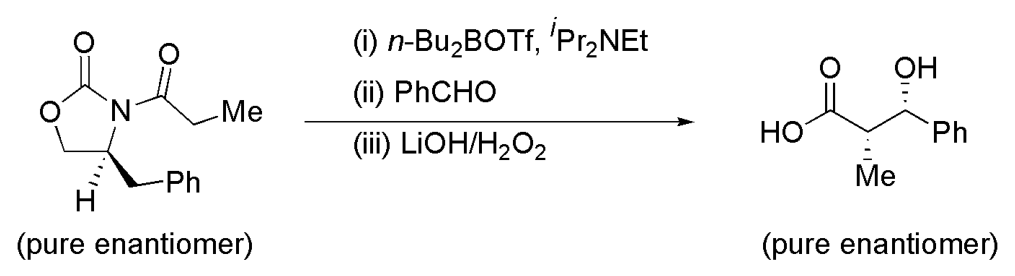
In the following asymmetric transformation, the key aldol reaction involves the attack of

(A) Si face of enolate on to the Re face of aldehyde
(B) Si face of enolate on to the Si face of aldehyde
(C) Re face of enolate on to the Re face of aldehyde
(D) Re face of enolate on to the Si face of aldehyde

Source question diagram

Open complete paper
18
2025 · Chemistry · Organic Chemistry · Stereochemistry
Chemistry (CY) 2025

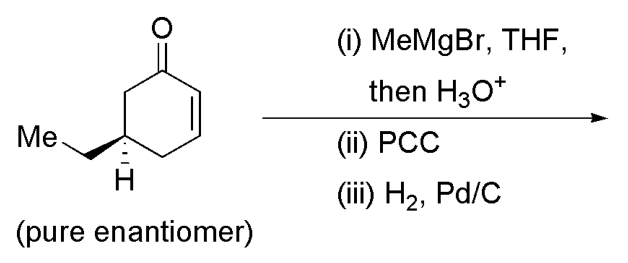
For the following reaction, the possible product(s) is/are

Source question diagram

Open complete paper
19
2007 · Chemistry · Organic Chemistry · Stereochemistry
Chemistry (CY) 2007
The result of the reduction of either (R) or (S) 2-methylcyclohexanone, in separate reactions, using LiAlH4 is that the reduction of
Open complete paper
20
2007 · Chemistry · Organic Chemistry · Stereochemistry
Chemistry (CY) 2007
The molecule(s) that exist as meso structure(s) is / are
Open complete paper

Showing 20 of 33 questions