My Cart
Your Cart 0

    Your cart is empty.

  • Total (Amount) ₹0.00
Previous year question hub

Thermodynamic Laws and Properties - Thermodynamics - Chemical Engineering Previous Year Questions

Practice Thermodynamic Laws and Properties - Thermodynamics - Chemical Engineering previous year questions organised from real papers, with year-wise coverage and clear topic navigation.

19Papers
19Years
57Questions
1Topics

Thermodynamic Laws and Properties question pattern

Every graph below is calculated only from this selection.

Questions by year

Compare question counts across years.

Difficulty distribution

How the classified questions are distributed by difficulty.

Easy 33 57.9%
Medium 24 42.1%

Question type distribution

MCQ, numerical, multiple-select and other formats found in these papers.

MCQ 40 70.2%
Numerical Answer Type (NAT) 15 26.3%
Fill in the blanks 1 1.8%
MSQ 1 1.8%

Subject weightage

Top subjects by unique question coverage.

Chemical Engineering
57 Qs

Most asked topics

Top topics across the included previous year papers.

Thermodynamics
57 Qs

Subtopic coverage

Top subtopics inside this exact selection.

Thermodynamic Laws and Properties
57 Qs

Paper coverage

Question coverage for the most populated papers. Every active PYP paper remains listed below.

Chemical Engineering (CH) 2026
2 Qs
Chemical Engineering (CH) 2025
3 Qs
Chemical Engineering (CH) 2024
2 Qs
Chemical Engineering (CH) 2023
2 Qs
Chemical Engineering (CH) 2022
4 Qs
Chemical Engineering (CH) 2021
3 Qs
Chemical Engineering (CH) 2020
3 Qs
Chemical Engineering (CH) 2019
3 Qs
Chemical Engineering (CH) 2018
2 Qs
Chemical Engineering (CH) 2017
3 Qs
Chemical Engineering (CH) 2016
2 Qs
Chemical Engineering (CH) 2014
2 Qs
Chemical Engineering (CH) 2013
5 Qs
Chemical Engineering (CH) 2012
4 Qs
Chemical Engineering (CH) 2011
1 Qs
Chemical Engineering (CH) 2010
2 Qs
Chemical Engineering (CH) 2009
3 Qs
Chemical Engineering (CH) 2008
2 Qs
Chemical Engineering (CH) 2007
9 Qs

Included previous year papers

Newest papers appear first. Search these papers or sort by year and name.

Paper nameYearPDFAttempt
Chemical Engineering (CH) 20262026
2 questions in this view
2026
Chemical Engineering (CH) 20252025
3 questions in this view
2025
Chemical Engineering (CH) 20242024
2 questions in this view
2024
Chemical Engineering (CH) 20232023
2 questions in this view
2023
Chemical Engineering (CH) 20222022
4 questions in this view
2022
Chemical Engineering (CH) 20212021
3 questions in this view
2021
Chemical Engineering (CH) 20202020
3 questions in this view
2020
Chemical Engineering (CH) 20192019
3 questions in this view
2019
Chemical Engineering (CH) 20182018
2 questions in this view
2018
Chemical Engineering (CH) 20172017
3 questions in this view
2017
Chemical Engineering (CH) 20162016
2 questions in this view
2016
Chemical Engineering (CH) 20142014
2 questions in this view
2014
Chemical Engineering (CH) 20132013
5 questions in this view
2013
Chemical Engineering (CH) 20122012
4 questions in this view
2012
Chemical Engineering (CH) 20112011
1 questions in this view
2011
Chemical Engineering (CH) 20102010
2 questions in this view
2010
Chemical Engineering (CH) 20092009
3 questions in this view
2009
Chemical Engineering (CH) 20082008
2 questions in this view
2008
Chemical Engineering (CH) 20072007
9 questions in this view
2007

All Thermodynamic Laws and Properties previous year questions

Practice every matching question in batches of 20, with every available option.

1
2007 · Chemical Engineering · Thermodynamics · Thermodynamic Laws and Properties
Chemical Engineering (CH) 2007
The state of an ideal gas is changed from \((T_1, P_1)\) to \((T_2, P_2)\) in a constant volume process. To calculate the change in enthalpy, \(\Delta h\), ALL of the following properties/variables are required.
Open complete paper
2
2007 · Chemical Engineering · Thermodynamics · Thermodynamic Laws and Properties
Chemical Engineering (CH) 2007
The change in entropy of the system, \(\Delta S_{sys}\), undergoing a cyclic irreversible process is
Open complete paper
3
2007 · Chemical Engineering · Thermodynamics · Thermodynamic Laws and Properties
Chemical Engineering (CH) 2007
Parameters ‘a’ and ‘b’ in the van der Waals and other cubic equations of state represent
Open complete paper
4
2007 · Chemical Engineering · Thermodynamics · Thermodynamic Laws and Properties
Chemical Engineering (CH) 2007

For the two paths as shown in the figure, one reversible and one irreversible, to change the state of the system from a to b,

Question diagram

Open complete paper
5
2007 · Chemical Engineering · Thermodynamics · Thermodynamic Laws and Properties
Chemical Engineering (CH) 2007
For a pure substance, the Maxwell’s relation obtained from the fundamental property relation \( du = Tds - Pdv \) is
Open complete paper
6
2007 · Chemical Engineering · Thermodynamics · Thermodynamic Laws and Properties
Chemical Engineering (CH) 2007
Which of the following represents the Carnot cycle ( ideal engine ) ?
Open complete paper
7
2007 · Chemical Engineering · Thermodynamics · Thermodynamic Laws and Properties
Chemical Engineering (CH) 2007
2 kg of steam in a piston-cylinder device at 400 kPa and 175 °C undergoes a mechanically reversible, isothermal compression to a final pressure such that the steam becomes just saturated. What is the work, W, required for the process.
Data:
T = 175°C, P = 400 kPa → v = 0.503 m³/kg, u = 2606 kJ/kg, s = 7.055 kJ/kg-K
T = 175°C, satd. vapor → v = 0.216 m³/kg, u = 2579 kJ/kg, s = 6.622 kJ/kg-K
Open complete paper
8
2007 · Chemical Engineering · Thermodynamics · Thermodynamic Laws and Properties
Chemical Engineering (CH) 2007
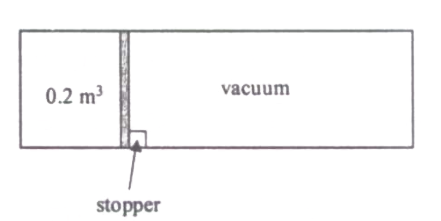
A perfectly insulated cylinder of volume 0.6 m3 is initially divided into two parts by a thin, frictionless piston, as shown in the figure. The smaller part of volume 0.2 m3 has ideal gas at 6 bar pressure and 100 °C. The other part is evacuated.
At certain instant of time t, the stopper is removed and the piston moves out freely to the other end. The final temperature is

Question diagram

Open complete paper
9
2007 · Chemical Engineering · Thermodynamics · Thermodynamic Laws and Properties
Chemical Engineering (CH) 2007
The cylinder insulation is now removed and the piston is pushed back to restore the system to its initial state. If this is to be achieved only by doing work on the system (no heat addition, only heat removal allowed), what is the minimum work required ?
Open complete paper
10
2008 · Chemical Engineering · Thermodynamics · Thermodynamic Laws and Properties
Chemical Engineering (CH) 2008
Q.6 For a Carnot refrigerator operating between 40°C and 25°C, the coefficient of performance is
Open complete paper
11
2008 · Chemical Engineering · Thermodynamics · Thermodynamic Laws and Properties
Chemical Engineering (CH) 2008
Q.7 The work done by one mole of a van der Waals fluid undergoing reversible isothermal expansion from initial volume \( V_i \) to final volume \( V_f \) is
Open complete paper
12
2009 · Chemical Engineering · Thermodynamics · Thermodynamic Laws and Properties
Chemical Engineering (CH) 2009
An ideal gas at temperature \( T_1 \) and pressure \( P_1 \) is compressed isothermally to pressure \( P_2 (> P_1) \) in a closed system. Which ONE of the following is TRUE for internal energy (U) and Gibbs free energy (G) of the gas at the two states ?
Open complete paper
13
2009 · Chemical Engineering · Thermodynamics · Thermodynamic Laws and Properties
Chemical Engineering (CH) 2009
The work required for compression (in kJ/mol) is
Open complete paper
14
2009 · Chemical Engineering · Thermodynamics · Thermodynamic Laws and Properties
Chemical Engineering (CH) 2009
The final pressure \( P_2 \) (in bar) is
Open complete paper
15
2010 · Chemical Engineering · Thermodynamics · Thermodynamic Laws and Properties
Chemical Engineering (CH) 2010
The Maxwell-Boltzmann velocity distribution for the x-component of the velocity, at temperature T, is \( f(v_x) = \sqrt{\frac{m}{2\pi kT}} \exp \left( -\frac{m v_x^2}{2kT} \right) \). The standard deviation of the distribution is
Open complete paper
16
2010 · Chemical Engineering · Thermodynamics · Thermodynamic Laws and Properties
Chemical Engineering (CH) 2010

A saturated liquid at 1500 kPa and 500 K, with an enthalpy of 750 kJ/kg, is throttled to a liquid-vapour mixture at 150 kPa and 300 K. At the exit conditions, the enthalpy of the saturated liquid is 500 kJ/kg and the enthalpy of the saturated vapour is 2500 kJ/kg. The percentage of the original liquid, which vaporizes, is

Open complete paper
17
2011 · Chemical Engineering · Thermodynamics · Thermodynamic Laws and Properties
Chemical Engineering (CH) 2011
One mole of methane is contained in a leak proof piston-cylinder assembly at 8 bar and 1000 K. The gas undergoes isothermal expansion to 4 bar under reversible conditions. Methane can be considered as an ideal gas under these conditions. The value of universal gas constant is 8.314 J mol\(^{-1}\) K\(^{-1}\). The heat transferred (in kJ) during the process is
Open complete paper
18
2012 · Chemical Engineering · Thermodynamics · Thermodynamic Laws and Properties
Chemical Engineering (CH) 2012
In a throttling process, the pressure of an ideal gas reduces by 50 %. If \( C_p \) and \( C_v \) are the heat capacities at constant pressure and constant volume, respectively (\( \gamma = C_p/C_v \)), the specific volume will change by a factor of
Open complete paper
19
2012 · Chemical Engineering · Thermodynamics · Thermodynamic Laws and Properties
Chemical Engineering (CH) 2012

If the temperature of saturated water is increased infinitesimally at constant entropy, the resulting state of water will be

Open complete paper
20
2012 · Chemical Engineering · Thermodynamics · Thermodynamic Laws and Properties
Chemical Engineering (CH) 2012
In a parallel flow heat exchanger operating under steady state, hot liquid enters at a temperature \( T_{h,in} \) and leaves at a temperature \( T_{h,out} \). Cold liquid enters at a temperature \( T_{c,in} \) and leaves at a temperature \( T_{c,out} \). Neglect any heat loss from the heat exchanger to the surrounding. If \( T_{h,in} > T_{c,in} \), then for a given time interval, which ONE of the following statements is true?
Open complete paper

Showing 20 of 57 questions