My Cart
Your Cart 0

    Your cart is empty.

  • Total (Amount) ₹0.00
Previous year question hub

Distillation and Absorption - Mass Transfer - Chemical Engineering Previous Year Questions

Practice Distillation and Absorption - Mass Transfer - Chemical Engineering previous year questions organised from real papers, with year-wise coverage and clear topic navigation.

18Papers
18Years
47Questions
1Topics

Distillation and Absorption question pattern

Every graph below is calculated only from this selection.

Questions by year

Compare question counts across years.

Difficulty distribution

How the classified questions are distributed by difficulty.

Medium 36 76.6%
Easy 8 17%
Hard 3 6.4%
Question type distribution

MCQ, numerical, multiple-select and other formats found in these papers.

MCQ 34 72.3%
Numerical Answer Type (NAT) 12 25.5%
Fill in the blanks 1 2.1%

Subject weightage

Top subjects by unique question coverage.

Chemical Engineering
47 Qs

Most asked topics

Top topics across the included previous year papers.

Mass Transfer
47 Qs

Subtopic coverage

Top subtopics inside this exact selection.

Distillation and Absorption
47 Qs

Paper coverage

Question coverage for the most populated papers. Every active PYP paper remains listed below.

Chemical Engineering (CH) 2026
4 Qs
Chemical Engineering (CH) 2024
3 Qs
Chemical Engineering (CH) 2023
2 Qs
Chemical Engineering (CH) 2022
1 Qs
Chemical Engineering (CH) 2021
1 Qs
Chemical Engineering (CH) 2020
3 Qs
Chemical Engineering (CH) 2019
4 Qs
Chemical Engineering (CH) 2018
2 Qs
Chemical Engineering (CH) 2017
2 Qs
Chemical Engineering (CH) 2016
1 Qs
Chemical Engineering (CH) 2014
2 Qs
Chemical Engineering (CH) 2013
3 Qs
Chemical Engineering (CH) 2012
2 Qs
Chemical Engineering (CH) 2011
2 Qs
Chemical Engineering (CH) 2010
1 Qs
Chemical Engineering (CH) 2009
6 Qs
Chemical Engineering (CH) 2008
4 Qs
Chemical Engineering (CH) 2007
4 Qs

Included previous year papers

Newest papers appear first. Search these papers or sort by year and name.

Paper nameYearPDFAttempt
Chemical Engineering (CH) 20262026
4 questions in this view
2026
Chemical Engineering (CH) 20242024
3 questions in this view
2024
Chemical Engineering (CH) 20232023
2 questions in this view
2023
Chemical Engineering (CH) 20222022
1 questions in this view
2022
Chemical Engineering (CH) 20212021
1 questions in this view
2021
Chemical Engineering (CH) 20202020
3 questions in this view
2020
Chemical Engineering (CH) 20192019
4 questions in this view
2019
Chemical Engineering (CH) 20182018
2 questions in this view
2018
Chemical Engineering (CH) 20172017
2 questions in this view
2017
Chemical Engineering (CH) 20162016
1 questions in this view
2016
Chemical Engineering (CH) 20142014
2 questions in this view
2014
Chemical Engineering (CH) 20132013
3 questions in this view
2013
Chemical Engineering (CH) 20122012
2 questions in this view
2012
Chemical Engineering (CH) 20112011
2 questions in this view
2011
Chemical Engineering (CH) 20102010
1 questions in this view
2010
Chemical Engineering (CH) 20092009
6 questions in this view
2009
Chemical Engineering (CH) 20082008
4 questions in this view
2008
Chemical Engineering (CH) 20072007
4 questions in this view
2007

All Distillation and Absorption previous year questions

Practice every matching question in batches of 20, with every available option.

1
2007 · Chemical Engineering · Mass Transfer · Distillation and Absorption
Chemical Engineering (CH) 2007
If \(T_A\) and \(T_B\) are the boiling points of pure A and pure B respectively and \(T_{AB}\) is that of a non-homogeneous immiscible mixture of A and B, then
Open complete paper
2
2007 · Chemical Engineering · Mass Transfer · Distillation and Absorption
Chemical Engineering (CH) 2007
In a distillation operation, it is desired to have a very high purity bottom product. Initially, a kettle-type reboiler is used at the bottom of the column and the following analytical equation is used to obtain the equilibrium trays in the exhausting section of the column
\[ N_p - m + 1 = \frac{\log \left[ \frac{x_m - x_w/\alpha}{x_w - x_w/\alpha}(1 - \bar{A}) + \bar{A} \right]}{\log(\bar{A})} \]
where \(x_m\) is the composition of the liquid leaving tray \(m\). Tray \(m\) is the last equilibrium tray obtained by a McCabe Thiele graph of the exhausting section. If the kettle-type reboiler is replaced by a thermo-syphon reboiler, the analytical equation, for the exhausting section will be
Open complete paper
3
2007 · Chemical Engineering · Mass Transfer · Distillation and Absorption
Chemical Engineering (CH) 2007
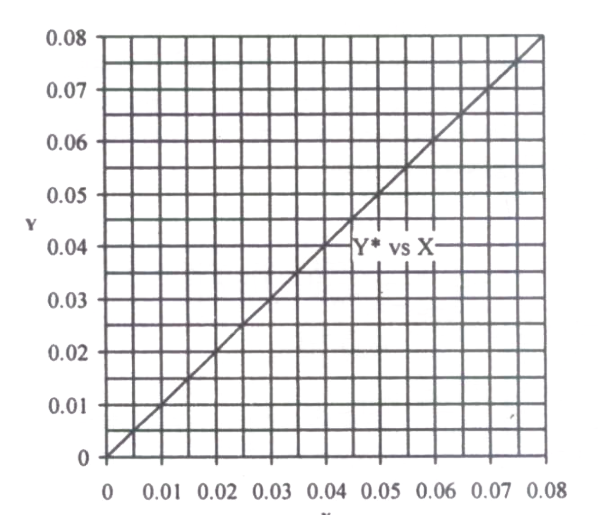
Benzene in an air-benzene mixture is to be reduced from 5.2 mol % in the feed to 0.5 mol % by contacting with wash oil in a multistage countercurrent gas absorber. The inlet flowrate of air-benzene mixture is 10 mol/s while benzene free wash oil comes in at 9.5 mol/s. If the equilibrium curve is given as Y* = X , where Y* and X are equilibrium mole ratios of benzene in air and benzene in oil, the number of equilibrium stages required to achieve the above separation is

Question diagram

Open complete paper
4
2007 · Chemical Engineering · Mass Transfer · Distillation and Absorption
Chemical Engineering (CH) 2007
Given the following statements listed from P to T, select the correct combination of TRUE statements from the choices that follow this list.
P) Plate columns are preferred when the operation involves liquids containing suspended solids.
Q) Packed towers are preferred if the liquids have a large foaming tendency.
R) The pressure drop through packed towers is more than the pressure drop through plate columns designed for the same duty.
S) Packed columns are preferred when large temperature changes are involved in distillation operations.
T) Packed towers are cheaper than plate towers if highly corrosive fluids must be handled.
Open complete paper
5
2008 · Chemical Engineering · Mass Transfer · Distillation and Absorption
Chemical Engineering (CH) 2008
Q.16 In a countercurrent gas absorber, both the operating and equilibrium relations are linear. The inlet liquid composition and the exit gas composition are maintained constant. In order to increase the absorption factor
Open complete paper
6
2008 · Chemical Engineering · Mass Transfer · Distillation and Absorption
Chemical Engineering (CH) 2008

In a binary mixture containing components A and B, the relative volatility of A with respect to B is 2.5 when mole fractions are used. The molecular weights of A and B are 78 and 92 respectively. If the compositions are however expressed in mass fractions the relative volatility will then be

Open complete paper
7
2008 · Chemical Engineering · Mass Transfer · Distillation and Absorption
Chemical Engineering (CH) 2008

An ideal flash vaporization is carried out with a binary mixture at constant temperature and pressure. A process upset leads to an increase in the mole fraction of the heavy component in the feed. The flash vessel continues to operate at the previous temperature and pressure and still produces liquid and vapor. After steady state is re-established,

Open complete paper
8
2008 · Chemical Engineering · Mass Transfer · Distillation and Absorption
Chemical Engineering (CH) 2008

A batch distillation operation is carried out to separate a feed containing 100 moles of a binary mixture of A and B. The mole fraction of A in the feed is 0.7. The distillation progresses until the mole fraction of A in the residue decreases to 0.6. The equilibrium curve in this composition range may be linearized to y* = 0.7353 x + 0.3088. Here x and y are the mole fractions of the more volatile component A in the liquid and vapor phases respectively. The number of moles of residue is

Open complete paper
9
2009 · Chemical Engineering · Mass Transfer · Distillation and Absorption
Chemical Engineering (CH) 2009
The ratio of the liquid to gas flow rate in a counter-current gas absorption column is increased, at otherwise identical conditions. Which ONE of the following statements is TRUE ?
Open complete paper
10
2009 · Chemical Engineering · Mass Transfer · Distillation and Absorption
Chemical Engineering (CH) 2009

The feed to a binary distillation column has 40 mol % vapor and 60 mol % liquid. Then, the slope of the q-line in the McCabe-Thiele plot is

Open complete paper
11
2009 · Chemical Engineering · Mass Transfer · Distillation and Absorption
Chemical Engineering (CH) 2009
An equi-molar mixture of four hydrocarbons (1, 2, 3, 4) is to be separated into high purity individual components using a sequence of simple distillation columns (one overhead and one bottom stream). Four possible schemes are shown below.
Component\(K_i\)
16
23
32.5
41.1

Using the \(K_i\) (\(= y_i^*/x_i\)) values given above, the optimal scheme is

Question diagram

Open complete paper
12
2009 · Chemical Engineering · Mass Transfer · Distillation and Absorption
Chemical Engineering (CH) 2009
Match the equipment in Group I to the internals in Group II.
Open complete paper
13
2009 · Chemical Engineering · Mass Transfer · Distillation and Absorption
Chemical Engineering (CH) 2009
The mole fraction of methanol in the distillate is

Question diagram

Open complete paper
14
2009 · Chemical Engineering · Mass Transfer · Distillation and Absorption
Chemical Engineering (CH) 2009
If the enthalpy of the distillate with reference to the feed is 3000 kJ/kmol, and the enthalpy of the bottoms with reference to the feed is -1000 kJ/kmol, the heat duty of the preheater (\( Q_h \) in kJ/hr) is
Open complete paper
15
2010 · Chemical Engineering · Mass Transfer · Distillation and Absorption
Chemical Engineering (CH) 2010

The flooding velocity in a plate column, operating at 1 atm pressure, is 3 m/s. If the column is operated at 2 atm pressure, under otherwise identical conditions, the flooding velocity will be

Open complete paper
16
2011 · Chemical Engineering · Mass Transfer · Distillation and Absorption
Chemical Engineering (CH) 2011
The MINIMUM reflux ratio is
Open complete paper
17
2011 · Chemical Engineering · Mass Transfer · Distillation and Absorption
Chemical Engineering (CH) 2011
The feed is
Open complete paper
18
2012 · Chemical Engineering · Mass Transfer · Distillation and Absorption
Chemical Engineering (CH) 2012
In the McCabe-Thiele diagram, if the \( x \)-coordinate of the point of intersection of the \( q \)-line and the vapor-liquid equilibrium curve is greater than the \( x \)-coordinate of the feed point, then the quality of the feed is
Open complete paper
19
2012 · Chemical Engineering · Mass Transfer · Distillation and Absorption
Chemical Engineering (CH) 2012

An equimolar mixture of A and B (A being more volatile) is flash distilled continuously at a feed rate of 100 kmol/h, such that the liquid product contains 40 mol % of A. If the relative volatility is 6, then the vapor product, in kmol/h, is

Open complete paper
20
2013 · Chemical Engineering · Mass Transfer · Distillation and Absorption
Chemical Engineering (CH) 2013
The vapor-liquid equilibrium curve of a binary mixture A-B, may be approximated by a linear equation over a narrow range of liquid mole fractions (\(0.2 < x_A < 0.3\)) as follows \(y_A^* = 1.325 x_A + 0.121\). Here \(y_A^*\) is the mole fraction of A in the vapor. 100 moles of a feed (\(x_{A,F} = 0.28\)) is batch distilled to a final residue (\(x_{A,W} = 0.2\)). Using the Rayleigh equation, the number of moles of the residue left behind in the distillation unit, up to 2 digits after the decimal point, is ______
Open complete paper

Showing 20 of 47 questions