My Cart
Your Cart 0

    Your cart is empty.

  • Total (Amount) ₹0.00
Previous year question hub

Diffusion and Mass-transfer Theories - Mass Transfer - Chemical Engineering Previous Year Questions

Practice Diffusion and Mass-transfer Theories - Mass Transfer - Chemical Engineering previous year questions organised from real papers, with year-wise coverage and clear topic navigation.

19Papers
19Years
43Questions
1Topics

Diffusion and Mass-transfer Theories question pattern

Every graph below is calculated only from this selection.

Questions by year

Compare question counts across years.

Difficulty distribution

How the classified questions are distributed by difficulty.

Medium 29 67.4%
Easy 13 30.2%
Hard 1 2.3%

Question type distribution

MCQ, numerical, multiple-select and other formats found in these papers.

MCQ 34 79.1%
Numerical Answer Type (NAT) 8 18.6%
Fill in the blanks 1 2.3%

Subject weightage

Top subjects by unique question coverage.

Chemical Engineering
43 Qs

Most asked topics

Top topics across the included previous year papers.

Mass Transfer
43 Qs

Subtopic coverage

Top subtopics inside this exact selection.

Diffusion and Mass-transfer Theories
43 Qs

Paper coverage

Question coverage for the most populated papers. Every active PYP paper remains listed below.

Chemical Engineering (CH) 2026
2 Qs
Chemical Engineering (CH) 2025
3 Qs
Chemical Engineering (CH) 2024
3 Qs
Chemical Engineering (CH) 2023
2 Qs
Chemical Engineering (CH) 2022
3 Qs
Chemical Engineering (CH) 2021
2 Qs
Chemical Engineering (CH) 2020
3 Qs
Chemical Engineering (CH) 2019
2 Qs
Chemical Engineering (CH) 2018
2 Qs
Chemical Engineering (CH) 2017
2 Qs
Chemical Engineering (CH) 2016
1 Qs
Chemical Engineering (CH) 2014
4 Qs
Chemical Engineering (CH) 2013
1 Qs
Chemical Engineering (CH) 2012
1 Qs
Chemical Engineering (CH) 2011
2 Qs
Chemical Engineering (CH) 2010
2 Qs
Chemical Engineering (CH) 2009
2 Qs
Chemical Engineering (CH) 2008
5 Qs
Chemical Engineering (CH) 2007
1 Qs

Included previous year papers

Newest papers appear first. Search these papers or sort by year and name.

Paper nameYearPDFAttempt
Chemical Engineering (CH) 20262026
2 questions in this view
2026
Chemical Engineering (CH) 20252025
3 questions in this view
2025
Chemical Engineering (CH) 20242024
3 questions in this view
2024
Chemical Engineering (CH) 20232023
2 questions in this view
2023
Chemical Engineering (CH) 20222022
3 questions in this view
2022
Chemical Engineering (CH) 20212021
2 questions in this view
2021
Chemical Engineering (CH) 20202020
3 questions in this view
2020
Chemical Engineering (CH) 20192019
2 questions in this view
2019
Chemical Engineering (CH) 20182018
2 questions in this view
2018
Chemical Engineering (CH) 20172017
2 questions in this view
2017
Chemical Engineering (CH) 20162016
1 questions in this view
2016
Chemical Engineering (CH) 20142014
4 questions in this view
2014
Chemical Engineering (CH) 20132013
1 questions in this view
2013
Chemical Engineering (CH) 20122012
1 questions in this view
2012
Chemical Engineering (CH) 20112011
2 questions in this view
2011
Chemical Engineering (CH) 20102010
2 questions in this view
2010
Chemical Engineering (CH) 20092009
2 questions in this view
2009
Chemical Engineering (CH) 20082008
5 questions in this view
2008
Chemical Engineering (CH) 20072007
1 questions in this view
2007

All Diffusion and Mass-transfer Theories previous year questions

Practice every matching question in batches of 20, with every available option.

1
2007 · Chemical Engineering · Mass Transfer · Diffusion and Mass-transfer Theories
Chemical Engineering (CH) 2007

The following figure depicts steady one-dimensional diffusion of water vapour from the surface of water taken in a conical flask at room temperature. Derive the governing equation for determining the concentration profile of water vapour in the gas medium. Neglect change of level of water due to condensation. The temperatures of the gas and the liquid media are identical and constant.

Question diagram

Open complete paper
2
2008 · Chemical Engineering · Mass Transfer · Diffusion and Mass-transfer Theories
Chemical Engineering (CH) 2008
A rectangular slab of thickness 2b along the x axis and extending to infinity along the other directions is initially at concentration c_{A0}. At time t=0, both surfaces of the slab (x = ± b) have their concentrations increased to c_{AW} and maintained at that value. Solute A diffuses into the solid. The dimensionless concentration C is defined as
\[ C = \frac{c_A - c_{A0}}{c_{AW} - c_{A0}} \]
The diffusivity of A inside the solid is assumed constant. At a certain time instant, which ONE of the following is the correct representation of the concentration profile?
Open complete paper
3
2008 · Chemical Engineering · Mass Transfer · Diffusion and Mass-transfer Theories
Chemical Engineering (CH) 2008
A sparingly soluble solute in the form of a circular disk is dissolved in an organic solvent as shown in the figure. The area available for mass transfer from the disk is A and the volume of the initially pure organic solvent is V. The disk is rotated along the horizontal plane at a fixed rpm to produce a uniform concentration of the dissolving solute in the liquid. The convective mass transfer coefficient under these conditions is k_c. The equilibrium concentration of the solute in the solvent is C*. The time required for the concentration to reach 1% of the saturation value is given by

Question diagram

Open complete paper
4
2008 · Chemical Engineering · Mass Transfer · Diffusion and Mass-transfer Theories
Chemical Engineering (CH) 2008
Air concentrated with solute P is brought in contact with water. At steady state, the bulk concentrations of P in air and water are 0.3 and 0.02 respectively. The equilibrium equation relating the interface compositions is
\[ y_{P,i} = 0.25 x_{P,i} \]
Assume that the mass transfer coefficients \( F_G \) and \( F_L \) are identical. The gas phase mole fraction of P at the interface (\( y_{P,i} \)) is
Open complete paper
5
2008 · Chemical Engineering · Mass Transfer · Diffusion and Mass-transfer Theories
Chemical Engineering (CH) 2008
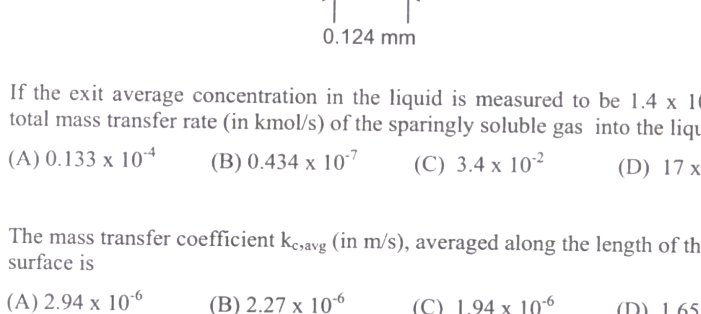
If the exit average concentration in the liquid is measured to be 1.4 × 10⁻² kmol/m3, the total mass transfer rate (in kmol/s) of the sparingly soluble gas into the liquid is

Question diagram

Open complete paper
6
2008 · Chemical Engineering · Mass Transfer · Diffusion and Mass-transfer Theories
Chemical Engineering (CH) 2008
The mass transfer coefficient kc,avg (in m/s), averaged along the length of the vertical surface is
Open complete paper
7
2009 · Chemical Engineering · Mass Transfer · Diffusion and Mass-transfer Theories
Chemical Engineering (CH) 2009

According to the penetration theory of mass transfer, the mass transfer coefficient (k) varies with diffusion coefficient (D) of the diffusing species as

Open complete paper
8
2009 · Chemical Engineering · Mass Transfer · Diffusion and Mass-transfer Theories
Chemical Engineering (CH) 2009
Species A is diffusing at steady state from the surface of a sphere (radius = 1 cm) into a stagnant fluid. If the diffusive flux at a distance \(r = 3\) cm from the center of the sphere is 27 mol/cm²·s, the diffusive flux (in mol/cm²·s) at a distance \(r = 9\) cm is
Open complete paper
9
2010 · Chemical Engineering · Mass Transfer · Diffusion and Mass-transfer Theories
Chemical Engineering (CH) 2010
At 25°C and 90% relative humidity, water evaporates from the surface of a lake at the rate of 1.0 kg/m²/h. The relative humidity that will lead to an evaporation rate of 3.0 kg/m²/h, with other conditions remaining the same, is
Open complete paper
10
2010 · Chemical Engineering · Mass Transfer · Diffusion and Mass-transfer Theories
Chemical Engineering (CH) 2010
A liquid flows over a flat naphthalene plate of length L, at a Reynolds number (Re_L = Lρu∞/μ) of 1500, as shown in the figure. The surface concentration of naphthalene is C_As > C_A∞, and the surface temperature is T_s > T_∞. Assume Pr = Sc = 1.
If, at x = L, \(\left|\frac{\partial C_A^*}{\partial y^*}\right|_{y^*=0} = 10\) where \(C_A^* = \frac{C_A - C_{A\infty}}{C_{As} - C_{A\infty}}\) and \(y^* = \frac{y}{L}\), then the Nusselt number and the friction coefficient at x = L, are

Question diagram

Open complete paper
11
2011 · Chemical Engineering · Mass Transfer · Diffusion and Mass-transfer Theories
Chemical Engineering (CH) 2011
Ammonia (component 1) is evaporating from a partially filled bottle into surrounding air (component 2). The liquid level in the bottle and the concentration of ammonia at the top of the bottle are maintained constant. \(N_1\) is the molar flux relative to a fixed location in space and \(J_1\) is the molar flux with respect to the average molar velocity of the constituent species in the gas phase. Assume that air in the bottle is stagnant. Which ONE of the following is CORRECT?
Open complete paper
12
2011 · Chemical Engineering · Mass Transfer · Diffusion and Mass-transfer Theories
Chemical Engineering (CH) 2011
A gas mixture is in contact with a liquid. Component P in the gas mixture is highly soluble in the liquid. Possible concentration profiles during absorption of P are shown in the choices, where

x : mole fraction of P in bulk liquid
y : mole fraction of P in bulk gas
xi : mole fraction of P at the interface in liquid
yi : mole fraction of P at the interface in gas
y*: equilibrium gas phase mole fraction corresponding to xi

The CORRECT profile is

Question diagram

Open complete paper
13
2012 · Chemical Engineering · Mass Transfer · Diffusion and Mass-transfer Theories
Chemical Engineering (CH) 2012
For which of the following combinations, does the absorption operation become gas-film controlled?
P. The solubility of gas in the liquid is very high
Q. The solubility of gas in the liquid is very low
R. The liquid-side mass transfer coefficient is much higher than the gas-side mass transfer coefficient
S. The liquid-side mass transfer coefficient is much lower than the gas-side mass transfer coefficient
Open complete paper
14
2013 · Chemical Engineering · Mass Transfer · Diffusion and Mass-transfer Theories
Chemical Engineering (CH) 2013
A study was conducted in which water was pumped through cylindrical pipes made of a sparingly soluble solid. For a given pipe and certain flow conditions, the mass transfer coefficient \(k_c\) has been calculated as 1 mm/s using the correlation \(Sh = 0.025 Re^{0.8} Sc^{0.33}\). If the velocity of the fluid and the diameter of the pipe are both doubled, what is the new value of \(k_c\) in mm/s, up to 2 digits after the decimal point? ______
Open complete paper
15
2014 · Chemical Engineering · Mass Transfer · Diffusion and Mass-transfer Theories
Chemical Engineering (CH) 2014
A spherical storage vessel is quarter-filled with toluene. The diameter of the vent at the top of the vessel is 1/20\(^{th}\) of the diameter of the vessel. Under the steady state condition, the diffusive flux of toluene is maximum at
Open complete paper
16
2014 · Chemical Engineering · Mass Transfer · Diffusion and Mass-transfer Theories
Chemical Engineering (CH) 2014
Assuming the mass transfer coefficients in the gas and the liquid phases are comparable, the absorption of \(CO_2\) from reformer gas (\(CO_2+H_2\)) into an aqueous solution of diethanolamine is controlled by
Open complete paper
17
2014 · Chemical Engineering · Mass Transfer · Diffusion and Mass-transfer Theories
Chemical Engineering (CH) 2014

Which ONE of the following statements is CORRECT for the surface renewal theory?

Open complete paper
18
2014 · Chemical Engineering · Mass Transfer · Diffusion and Mass-transfer Theories
Chemical Engineering (CH) 2014
A spherical ball of benzoic acid (diameter = 1.5 cm) is submerged in a pool of still water. The solubility and diffusivity of benzoic acid in water are 0.03 kmol/m³ and 1.25 x 10⁻⁹ m²/s respectively. Sherwood number is given as Sh = 2.0 + 0.6 Re⁰.⁵ Sc⁰.³³. The initial rate of dissolution (in kmol/s) of benzoic acid approximately is
Open complete paper
19
2016 · Chemical Engineering · Mass Transfer · Diffusion and Mass-transfer Theories
Chemical Engineering (CH) 2016

Consider the following two cases for a binary mixture of ideal gases A and B under steady state conditions. In Case 1, the diffusion of A occurs through non-diffusing B. In Case 2, equimolar counter diffusion of A and B occurs. In both the cases, the total pressure is 100 kPa and the partial pressures of A at two points separated by a distance of 10 mm are 10 kPa and 5 kPa. Assume that the Fick’s first law of diffusion is applicable. What is the ratio of molar flux of A in Case 1 to that in Case 2?

Open complete paper
20
2017 · Chemical Engineering · Mass Transfer · Diffusion and Mass-transfer Theories
Chemical Engineering (CH) 2017
Consider steady state mass transfer of a solute A from a gas phase to a liquid phase. The gas phase bulk and interface mole fractions are \(y_{A,G}\) and \(y_{A,i}\), respectively. The liquid phase bulk and interface mole fractions are \(x_{A,L}\) and \(x_{A,i}\), respectively. The ratio \(\frac{(x_{A,i} - x_{A,L})}{(y_{A,G} - y_{A,i})}\) is very close to zero.
This implies that mass transfer resistance is
Open complete paper

Showing 20 of 43 questions