My Cart
Your Cart 0

    Your cart is empty.

  • Total (Amount) ₹0.00
Previous year question hub

Process Modelling and Dynamic Response - Instrumentation and Process Control - Chemical Engineering Previous Year Questions

Practice Process Modelling and Dynamic Response - Instrumentation and Process Control - Chemical Engineering previous year questions organised from real papers, with year-wise coverage and clear topic navigation.

17Papers
17Years
35Questions
1Topics

Process Modelling and Dynamic Response question pattern

Every graph below is calculated only from this selection.

Questions by year

Compare question counts across years.

Difficulty distribution

How the classified questions are distributed by difficulty.

Medium 20 57.1%
Easy 13 37.1%
Hard 2 5.7%
Question type distribution

MCQ, numerical, multiple-select and other formats found in these papers.

MCQ 24 68.6%
Numerical Answer Type (NAT) 10 28.6%
MSQ 1 2.9%

Subject weightage

Top subjects by unique question coverage.

Chemical Engineering
35 Qs

Most asked topics

Top topics across the included previous year papers.

Instrumentation and Process Control
35 Qs

Subtopic coverage

Top subtopics inside this exact selection.

Process Modelling and Dynamic Response
35 Qs

Paper coverage

Question coverage for the most populated papers. Every active PYP paper remains listed below.

Chemical Engineering (CH) 2026
2 Qs
Chemical Engineering (CH) 2025
2 Qs
Chemical Engineering (CH) 2024
1 Qs
Chemical Engineering (CH) 2023
2 Qs
Chemical Engineering (CH) 2022
2 Qs
Chemical Engineering (CH) 2021
2 Qs
Chemical Engineering (CH) 2019
2 Qs
Chemical Engineering (CH) 2018
2 Qs
Chemical Engineering (CH) 2017
1 Qs
Chemical Engineering (CH) 2016
2 Qs
Chemical Engineering (CH) 2014
3 Qs
Chemical Engineering (CH) 2013
2 Qs
Chemical Engineering (CH) 2012
1 Qs
Chemical Engineering (CH) 2010
3 Qs
Chemical Engineering (CH) 2009
2 Qs
Chemical Engineering (CH) 2008
4 Qs
Chemical Engineering (CH) 2007
2 Qs

Included previous year papers

Newest papers appear first. Search these papers or sort by year and name.

Paper nameYearPDFAttempt
Chemical Engineering (CH) 20262026
2 questions in this view
2026
Chemical Engineering (CH) 20252025
2 questions in this view
2025
Chemical Engineering (CH) 20242024
1 questions in this view
2024
Chemical Engineering (CH) 20232023
2 questions in this view
2023
Chemical Engineering (CH) 20222022
2 questions in this view
2022
Chemical Engineering (CH) 20212021
2 questions in this view
2021
Chemical Engineering (CH) 20192019
2 questions in this view
2019
Chemical Engineering (CH) 20182018
2 questions in this view
2018
Chemical Engineering (CH) 20172017
1 questions in this view
2017
Chemical Engineering (CH) 20162016
2 questions in this view
2016
Chemical Engineering (CH) 20142014
3 questions in this view
2014
Chemical Engineering (CH) 20132013
2 questions in this view
2013
Chemical Engineering (CH) 20122012
1 questions in this view
2012
Chemical Engineering (CH) 20102010
3 questions in this view
2010
Chemical Engineering (CH) 20092009
2 questions in this view
2009
Chemical Engineering (CH) 20082008
4 questions in this view
2008
Chemical Engineering (CH) 20072007
2 questions in this view
2007

All Process Modelling and Dynamic Response previous year questions

Practice every matching question in batches of 20, with every available option.

1
2007 · Chemical Engineering · Instrumentation and Process Control · Process Modelling and Dynamic Response
Chemical Engineering (CH) 2007
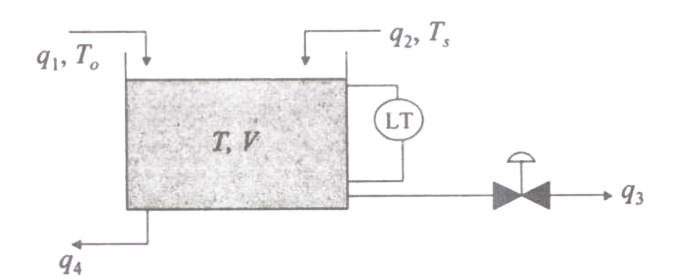
The dynamic model for a mixing tank open to atmosphere at its top as shown below is to be written. The objective of mixing is to cool the hot water stream entering the tank at a flow rate q2 and feed temperature of T2 with a cold water feed stream entering the tank at a flow rate q1 and feed temperature of T0. A water stream is drawn from the tank bottom at a flow rate of q4 by a pump and the level in the tank is proposed to be controlled by drawing another water stream at a flow rate q3. Neglect evaporation and other heat losses from the tank.
The dynamic model for the tank is given as

Question diagram

Open complete paper
2
2007 · Chemical Engineering · Instrumentation and Process Control · Process Modelling and Dynamic Response
Chemical Engineering (CH) 2007
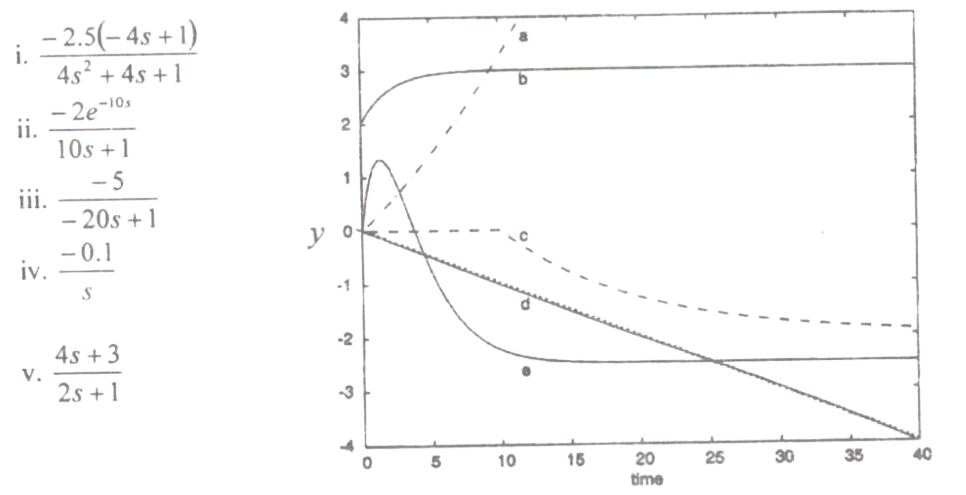
Match the transfer functions with the responses to a unit step input shown in the figure.
i. \(\frac{-2.5(-4s+1)}{4s^2+4s+1}\)
ii. \(\frac{-2e^{-10s}}{10s+1}\)
iii. \(\frac{-5}{-20s+1}\)
iv. \(\frac{-0.1}{s}\)
v. \(\frac{4s+3}{2s+1}\)

Question diagram

Open complete paper
3
2008 · Chemical Engineering · Instrumentation and Process Control · Process Modelling and Dynamic Response
Chemical Engineering (CH) 2008
The unit impulse response of a first order process is given by \( 2 e^{-0.5t} \). The gain and time constant of the process are, respectively,
Open complete paper
4
2008 · Chemical Engineering · Instrumentation and Process Control · Process Modelling and Dynamic Response
Chemical Engineering (CH) 2008
A unit step input is given to a process that is represented by the transfer function \( \frac{(s + 2)}{(s + 5)} \). The initial value (\( t = 0^+ \)) of the response of the process to the step input is
Open complete paper
5
2008 · Chemical Engineering · Instrumentation and Process Control · Process Modelling and Dynamic Response
Chemical Engineering (CH) 2008

Which ONE of the following transfer functions corresponds to an inverse response process with a positive gain?

Open complete paper
6
2008 · Chemical Engineering · Instrumentation and Process Control · Process Modelling and Dynamic Response
Chemical Engineering (CH) 2008
The time constant, \( \tau \) (in minutes) is
Open complete paper
7
2009 · Chemical Engineering · Instrumentation and Process Control · Process Modelling and Dynamic Response
Chemical Engineering (CH) 2009

The roots of the characteristic equation of an underdamped second order system are

Open complete paper
8
2009 · Chemical Engineering · Instrumentation and Process Control · Process Modelling and Dynamic Response
Chemical Engineering (CH) 2009
For a tank of cross-sectional area 100 cm² and inlet flow rate (\(Q_i\) in cm³/s), the outlet flow rate (\(Q_o\) in cm³/s) is related to the liquid height (\(H\) in cm) as \(Q_o = 3\sqrt{H}\) (see figure below).
Then the transfer function \(\frac{\bar{H}(s)}{\bar{Q}_i(s)}\) (overbar indicates deviation variables) of the process around the steady-state point, \(Q_{i,s} = 18\) cm³/s and \(H_s = 36\) cm, is

Question diagram

Open complete paper
9
2010 · Chemical Engineering · Instrumentation and Process Control · Process Modelling and Dynamic Response
Chemical Engineering (CH) 2010
Match the location of the poles/zeros in the s-plane, listed in GROUP I, with the system response characteristics in GROUP II.
GROUP I
P. Pole in the right half plane
Q. Pole at origin
R. Zero in the right half plane
GROUP II
I. Stable response
II. Integrating response
III. Unstable response
IV. Inverse response
Open complete paper
10
2010 · Chemical Engineering · Instrumentation and Process Control · Process Modelling and Dynamic Response
Chemical Engineering (CH) 2010

The transfer function, G(s), whose asymptotic Bode diagram is shown below, is

Question diagram

Open complete paper
11
2010 · Chemical Engineering · Instrumentation and Process Control · Process Modelling and Dynamic Response
Chemical Engineering (CH) 2010
Consider the process as shown below:
A constant head pump transfers a liquid from a tank maintained at 20 psi to a reactor operating at 100 psi, through a heat exchanger and a control valve. At the design conditions, the liquid flow rate is 1000 litres/min, while the pressure drop across the heat exchanger is 40 psi, and that across the control valve is 20 psi. Assume that the pressure drop across the heat exchanger varies as the square of the flow rate. If the flow is reduced to 500 litres/min, then the pressure drop across the control valve is

Question diagram

Open complete paper
12
2012 · Chemical Engineering · Instrumentation and Process Control · Process Modelling and Dynamic Response
Chemical Engineering (CH) 2012
A thermometer initially at 100°C is dipped at \( t = 0 \) into an oil bath, maintained at 150°C. If the recorded temperature is 130°C after 1 minute, then the time constant of thermometer (in min) is
Open complete paper
13
2013 · Chemical Engineering · Instrumentation and Process Control · Process Modelling and Dynamic Response
Chemical Engineering (CH) 2013

A unit gain 2nd order underdamped process has a period of oscillation 1 second and decay ratio 0.25. The transfer function of the process is

Open complete paper
14
2013 · Chemical Engineering · Instrumentation and Process Control · Process Modelling and Dynamic Response
Chemical Engineering (CH) 2013
Consider the following transfer function G_p(s) = \frac{5}{(2s+1)^4} (Note: The unit of the process time constant is in seconds.) The crossover frequency (in rad/s) of the process is
Open complete paper
15
2014 · Chemical Engineering · Instrumentation and Process Control · Process Modelling and Dynamic Response
Chemical Engineering (CH) 2014
A unit IMPULSE response of a first order system with time constant \(\tau\) and steady state gain \(K_p\) is given by
Open complete paper
16
2014 · Chemical Engineering · Instrumentation and Process Control · Process Modelling and Dynamic Response
Chemical Engineering (CH) 2014
Assume that an ordinary mercury-in-glass thermometer follows first order dynamics with a time constant of 10 s. It is at a steady state temperature of 0 \(^{\circ}C\). At time \(t = 0\), the thermometer is suddenly immersed in a constant temperature bath at 100 \(^{\circ}C\). The time required (in s) for the thermometer to read 95 \(^{\circ}C\), approximately is
Open complete paper
17
2014 · Chemical Engineering · Instrumentation and Process Control · Process Modelling and Dynamic Response
Chemical Engineering (CH) 2014
A step change of magnitude 2 is introduced into a system having the following transfer function
\(G(s) = \frac{2}{s^2 + 2s + 4}\)
The percent overshoot is __________
Open complete paper
18
2016 · Chemical Engineering · Instrumentation and Process Control · Process Modelling and Dynamic Response
Chemical Engineering (CH) 2016

A system exhibits inverse response for a unit step change in the input. Which one of the following statement must necessarily be satisfied?

Open complete paper
19
2016 · Chemical Engineering · Instrumentation and Process Control · Process Modelling and Dynamic Response
Chemical Engineering (CH) 2016
For a unit step input, the response of a second order system is
\[y(t) = K_p \left[ 1 - \frac{1}{\sqrt{1-\zeta^2}} e^{-\frac{\zeta t}{\tau}} \sin \left( \frac{\sqrt{1-\zeta^2}}{\tau} t + \phi \right) \right]\]
where, K_p is the steady state gain, ζ is the damping coefficient, τ is the natural period of oscillation and φ is the phase lag. The overshoot of the system is exp(−πζ/√(1−ζ²)). For a unit step input, the response of the system from an initial steady state condition at t = 0 is shown in the figure below.
What is the natural period of oscillation (in seconds) of the system?

Question diagram

Open complete paper
20
2017 · Chemical Engineering · Instrumentation and Process Control · Process Modelling and Dynamic Response
Chemical Engineering (CH) 2017
The transfer function of a system is
\[ \frac{1}{4s^2 + 1.2s + 1} \]
For a unit step increase in the input, the fractional overshoot, rounded to 2 decimal places, is ______.
Open complete paper

Showing 20 of 35 questions