My Cart
Your Cart 0

    Your cart is empty.

  • Total (Amount) ₹0.00
Previous year question hub

Feedback Control and Stability - Instrumentation and Process Control - Chemical Engineering Previous Year Questions

Practice Feedback Control and Stability - Instrumentation and Process Control - Chemical Engineering previous year questions organised from real papers, with year-wise coverage and clear topic navigation.

16Papers
16Years
33Questions
1Topics

Feedback Control and Stability question pattern

Every graph below is calculated only from this selection.

Questions by year

Compare question counts across years.

Difficulty distribution

How the classified questions are distributed by difficulty.

Medium 25 75.8%
Hard 5 15.2%
Easy 3 9.1%
Question type distribution

MCQ, numerical, multiple-select and other formats found in these papers.

MCQ 22 66.7%
Numerical Answer Type (NAT) 11 33.3%

Subject weightage

Top subjects by unique question coverage.

Chemical Engineering
33 Qs

Most asked topics

Top topics across the included previous year papers.

Instrumentation and Process Control
33 Qs

Subtopic coverage

Top subtopics inside this exact selection.

Feedback Control and Stability
33 Qs

Paper coverage

Question coverage for the most populated papers. Every active PYP paper remains listed below.

Chemical Engineering (CH) 2025
1 Qs
Chemical Engineering (CH) 2024
3 Qs
Chemical Engineering (CH) 2023
3 Qs
Chemical Engineering (CH) 2022
1 Qs
Chemical Engineering (CH) 2021
3 Qs
Chemical Engineering (CH) 2020
2 Qs
Chemical Engineering (CH) 2018
2 Qs
Chemical Engineering (CH) 2017
2 Qs
Chemical Engineering (CH) 2016
1 Qs
Chemical Engineering (CH) 2014
2 Qs
Chemical Engineering (CH) 2012
3 Qs
Chemical Engineering (CH) 2011
2 Qs
Chemical Engineering (CH) 2010
1 Qs
Chemical Engineering (CH) 2009
2 Qs
Chemical Engineering (CH) 2008
1 Qs
Chemical Engineering (CH) 2007
4 Qs

Included previous year papers

Newest papers appear first. Search these papers or sort by year and name.

Paper nameYearPDFAttempt
Chemical Engineering (CH) 20252025
1 questions in this view
2025
Chemical Engineering (CH) 20242024
3 questions in this view
2024
Chemical Engineering (CH) 20232023
3 questions in this view
2023
Chemical Engineering (CH) 20222022
1 questions in this view
2022
Chemical Engineering (CH) 20212021
3 questions in this view
2021
Chemical Engineering (CH) 20202020
2 questions in this view
2020
Chemical Engineering (CH) 20182018
2 questions in this view
2018
Chemical Engineering (CH) 20172017
2 questions in this view
2017
Chemical Engineering (CH) 20162016
1 questions in this view
2016
Chemical Engineering (CH) 20142014
2 questions in this view
2014
Chemical Engineering (CH) 20122012
3 questions in this view
2012
Chemical Engineering (CH) 20112011
2 questions in this view
2011
Chemical Engineering (CH) 20102010
1 questions in this view
2010
Chemical Engineering (CH) 20092009
2 questions in this view
2009
Chemical Engineering (CH) 20082008
1 questions in this view
2008
Chemical Engineering (CH) 20072007
4 questions in this view
2007

All Feedback Control and Stability previous year questions

Practice every matching question in batches of 20, with every available option.

1
2007 · Chemical Engineering · Instrumentation and Process Control · Feedback Control and Stability
Chemical Engineering (CH) 2007
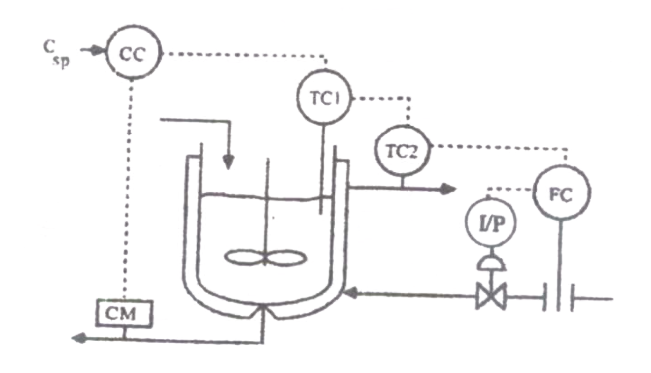
Consider the following instrumentation diagram for a chemical reactor. Csp represents a concentration setpoint.
Match the items in group 1 with the corresponding items given in column B.
Column AColumn B
P) control strategy1) feed forward control
Q) primary control variable2) cascade control
R) slowest controller3) concentration in the reactor
S) fastest controller4) reactor temperature
5) jacket temperature
6) concentration controller
7) reactor temperature controller
8) jacket temperature controller
9) flow controller
10) selective control

Question diagram

Open complete paper
2
2007 · Chemical Engineering · Instrumentation and Process Control · Feedback Control and Stability
Chemical Engineering (CH) 2007
The first two rows of Routh's tabulation of a third order equation are
\(s^3\)22
\(s^2\)44

Select the correct answer from the following choices:
Open complete paper
3
2007 · Chemical Engineering · Instrumentation and Process Control · Feedback Control and Stability
Chemical Engineering (CH) 2007
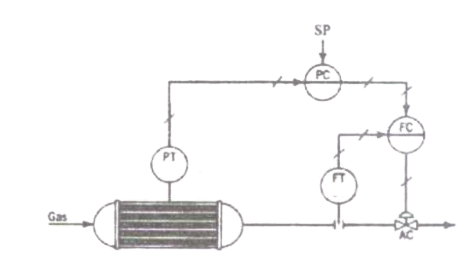
A cascade control system for pressure control is shown in the figure given below. The pressure transmitter has a range of 0 to 6 bar(g) and the flow transmitter range is 0 to 81 nm³/hr. The normal flow rate through the valve is 32.4 nm³/hr corresponding to the value of set point for pressure = 1bar(g) and to give the flow, the valve must be 40% opened. The control valve has linear characteristics and is fail-open (air to close). Error, set point and control variable are expressed in percentage transmitter output(%TO). Proportional gain is expressed in the units of % controller output (CO/%TO).

The types of action for the two controllers are

Question diagram

Open complete paper
4
2007 · Chemical Engineering · Instrumentation and Process Control · Feedback Control and Stability
Chemical Engineering (CH) 2007
Given that the actual tank pressure is 4 bar(g) and a proportional controller is employed for pressure control, the proportional band setting of the pressure controller required to obtain a set point to the flow controller equal to 54 nm³/hr is
Open complete paper
5
2008 · Chemical Engineering · Instrumentation and Process Control · Feedback Control and Stability
Chemical Engineering (CH) 2008

If the control loop is to operate at a gain margin of 2.0, the gain of the proportional controller must equal

Open complete paper
6
2009 · Chemical Engineering · Instrumentation and Process Control · Feedback Control and Stability
Chemical Engineering (CH) 2009
The characteristic equation of a closed loop system using a proportional controller with gain \(K_c\) is \(12{s^3} + 19{s^2} + 8s + 1 + {K_c} = 0\) At the onset of instability, the value of \(K_c\) is
Open complete paper
7
2009 · Chemical Engineering · Instrumentation and Process Control · Feedback Control and Stability
Chemical Engineering (CH) 2009
The block diagram for a control system is shown below:
For a unit step change in the set point, \(R(s)\), the steady state offset in the output \(Y(s)\) is

Question diagram

Open complete paper
8
2010 · Chemical Engineering · Instrumentation and Process Control · Feedback Control and Stability
Chemical Engineering (CH) 2010
Consider the cascade control configuration shown in the figure below:
The system is stable when K_c2 is

Question diagram

Open complete paper
9
2011 · Chemical Engineering · Instrumentation and Process Control · Feedback Control and Stability
Chemical Engineering (CH) 2011
The following diagram shows a CSTR with two control loops. A liquid phase, endothermic reaction is taking place in the CSTR, and the system is initially at steady state. Assume that the changes in physical properties of the system are negligible.
TC: Temperature controller, LC: Level controller, TT: Temperature transmitter, LT: Level transmitter, V₁ and V₂: Control valves
Which ONE of the following statements is TRUE?

Question diagram

Open complete paper
10
2011 · Chemical Engineering · Instrumentation and Process Control · Feedback Control and Stability
Chemical Engineering (CH) 2011

The characteristic equation of the closed loop is

Open complete paper
11
2012 · Chemical Engineering · Instrumentation and Process Control · Feedback Control and Stability
Chemical Engineering (CH) 2012

The Bode stability criterion is applicable when

Open complete paper
12
2012 · Chemical Engineering · Instrumentation and Process Control · Feedback Control and Stability
Chemical Engineering (CH) 2012
The characteristic equation for a system is \(s^3 + 9s^2 + 26s + 12(2 + K_c) = 0\). Using the Routh test, the value of \(K_c\) that will keep the system on the verge of instability is
Open complete paper
13
2012 · Chemical Engineering · Instrumentation and Process Control · Feedback Control and Stability
Chemical Engineering (CH) 2012
The block diagram of a system with a proportional controller is shown below. A unit step input is introduced in the set point. The value of \(K_c\) to provide a critically damped response for \(U = 0\), \(\tau_p = 8\) and \(\tau_m = 1\) is

Question diagram

Open complete paper
14
2014 · Chemical Engineering · Instrumentation and Process Control · Feedback Control and Stability
Chemical Engineering (CH) 2014
A process with transfer function \( G_p = \frac{2}{s-1} \) is to be controlled by a feedback proportional controller with a gain \( K_c \). If the transfer functions of all other elements in the control loop are unity, then which ONE of the following conditions produces a stable closed loop response?
Open complete paper
15
2014 · Chemical Engineering · Instrumentation and Process Control · Feedback Control and Stability
Chemical Engineering (CH) 2014
Consider the following block diagram for a closed-loop feedback control system
A proportional controller is being used with \( K_c = -4 \). If a step change in disturbance of magnitude 2 affects the system, then the value of the offset is ______

Question diagram

Open complete paper
16
2016 · Chemical Engineering · Instrumentation and Process Control · Feedback Control and Stability
Chemical Engineering (CH) 2016
A PI controller with integral time constant of 0.1 min is to be designed to control a process with transfer function
\[G_p(s) = \frac{10}{s^2 + 2s + 100}\]
Assume the transfer functions of the measuring element and the final control element are both unity (G_m = 1, G_f = 1). The gain (rounded off to the first decimal place) of the controller that will constitute the critical condition for stability of the PI feedback control system is ______
Open complete paper
17
2017 · Chemical Engineering · Instrumentation and Process Control · Feedback Control and Stability
Chemical Engineering (CH) 2017
The open loop transfer function of a process with a proportional controller (gain K_C) is
\[ G_{OL} = K_C \frac{e^{-2s}}{s} \]
Based on the Bode criterion for closed-loop stability, the ultimate gain of the controller, rounded to 2 decimal places, is ______.
Open complete paper
18
2017 · Chemical Engineering · Instrumentation and Process Control · Feedback Control and Stability
Chemical Engineering (CH) 2017
The characteristic equation of a closed-loop system is
\[ 6s^3 + 11s^2 + 6s + (1 + K) = 0, \quad \text{where } K > 0 \]
The value of K beyond which the system just becomes unstable, rounded to the nearest integer, is ______.
Open complete paper
19
2018 · Chemical Engineering · Instrumentation and Process Control · Feedback Control and Stability
Chemical Engineering (CH) 2018
A first-order process having a transfer function, G_p = \frac{2}{7s+1} is controlled by a proportional controller with gain of 3.2. The process time constant is in minutes. Addition of the integral control action with an integral time constant of 5 minutes leads to increase in
Open complete paper
20
2018 · Chemical Engineering · Instrumentation and Process Control · Feedback Control and Stability
Chemical Engineering (CH) 2018
For a closed-loop system, consider the following transfer functions: process \( G_p(s) \), controller \( G_c(s) \), measuring device \( G_m(s) \), and final control element \( G_f(s) \) \( G_p(s) = \frac{2}{7s + 1} \) ; \( G_c(s) = 2 \) ; \( G_m(s) = 1 \) ; \( G_f(s) = 1 \) The offset in the closed loop response due to a unit step change introduced in the set point of the output variable is __________.
Open complete paper

Showing 20 of 33 questions