My Cart
Your Cart 0

    Your cart is empty.

  • Total (Amount) ₹0.00
Previous year question hub

Numerical Methods - Engineering Mathematics - Chemical Engineering Previous Year Questions

Practice Numerical Methods - Engineering Mathematics - Chemical Engineering previous year questions organised from real papers, with year-wise coverage and clear topic navigation.

18Papers
18Years
27Questions
1Topics

Numerical Methods question pattern

Every graph below is calculated only from this selection.

Questions by year

Compare question counts across years.

Difficulty distribution

How the classified questions are distributed by difficulty.

Easy 22 81.5%
Medium 5 18.5%

Question type distribution

MCQ, numerical, multiple-select and other formats found in these papers.

MCQ 13 48.1%
Numerical Answer Type (NAT) 13 48.1%
Fill in the blanks 1 3.7%

Subject weightage

Top subjects by unique question coverage.

Chemical Engineering
27 Qs

Most asked topics

Top topics across the included previous year papers.

Engineering Mathematics
27 Qs

Subtopic coverage

Top subtopics inside this exact selection.

Numerical Methods
27 Qs

Paper coverage

Question coverage for the most populated papers. Every active PYP paper remains listed below.

Chemical Engineering (CH) 2026
2 Qs
Chemical Engineering (CH) 2025
1 Qs
Chemical Engineering (CH) 2024
1 Qs
Chemical Engineering (CH) 2023
1 Qs
Chemical Engineering (CH) 2022
2 Qs
Chemical Engineering (CH) 2021
2 Qs
Chemical Engineering (CH) 2020
2 Qs
Chemical Engineering (CH) 2019
1 Qs
Chemical Engineering (CH) 2018
2 Qs
Chemical Engineering (CH) 2017
1 Qs
Chemical Engineering (CH) 2016
3 Qs
Chemical Engineering (CH) 2014
1 Qs
Chemical Engineering (CH) 2013
1 Qs
Chemical Engineering (CH) 2012
1 Qs
Chemical Engineering (CH) 2011
1 Qs
Chemical Engineering (CH) 2010
1 Qs
Chemical Engineering (CH) 2009
1 Qs
Chemical Engineering (CH) 2008
3 Qs

Included previous year papers

Newest papers appear first. Search these papers or sort by year and name.

Paper nameYearPDFAttempt
Chemical Engineering (CH) 20262026
2 questions in this view
2026
Chemical Engineering (CH) 20252025
1 questions in this view
2025
Chemical Engineering (CH) 20242024
1 questions in this view
2024
Chemical Engineering (CH) 20232023
1 questions in this view
2023
Chemical Engineering (CH) 20222022
2 questions in this view
2022
Chemical Engineering (CH) 20212021
2 questions in this view
2021
Chemical Engineering (CH) 20202020
2 questions in this view
2020
Chemical Engineering (CH) 20192019
1 questions in this view
2019
Chemical Engineering (CH) 20182018
2 questions in this view
2018
Chemical Engineering (CH) 20172017
1 questions in this view
2017
Chemical Engineering (CH) 20162016
3 questions in this view
2016
Chemical Engineering (CH) 20142014
1 questions in this view
2014
Chemical Engineering (CH) 20132013
1 questions in this view
2013
Chemical Engineering (CH) 20122012
1 questions in this view
2012
Chemical Engineering (CH) 20112011
1 questions in this view
2011
Chemical Engineering (CH) 20102010
1 questions in this view
2010
Chemical Engineering (CH) 20092009
1 questions in this view
2009
Chemical Engineering (CH) 20082008
3 questions in this view
2008

All Numerical Methods previous year questions

Practice every matching question in batches of 20, with every available option.

1
2008 · Chemical Engineering · Engineering Mathematics · Numerical Methods
Chemical Engineering (CH) 2008
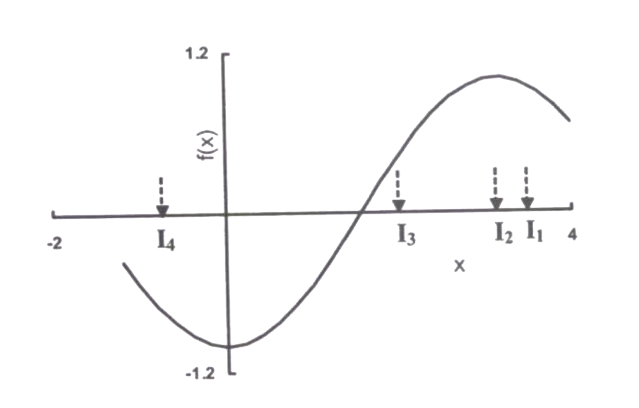
Q.5 A nonlinear function f(x) is defined in the interval -1.2 < x < 4 as illustrated in the figure below. The equation f(x) = 0 is solved for x within this interval by using the Newton-Raphson iterative scheme. Among the initial guesses (I1, I2, I3, and I4), the guess that is likely to lead to the root most rapidly is

Question diagram

Open complete paper
2
2008 · Chemical Engineering · Engineering Mathematics · Numerical Methods
Chemical Engineering (CH) 2008
Using Simpson's 1/3 rule and FOUR equally spaced intervals (n = 4), estimate the value of the integral \( \int_{0}^{\pi/4} \frac{\sin x}{\cos^3 x} \, dx \)
Open complete paper
3
2008 · Chemical Engineering · Engineering Mathematics · Numerical Methods
Chemical Engineering (CH) 2008
The following differential equation is to be solved numerically by the Euler's explicit method.
\( \frac{dy}{dx} = x^2 y - 1.2 y \) with \( y(0) = 1 \)
A step size of 0.1 is used. The solution for \( y \) at \( x = 0.1 \) is
Open complete paper
4
2009 · Chemical Engineering · Engineering Mathematics · Numerical Methods
Chemical Engineering (CH) 2009
Using the trapezoidal rule and 4 equal intervals (\(n = 4\)), the calculated value of the integral (rounded to the first place of decimal) \(\int_0^{\pi} \sin \theta \, d\theta\) is
Open complete paper
5
2010 · Chemical Engineering · Engineering Mathematics · Numerical Methods
Chemical Engineering (CH) 2010
A root of the equation \( x^4 - 3x + 1 = 0 \) needs to be found using the Newton-Raphson method. If the initial guess, \( x_0 \), is taken as 0, then the new estimate, \( x_1 \), after the first iteration is
Open complete paper
6
2011 · Chemical Engineering · Engineering Mathematics · Numerical Methods
Chemical Engineering (CH) 2011
In the fixed point iteration method for solving equations of the form \( x = g(x) \), the \((n+1)^{th}\) iteration value is \( x_{n+1} = g(x_n) \), where \( x_n \) represents the \( n^{th} \) iteration value. \( g(x) \) and corresponding initial guess value \( x_0 \) in the domain of interest are shown in the following choices. Which ONE of these choices leads to a converged solution for \( x \)?
Open complete paper
7
2012 · Chemical Engineering · Engineering Mathematics · Numerical Methods
Chemical Engineering (CH) 2012
The Newton-Raphson method is used to find the roots of the equation \[ f(x) = x - \cos \pi x \quad 0 \le x \le 1. \] If the initial guess for the root is 0.5, then the value of \( x \) after the first iteration is
Open complete paper
8
2013 · Chemical Engineering · Engineering Mathematics · Numerical Methods
Chemical Engineering (CH) 2013
The value of the integral \(\int_{0.1}^{0.5} e^{-x^3} dx\) evaluated by Simpson's rule using 4 subintervals (up to 3 digits after the decimal point) is ______
Open complete paper
9
2014 · Chemical Engineering · Engineering Mathematics · Numerical Methods
Chemical Engineering (CH) 2014
Consider the following differential equation
\(\frac{dy}{dx} = x + \ln(y) ; \quad y = 2 \text{ at } x = 0\)
The solution of this equation at \(x = 0.4\) using Euler method with a step size of \(h = 0.2\) is ____
Open complete paper
10
2016 · Chemical Engineering · Engineering Mathematics · Numerical Methods
Chemical Engineering (CH) 2016
Which one of the following is an iterative technique for solving a system of simultaneous linear algebraic equations?
Open complete paper
11
2016 · Chemical Engineering · Engineering Mathematics · Numerical Methods
Chemical Engineering (CH) 2016
The model \( y = mx^2 \) is to be fit to the data given below.
\( x \)1\( \sqrt{2} \)\( \sqrt{3} \)
\( y \)258
Using linear regression, the value (rounded off to the second decimal place) of \( m \) is ________
Open complete paper
12
2016 · Chemical Engineering · Engineering Mathematics · Numerical Methods
Chemical Engineering (CH) 2016
Values of \( f(x) \) in the interval \( [0, 4] \) are given below.
\( x \)01234
\( f(x) \)310213655
Using Simpson’s 1/3 rule with a step size of 1, the numerical approximation (rounded off to the second decimal place) of \( \int_{0}^{4} f(x) dx \) is ________
Open complete paper
13
2017 · Chemical Engineering · Engineering Mathematics · Numerical Methods
Chemical Engineering (CH) 2017
Match the problem type in Group-1 with the numerical method in Group-2.
Group-1
P) System of linear algebraic equations
Q) Non-linear algebraic equations
R) Ordinary differential equations
S) Numerical integration
Group-2
I) Newton-Raphson
II) Gauss-Seidel
III) Simpson's rule
IV) Runge-Kutta
Choose the correct set of combinations.
Open complete paper
14
2018 · Chemical Engineering · Engineering Mathematics · Numerical Methods
Chemical Engineering (CH) 2018
The fourth order Runge-Kutta (RK4) method to solve an ordinary differential equation \(\frac{dy}{dx} = f(x,y)\) is given as
\[y(x+h) = y(x) + \frac{1}{6}(k_1 + 2k_2 + 2k_3 + k_4)\]
\[k_1 = h f(x, y)\]
\[k_2 = h f\left(x+\frac{h}{2}, y+\frac{k_1}{2}\right)\]
\[k_3 = h f\left(x+\frac{h}{2}, y+\frac{k_2}{2}\right)\]
\[k_4 = h f\left(x+h, y+k_3\right)\]
For a special case when the function \(f\) depends solely on \(x\), the above RK4 method reduces to
Open complete paper
15
2018 · Chemical Engineering · Engineering Mathematics · Numerical Methods
Chemical Engineering (CH) 2018
The volume of liquid filled in a spherical storage tank of radius R is computed from height of liquid, h, in the outside tube (neglecting the volume of liquid in the outside tube) as \( V = \pi h^2 \frac{(3R - h)}{3} \). The estimate of liquid height (in m) to store V = 30 m3 of water in R = 3 m tank, after performing ONE iteration of Secant method, using 1 m and 3 m as two initial guesses of liquid height is __________ (rounded off to second decimal place).

Question diagram

Open complete paper
16
2019 · Chemical Engineering · Engineering Mathematics · Numerical Methods
Chemical Engineering (CH) 2019
The Newton-Raphson method is used to determine the root of the equation f(x) = exx. If the initial guess for the root is 0, the estimate of the root after two iterations is ______ (rounded off to three decimal places).
Open complete paper
17
2020 · Chemical Engineering · Engineering Mathematics · Numerical Methods
Chemical Engineering (CH) 2020
Which one of the following methods requires specifying an initial interval containing the root (i.e., bracketing) to obtain the solution of \(f(x) = 0\), where \(f(x)\) is a continuous non-linear algebraic function?
Open complete paper
18
2020 · Chemical Engineering · Engineering Mathematics · Numerical Methods
Chemical Engineering (CH) 2020
Consider the following dataset.
\(x\)1351525
\(f(x)\)6810125
The value of the integral \(\int_{1}^{25} f(x) dx\) using Simpson's 1/3rd rule is \_\_\_\_\_\_\_\_\_\_ (round off to 1 decimal place).
Open complete paper
19
2021 · Chemical Engineering · Engineering Mathematics · Numerical Methods
Chemical Engineering (CH) 2021
An ordinary differential equation (ODE), \(\frac{dy}{dx} = 2y\), with an initial condition \(y(0) = 1\), has the analytical solution \(y = e^{2x}\).
Using Runge-Kutta second order method, numerically integrate the ODE to calculate \(y\) at \(x = 0.5\) using a step size of \(h = 0.5\).
If the relative percentage error is defined as,
\[ \epsilon = \left| \frac{y_{analytical} - y_{numerical}}{y_{analytical}} \right| \times 100 \]
then the value of \(\epsilon\) at \(x = 0.5\) is ________.
Open complete paper
20
2021 · Chemical Engineering · Engineering Mathematics · Numerical Methods
Chemical Engineering (CH) 2021
To solve an algebraic equation \( f(x) = 0 \), an iterative scheme of the type
\( x_{n+1} = g(x_n) \) is proposed, where \( g(x) = x - \frac{f(x)}{f'(x)} \).
At the solution \( x = s \), \( g'(s) = 0 \) and \( g''(s) \neq 0 \).
The order of convergence for this iterative scheme near the solution is __________.
Open complete paper

Showing 20 of 27 questions