My Cart
Your Cart 0

    Your cart is empty.

  • Total (Amount) ₹0.00
Previous year question hub

Non-ideal and Non-isothermal Reactors - Chemical Reaction Engineering - Chemical Engineering Previous Year Questions

Practice Non-ideal and Non-isothermal Reactors - Chemical Reaction Engineering - Chemical Engineering previous year questions organised from real papers, with year-wise coverage and clear topic navigation.

14Papers
14Years
17Questions
1Topics

Non-ideal and Non-isothermal Reactors question pattern

Every graph below is calculated only from this selection.

Questions by year

Compare question counts across years.

Difficulty distribution

How the classified questions are distributed by difficulty.

Medium 7 41.2%
Easy 5 29.4%
Hard 5 29.4%
Question type distribution

MCQ, numerical, multiple-select and other formats found in these papers.

Numerical Answer Type (NAT) 9 52.9%
MCQ 8 47.1%

Subject weightage

Top subjects by unique question coverage.

Chemical Engineering
17 Qs

Most asked topics

Top topics across the included previous year papers.

Chemical Reaction Engineering
17 Qs

Subtopic coverage

Top subtopics inside this exact selection.

Non-ideal and Non-isothermal Reactors
17 Qs

Paper coverage

Question coverage for the most populated papers. Every active PYP paper remains listed below.

Chemical Engineering (CH) 2026
2 Qs
Chemical Engineering (CH) 2025
1 Qs
Chemical Engineering (CH) 2024
1 Qs
Chemical Engineering (CH) 2023
1 Qs
Chemical Engineering (CH) 2020
2 Qs
Chemical Engineering (CH) 2019
2 Qs
Chemical Engineering (CH) 2017
1 Qs
Chemical Engineering (CH) 2016
1 Qs
Chemical Engineering (CH) 2014
1 Qs
Chemical Engineering (CH) 2013
1 Qs
Chemical Engineering (CH) 2012
1 Qs
Chemical Engineering (CH) 2009
1 Qs
Chemical Engineering (CH) 2008
1 Qs
Chemical Engineering (CH) 2007
1 Qs

Included previous year papers

Newest papers appear first. Search these papers or sort by year and name.

Paper nameYearPDFAttempt
Chemical Engineering (CH) 20262026
2 questions in this view
2026
Chemical Engineering (CH) 20252025
1 questions in this view
2025
Chemical Engineering (CH) 20242024
1 questions in this view
2024
Chemical Engineering (CH) 20232023
1 questions in this view
2023
Chemical Engineering (CH) 20202020
2 questions in this view
2020
Chemical Engineering (CH) 20192019
2 questions in this view
2019
Chemical Engineering (CH) 20172017
1 questions in this view
2017
Chemical Engineering (CH) 20162016
1 questions in this view
2016
Chemical Engineering (CH) 20142014
1 questions in this view
2014
Chemical Engineering (CH) 20132013
1 questions in this view
2013
Chemical Engineering (CH) 20122012
1 questions in this view
2012
Chemical Engineering (CH) 20092009
1 questions in this view
2009
Chemical Engineering (CH) 20082008
1 questions in this view
2008
Chemical Engineering (CH) 20072007
1 questions in this view
2007

All Non-ideal and Non-isothermal Reactors previous year questions

Practice every matching question in batches of 20, with every available option.

1
2007 · Chemical Engineering · Chemical Reaction Engineering · Non-ideal and Non-isothermal Reactors
Chemical Engineering (CH) 2007
A pulse of concentrated KCl solution is introduced as tracer into the fluid entering a reaction vessel having volume equal to 1 m³ and flow rate equal to 1 m³/min. The concentration of tracer measured in the fluid leaving the vessel is shown in the figure given below. The flow model parameters that fit the measured RTD in terms of one or all of the following mixing elements, namely, volume of plug flow reactor, V_p, mixed flow volume, V_m, and dead space, V_d, are

Question diagram

Open complete paper
2
2008 · Chemical Engineering · Chemical Reaction Engineering · Non-ideal and Non-isothermal Reactors
Chemical Engineering (CH) 2008
The homogeneous reaction \( A + B \rightarrow C \) is conducted in an adiabatic CSTR at 800 K so as to achieve a 30% conversion of A. The relevant specific heats and enthalpy change of reaction are given by
\[ C_{P,A} = 100 \ J/(mol \ K), \ C_{P,C} = 150 \ J/(mol \ K) \]
\[ C_{P,B} = 50 \ J/(mol \ K), \ \Delta H^{\circ} = -100 \ kJ / mol \]
If the feed, a mixture of A and B, is available at 550 K, the mole fraction of A in the feed that is consistent with the above data is
Open complete paper
3
2009 · Chemical Engineering · Chemical Reaction Engineering · Non-ideal and Non-isothermal Reactors
Chemical Engineering (CH) 2009
The liquid-phase reaction A → B is conducted in an adiabatic plug flow reactor.
Data:
Inlet concentration of A = 4.0 kmol/m³
Density of reaction mixture (independent of temperature) = 1200 kg/m³
Average heat capacity of feed stream (independent of temperature) = 2000 J/kg.K
Heat of reaction (independent of temperature) = – 120 kJ/mol of A reacting
If the maximum allowable temperature in the reactor is 800 K, then the feed temperature (in K) should not exceed
Open complete paper
4
2012 · Chemical Engineering · Chemical Reaction Engineering · Non-ideal and Non-isothermal Reactors
Chemical Engineering (CH) 2012
The elementary reversible exothermic gas-phase reaction \(A + 3B \rightleftharpoons 2C\) is to be conducted in a non-isothermal, non-adiabatic plug flow reactor. The maximum allowable reactor temperature is \(T_{max}\). To minimize the total reactor volume, the variation of reactor temperature (\(T\)) with axial distance from the inlet (\(z\)) should be

Question diagram

Open complete paper
5
2013 · Chemical Engineering · Chemical Reaction Engineering · Non-ideal and Non-isothermal Reactors
Chemical Engineering (CH) 2013
In the manufacture of sulphuric acid by the contact process, the catalytic oxidation of SO₂ is carried out in multiple stages mainly to
Open complete paper
6
2014 · Chemical Engineering · Chemical Reaction Engineering · Non-ideal and Non-isothermal Reactors
Chemical Engineering (CH) 2014

The vessel dispersion number for an ideal CSTR is

Open complete paper
7
2016 · Chemical Engineering · Chemical Reaction Engineering · Non-ideal and Non-isothermal Reactors
Chemical Engineering (CH) 2016
A CSTR has a long inlet pipe. A tracer is injected at the entrance of the pipe. The E-curve obtained at the exit of the CSTR is shown in the figure below.

Assuming plug flow in the inlet pipe, the ratio (rounded off to the second decimal place) of the volume of the pipe to that of the CSTR is ______

Question diagram

Open complete paper
8
2017 · Chemical Engineering · Chemical Reaction Engineering · Non-ideal and Non-isothermal Reactors
Chemical Engineering (CH) 2017
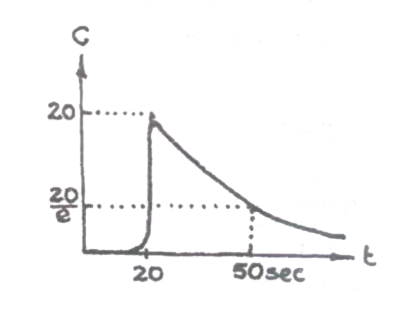
The C-curve measured during a pulse tracer experiment is shown below. In the figure, \( C(t) \) is the concentration of the tracer measured at the reactor exit in mol/liter at time \( t \) seconds.
The mean residence time in the reactor, rounded to 1 decimal place, is ______ s.

Question diagram

Open complete paper
9
2019 · Chemical Engineering · Chemical Reaction Engineering · Non-ideal and Non-isothermal Reactors
Chemical Engineering (CH) 2019
The elementary, irreversible, liquid-phase, parallel reactions, \(2A \rightarrow D\) and \(2A \rightarrow U\), take place in an isothermal non-ideal reactor. The C-curve measured in a tracer experiment is shown in the figure, where \(C(t)\) is the concentration of the tracer in g/m³ at the reactor exit at time \(t\) (in min).
The rate constants are \(k_1 = 0.2\) Liter/(mcl min) and \(k_2 = 0.3\) Liter/(mol min). Pure A is fed to the reactor at a concentration of 2 mol/Liter. Using the segregated model, the percentage conversion in the reactor is __________ (rounded off to the nearest integer).
Open complete paper
10
2019 · Chemical Engineering · Chemical Reaction Engineering · Non-ideal and Non-isothermal Reactors
Chemical Engineering (CH) 2019
The elementary irreversible gas-phase reaction A \(\to\) B + C is carried out adiabatically in an ideal CSTR (Continuous-Stirred Tank Reactor) operating at 10 atm. Pure A enters the CSTR at a flow rate of 10 mol/s and a temperature of 450 K. Assume A, B and C to be ideal gases.
The specific heat capacity at constant pressure (\(C_p\)) and heat of formation (\(H_f^o\)), of component \(i\) (\(i = A, B, C\)), are:
\(C_{pA} = 30\) J/(mol K) \(\quad C_{pB} = 10\) J/(mol K) \(\quad C_{pC} = 20\) J/(mol K)
\(H_f^o = -90\) kJ/mol \(\quad H_B^o = -54\) kJ/mol \(\quad H_C^o = -45\) kJ/mol
The reaction rate constant \(k\) (per second) = \(0.133 \exp \left[ \frac{E}{R} \left( \frac{1}{450} - \frac{1}{T} \right) \right]\), where \(E = 31.4\) kJ/mol and universal gas constant \(R=0.082\) L atm/(mol K) \(= 8.314\) J/(mol K). The shaft work may be neglected in the analysis, and specific heat capacities do not vary with temperature. All heats of formation are referenced to 273 K. The reactor volume (in Liters) for 75% conversion is __________ (rounded off to the nearest integer).
Open complete paper
11
2020 · Chemical Engineering · Chemical Reaction Engineering · Non-ideal and Non-isothermal Reactors
Chemical Engineering (CH) 2020
In a laboratory experiment, a unit pulse input of tracer is given to an ideal plug flow reactor operating at steady state with a recycle ratio, R = 1. The exit age distribution, E(t), of the tracer at the outlet of the reactor is measured. The first four pulses observed at t_1, t_2, t_3, and t_4 are shown below.

In addition, use the following data and assumptions
• R is defined as ratio of the volume of fluid returned to the entrance of the reactor to the volume leaving the system
• No reaction occurs in the reactor
• Ignore any dead volume in the recycle loop
If the space time of the plug flow reactor is τ seconds, which one of the following is correct?

Question diagram

Open complete paper
12
2020 · Chemical Engineering · Chemical Reaction Engineering · Non-ideal and Non-isothermal Reactors
Chemical Engineering (CH) 2020
An exothermic, aqueous phase, irreversible, first order reaction, \(\mathbf{Y} \longrightarrow \mathbf{Z}\) is carried out in an ideal continuous stirred tank reactor (CSTR) operated adiabatically at steady state. Rate of consumption of \(\mathbf{Y}\) (in mol liter-1 minute-1) is given by
\[-r_Y = 10^9 e^{-\frac{6500}{T}} C_Y\]
where \(C_Y\) is the concentration of \(\mathbf{Y}\) (in mol liter-1), and \(T\) is the temperature of the reaction mixture (in K). Reactant \(\mathbf{Y}\) is fed at 50 °C. Its inlet concentration is 1.0 mol liter-1, and its volumetric flow rate is 1.0 liter minute-1.

In addition, use the following data and assumptions
  • Heat of the reaction = -42000 J mol-1
  • Specific heat capacity of the reaction mixture = 4.2 J g-1 K-1
  • Density of the reaction mixture = 1000 g liter-1
  • Heat of the reaction, specific heat capacity and density of the reaction mixture do not vary with temperature
  • Shaft work is negligible
If the conversion of \(\mathbf{Y}\) at the exit of the reactor is 90%, the volume of the CSTR (in liter) is __________ (round off to 2 decimal places).
Open complete paper
13
2023 · Chemical Engineering · Chemical Reaction Engineering · Non-ideal and Non-isothermal Reactors
Chemical Engineering (CH) 2023
An irreversible liquid-phase second-order reaction
\[ A \xrightarrow{k} B \]
with rate constant \( k = 0.2 \) liter. mol^{-1} min^{-1}, is carried out in an isothermal non-ideal reactor. A tracer experiment conducted on this reactor resulted in a residence time distribution (E-curve) as shown in the figure below. The areas of the rectangles (i), (ii), and (iii) are equal. Pure A at a concentration of 1.5 mol. liter^{-1} is fed to the reactor. The segregated model mimics the nonideality of this reactor. The percentage conversion of A at the exit of the reactor is ______ (rounded off to the nearest integer).

Question diagram

Open complete paper
14
2024 · Chemical Engineering · Chemical Reaction Engineering · Non-ideal and Non-isothermal Reactors
Chemical Engineering (CH) 2024
Methane combusts with air in a furnace as \( CH_4 + 2O_2 \rightarrow CO_2 + 2H_2O \). The heat of reaction \( \Delta H_{rxn} = -880 \) kJ per mol \( CH_4 \) and is assumed to be constant. The furnace is well-insulated and no other side reactions occur. All components behave as ideal gases with a constant molar heat capacity of 44 J mol⁻¹ °C⁻¹. Air may be considered as 20 mol% \( O_2 \) and 80 mol% \( N_2 \). The air-fuel mixture enters the furnace at 50 °C. The methane conversion \( X \) varies with the air-to-methane mole ratio, \( r \), as \( X = 1 - 0.1 e^{-2(r - r_s)} \) with \( 0.9 r_s \leq r \leq 1.1 r_s \), where \( r_s \) is the stoichiometric air-to-methane mole ratio. For \( r = 1.05 r_s \), the exit flue gas temperature in °C, rounded off to 1 decimal place, is ________
Open complete paper
15
2025 · Chemical Engineering · Chemical Reaction Engineering · Non-ideal and Non-isothermal Reactors
Chemical Engineering (CH) 2025
Choose the CORRECT statement that describes the dependence of the variance (\(\sigma_\theta^2\)) of the residence time distribution (RTD) with respect to the number of tanks (\(n\)) in the Tanks-in-Series model of non-ideal reactors.
Open complete paper
16
2026 · Chemical Engineering · Chemical Reaction Engineering · Non-ideal and Non-isothermal Reactors
Chemical Engineering (CH) 2026
A first-order homogeneous liquid-phase reaction (A→B) occurs in an adiabatic, ideal mixed flow reactor operating at steady state. The volumetric flow rate of the feed is 4 L min−1 and volume of the reactor is 20 L. At the reactor temperature of 500 K, the reaction rate constant is 1 min−1, and heat of reaction is −20 kcal mol−1. The average heat capacity of the feed as well as the reaction mixture in the temperature range of interest is 0.3 kcal mol−1 K−1.
At the inlet, the feed temperature (in K) is ______ (rounded off to one decimal place).
Open complete paper
17
2026 · Chemical Engineering · Chemical Reaction Engineering · Non-ideal and Non-isothermal Reactors
Chemical Engineering (CH) 2026
A first-order homogeneous liquid-phase reaction (A→B) occurs in a non-ideal isothermal reactor operating at steady state. The variance (σ2) of residence time distribution (RTD) from a pulse tracer experiment is 4 min2. The volumetric flow rate of the feed is 5 L min−1 and volume of the reactor is 25 L. The reaction rate constant is 0.4 min−1. Based on the tanks-in-series model, the conversion (in %) is ______ (rounded off to one decimal place).
Open complete paper