My Cart
Your Cart 0

    Your cart is empty.

  • Total (Amount) ₹0.00
Previous year question hub

Heterogeneous Catalysis and Diffusion - Chemical Reaction Engineering - Chemical Engineering Previous Year Questions

Practice Heterogeneous Catalysis and Diffusion - Chemical Reaction Engineering - Chemical Engineering previous year questions organised from real papers, with year-wise coverage and clear topic navigation.

19Papers
19Years
26Questions
1Topics

Heterogeneous Catalysis and Diffusion question pattern

Every graph below is calculated only from this selection.

Questions by year

Compare question counts across years.

Difficulty distribution

How the classified questions are distributed by difficulty.

Medium 17 65.4%
Easy 8 30.8%
Hard 1 3.8%
Question type distribution

MCQ, numerical, multiple-select and other formats found in these papers.

MCQ 25 96.2%
Fill in the blanks 1 3.8%

Subject weightage

Top subjects by unique question coverage.

Chemical Engineering
26 Qs

Most asked topics

Top topics across the included previous year papers.

Chemical Reaction Engineering
26 Qs

Subtopic coverage

Top subtopics inside this exact selection.

Heterogeneous Catalysis and Diffusion
26 Qs

Paper coverage

Question coverage for the most populated papers. Every active PYP paper remains listed below.

Chemical Engineering (CH) 2026
1 Qs
Chemical Engineering (CH) 2025
2 Qs
Chemical Engineering (CH) 2024
1 Qs
Chemical Engineering (CH) 2023
2 Qs
Chemical Engineering (CH) 2022
1 Qs
Chemical Engineering (CH) 2021
1 Qs
Chemical Engineering (CH) 2020
1 Qs
Chemical Engineering (CH) 2019
1 Qs
Chemical Engineering (CH) 2018
1 Qs
Chemical Engineering (CH) 2017
2 Qs
Chemical Engineering (CH) 2016
1 Qs
Chemical Engineering (CH) 2014
1 Qs
Chemical Engineering (CH) 2013
1 Qs
Chemical Engineering (CH) 2012
1 Qs
Chemical Engineering (CH) 2011
2 Qs
Chemical Engineering (CH) 2010
1 Qs
Chemical Engineering (CH) 2009
2 Qs
Chemical Engineering (CH) 2008
2 Qs
Chemical Engineering (CH) 2007
2 Qs

Included previous year papers

Newest papers appear first. Search these papers or sort by year and name.

Paper nameYearPDFAttempt
Chemical Engineering (CH) 20262026
1 questions in this view
2026
Chemical Engineering (CH) 20252025
2 questions in this view
2025
Chemical Engineering (CH) 20242024
1 questions in this view
2024
Chemical Engineering (CH) 20232023
2 questions in this view
2023
Chemical Engineering (CH) 20222022
1 questions in this view
2022
Chemical Engineering (CH) 20212021
1 questions in this view
2021
Chemical Engineering (CH) 20202020
1 questions in this view
2020
Chemical Engineering (CH) 20192019
1 questions in this view
2019
Chemical Engineering (CH) 20182018
1 questions in this view
2018
Chemical Engineering (CH) 20172017
2 questions in this view
2017
Chemical Engineering (CH) 20162016
1 questions in this view
2016
Chemical Engineering (CH) 20142014
1 questions in this view
2014
Chemical Engineering (CH) 20132013
1 questions in this view
2013
Chemical Engineering (CH) 20122012
1 questions in this view
2012
Chemical Engineering (CH) 20112011
2 questions in this view
2011
Chemical Engineering (CH) 20102010
1 questions in this view
2010
Chemical Engineering (CH) 20092009
2 questions in this view
2009
Chemical Engineering (CH) 20082008
2 questions in this view
2008
Chemical Engineering (CH) 20072007
2 questions in this view
2007

All Heterogeneous Catalysis and Diffusion previous year questions

Practice every matching question in batches of 20, with every available option.

1
2007 · Chemical Engineering · Chemical Reaction Engineering · Heterogeneous Catalysis and Diffusion
Chemical Engineering (CH) 2007
The first order reaction of A to R is run in an experimental mixed flow reactor. Find the role played by pore diffusion in the run given below. C_A0 is 100 and W is fixed. Agitation rate was found to have no effect on conversion.
d_pF_A0X_A
420.8
640.4
Open complete paper
2
2007 · Chemical Engineering · Chemical Reaction Engineering · Heterogeneous Catalysis and Diffusion
Chemical Engineering (CH) 2007

A packed bed reactor converts A to R by first order reaction with 9 mm pellets in strong pore diffusion regime to 63.2% level. If 18 mm pellets are used what is the conversion.

Open complete paper
3
2008 · Chemical Engineering · Chemical Reaction Engineering · Heterogeneous Catalysis and Diffusion
Chemical Engineering (CH) 2008
A species \( A \) reacts on a solid catalyst to produce \( R \) and \( S \) as follows:
1) \( A \rightarrow R \)    \( r_R = k_1 C_A^2 \)
2) \( A \rightarrow S \)    \( r_S = k_2 C_A^2 \)
Assume film resistance to mass transfer is negligible. The ratio of instantaneous fractional yield of \( R \) in the presence of pore diffusion to that in the absence of pore diffusion is
Open complete paper
4
2008 · Chemical Engineering · Chemical Reaction Engineering · Heterogeneous Catalysis and Diffusion
Chemical Engineering (CH) 2008
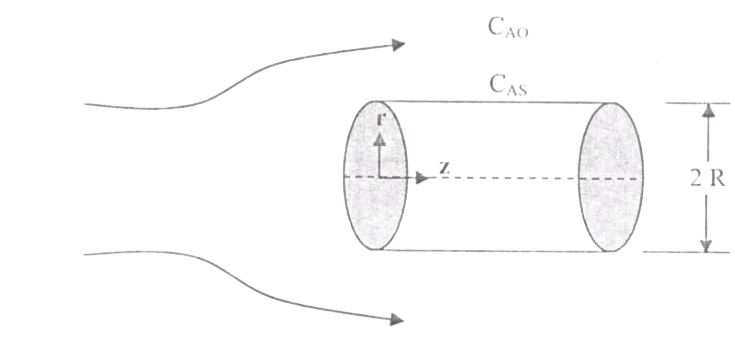
The irreversible zero order reaction \( A \rightarrow B \) takes place in a porous cylindrical catalyst that is sealed at both ends as shown in the figure. Assume dilute concentrations and neglect any variations in the axial direction.
The steady state concentration profile is
\[ \frac{C_A}{C_{AS}} = 1 + \frac{\phi_0^2}{4} \left[ \left( \frac{r}{R} \right)^2 - 1 \right] \]
where \( \phi_0 \) is the Thiele modulus. For \( \phi_0 = 4 \), the range of \( r \) where \( C_A = 0 \) is

Question diagram

Open complete paper
5
2009 · Chemical Engineering · Chemical Reaction Engineering · Heterogeneous Catalysis and Diffusion
Chemical Engineering (CH) 2009

For a solid-catalyzed reaction, the Thiele modulus is proportional to

Open complete paper
6
2009 · Chemical Engineering · Chemical Reaction Engineering · Heterogeneous Catalysis and Diffusion
Chemical Engineering (CH) 2009

The active component of catalysts used in steam reforming of methane to produce synthesis gas is

Open complete paper
7
2010 · Chemical Engineering · Chemical Reaction Engineering · Heterogeneous Catalysis and Diffusion
Chemical Engineering (CH) 2010
For a first order isothermal catalytic reaction, \( A \rightarrow P \), occurring in an infinitely long cylindrical pore, the relationship between effectiveness factor, \( \varepsilon \), and Thiele modulus, \( \phi \), is
Open complete paper
8
2011 · Chemical Engineering · Chemical Reaction Engineering · Heterogeneous Catalysis and Diffusion
Chemical Engineering (CH) 2011
Consider an irreversible, solid catalysed, liquid phase first order reaction. The diffusion and the reaction resistances are comparable. The overall rate constant (\(k_o\)) is related to the overall mass transfer coefficient (\(k_m\)) and the reaction rate constant (\(k\)) as
Open complete paper
9
2011 · Chemical Engineering · Chemical Reaction Engineering · Heterogeneous Catalysis and Diffusion
Chemical Engineering (CH) 2011
For a first order catalytic reaction the Thiele modulus (φ) of a spherical pellet is defined as
\[ \phi = \frac{R_p}{3} \sqrt{\frac{k \rho_p}{D_e}} \]
where
ρp = pellet density, Rp = pellet radius
De = effective diffusivity, k = first order reaction rate constant
If φ > 5, then the apparent activation energy (Ea) is related to the intrinsic (or true) activation energy (E) as
Open complete paper
10
2012 · Chemical Engineering · Chemical Reaction Engineering · Heterogeneous Catalysis and Diffusion
Chemical Engineering (CH) 2012
The rate-controlling step for the solid-catalyzed irreversible reaction \[ A + B \longrightarrow C \] is known to be the reaction of adsorbed \( A \) with adsorbed \( B \) to give adsorbed \( C \). If \( P_i \) is the partial pressure of component \( i \) and \( K_i \) is the adsorption equilibrium constant of component \( i \), then the form of the Langmuir-Hinshelwood rate expression will be
Open complete paper
11
2013 · Chemical Engineering · Chemical Reaction Engineering · Heterogeneous Catalysis and Diffusion
Chemical Engineering (CH) 2013
The overall rates of an isothermal catalytic reaction using spherical catalyst particles of diameters 1 mm and 2 mm are \(r_{A1}\) and \(r_{A2}\) (in mol (kg-catalyst)⁻¹ h⁻¹), respectively. The other physical properties of the catalyst particles are identical. If pore diffusion resistance is very high, the ratio \(r_{A2}/r_{A1}\) is __________
Open complete paper
12
2014 · Chemical Engineering · Chemical Reaction Engineering · Heterogeneous Catalysis and Diffusion
Chemical Engineering (CH) 2014
A vapour phase catalytic reaction (Q + R → S) follows Rideal mechanism (R and S are not adsorbed). Initially, the mixture contains only the reactants in equimolar ratio. The surface reaction step is rate controlling. With constants a and b, the initial rate of reaction (−r₀) in terms of total pressure (P_T) is given by
Open complete paper
13
2016 · Chemical Engineering · Chemical Reaction Engineering · Heterogeneous Catalysis and Diffusion
Chemical Engineering (CH) 2016
A porous pellet with Pt dispersed in it is used to carry out a catalytic reaction. Following two scenarios are possible.

Scenario 1: Pt present throughout the pores of the pellet is used for catalyzing the reaction.
Scenario 2: Pt present only in the immediate vicinity of the external surface of the pellet is used for catalyzing the reaction.

At a large value of Thiele modulus, which one of the following statements is TRUE?
Open complete paper
14
2017 · Chemical Engineering · Chemical Reaction Engineering · Heterogeneous Catalysis and Diffusion
Chemical Engineering (CH) 2017
Consider a first order catalytic reaction in a porous catalyst pellet.
Given \(R\) – characteristic length of the pellet; \(D_e\) – effective diffusivity; \(k_c\) – mass transfer coefficient; \(k_1\) – rate constant based on volume of the catalyst pellet; \(C_s\) – concentration of reactant on the pellet surface.
The expression for Thiele modulus is
Open complete paper
15
2017 · Chemical Engineering · Chemical Reaction Engineering · Heterogeneous Catalysis and Diffusion
Chemical Engineering (CH) 2017

For a solid-catalyzed gas phase reversible reaction, which of the following statements is ALWAYS TRUE?

Open complete paper
16
2018 · Chemical Engineering · Chemical Reaction Engineering · Heterogeneous Catalysis and Diffusion
Chemical Engineering (CH) 2018
Liquid phase isomerization of o-xylene to p-xylene using a zeolite catalyst was carried out in a CSTR. Three sets of kinetic data at different temperatures and stirring speeds were obtained as shown below.
set Aset Bset C
temperature (K)500500500600600600700700700
stirring speed (rpm)100020003000100020003000100020003000
reaction rate (mol L-1 s-1)0.0200.0250.0250.0370.0470.0470.0690.0780.086

The operating condition at which the reaction rate is not controlled by external mass transfer resistance is
Open complete paper
17
2019 · Chemical Engineering · Chemical Reaction Engineering · Heterogeneous Catalysis and Diffusion
Chemical Engineering (CH) 2019
For a first order reaction in a porous spherical catalyst pellet, diffusional effects are most likely to lower the observed rate of reaction for
Open complete paper
18
2020 · Chemical Engineering · Chemical Reaction Engineering · Heterogeneous Catalysis and Diffusion
Chemical Engineering (CH) 2020
The square of Thiele modulus, M_T, is given by M_T^2 = L^2 k / D_eff, where L is the characteristic length of the catalyst pellet, k is the rate constant of a first order reaction, and D_eff is the effective diffusivity of the species in the pores. M_T is a measure of
Open complete paper
19
2021 · Chemical Engineering · Chemical Reaction Engineering · Heterogeneous Catalysis and Diffusion
Chemical Engineering (CH) 2021
Ethylene adsorbs on the vacant active sites V of a transition metal catalyst according to the following mechanism.
\[ \mathrm{C_2H_4 + 2V \rightleftharpoons \begin{array}{c} \mathrm{C_2H_4} \\ | \\ \mathrm{V} \end{array} \begin{array}{c} \mathrm{C_2H_4} \\ | \\ \mathrm{V} \end{array} } \]
If \( N_T \), \( N_V \) and \( N_{C_2H_4} \) denote the total number of active sites, number of vacant active sites and number of adsorbed \( \mathrm{C_2H_4} \) molecules, respectively, the balance on the total number of active sites is given by
Open complete paper
20
2022 · Chemical Engineering · Chemical Reaction Engineering · Heterogeneous Catalysis and Diffusion
Chemical Engineering (CH) 2022
The reaction \( A \rightarrow B \) is carried out isothermally on a porous catalyst. The intrinsic reaction rate is \( kC_A^2 \), where \( k \) is the rate constant and \( C_A \) is the concentration of \( A \). If the reaction is strongly pore-diffusion controlled, the observed order of the reaction is
Open complete paper

Showing 20 of 26 questions