My Cart
Your Cart 0

    Your cart is empty.

  • Total (Amount) ₹0.00
Previous year question hub

Molecular tools - Recombinant DNA technology and Other Tools in Biotechnology - Biotechnology Previous Year Questions

Practice Molecular tools - Recombinant DNA technology and Other Tools in Biotechnology - Biotechnology previous year questions organised from real papers, with year-wise coverage and clear topic navigation.

16Papers
16Years
58Questions
1Topics

Molecular tools question pattern

Every graph below is calculated only from this selection.

Questions by year

Compare question counts across years.

Difficulty distribution

How the classified questions are distributed by difficulty.

Easy 41 70.7%
Medium 16 27.6%
Hard 1 1.7%

Question type distribution

MCQ, numerical, multiple-select and other formats found in these papers.

MCQ 50 86.2%
Numerical Answer Type (NAT) 6 10.3%
MSQ 2 3.4%

Subject weightage

Top subjects by unique question coverage.

Biotechnology
58 Qs

Most asked topics

Top topics across the included previous year papers.

Recombinant DNA technology and Other Tools in Biotechnology
58 Qs

Subtopic coverage

Top subtopics inside this exact selection.

Molecular tools
58 Qs

Paper coverage

Question coverage for the most populated papers. Every active PYP paper remains listed below.

Biotechnology (BT) 2026
2 Qs
Biotechnology (BT) 2025
1 Qs
Biotechnology (BT) 2024
3 Qs
Biotechnology (BT) 2023
3 Qs
Biotechnology (BT) 2022
3 Qs
Biotechnology (BT) 2021
6 Qs
Biotechnology (BT) 2020
3 Qs
Biotechnology (BT) 2019
4 Qs
Biotechnology (BT) 2018
3 Qs
Biotechnology (BT) 2017
4 Qs
Biotechnology (BT) 2016
2 Qs
Biotechnology (BT) 2014
2 Qs
Biotechnology (BT) 2013
6 Qs
Biotechnology (BT) 2012
5 Qs
Biotechnology (BT) 2011
5 Qs
Biotechnology (BT) 2010
6 Qs

Included previous year papers

Newest papers appear first. Search these papers or sort by year and name.

Paper nameYearPDFAttempt
Biotechnology (BT) 20262026
2 questions in this view
2026
Biotechnology (BT) 20252025
1 questions in this view
2025
Biotechnology (BT) 20242024
3 questions in this view
2024
Biotechnology (BT) 20232023
3 questions in this view
2023
Biotechnology (BT) 20222022
3 questions in this view
2022
Biotechnology (BT) 20212021
6 questions in this view
2021
Biotechnology (BT) 20202020
3 questions in this view
2020
Biotechnology (BT) 20192019
4 questions in this view
2019
Biotechnology (BT) 20182018
3 questions in this view
2018
Biotechnology (BT) 20172017
4 questions in this view
2017
Biotechnology (BT) 20162016
2 questions in this view
2016
Biotechnology (BT) 20142014
2 questions in this view
2014
Biotechnology (BT) 20132013
6 questions in this view
2013
Biotechnology (BT) 20122012
5 questions in this view
2012
Biotechnology (BT) 20112011
5 questions in this view
2011
Biotechnology (BT) 20102010
6 questions in this view
2010

All Molecular tools previous year questions

Practice every matching question in batches of 20, with every available option.

1
2013 · Biotechnology · Recombinant DNA technology and Other Tools in Biotechnology · Molecular tools
Biotechnology (BT) 2013

The first humanized monoclonal antibody approved for the treatment of breast cancers

Open complete paper
2
2013 · Biotechnology · Recombinant DNA technology and Other Tools in Biotechnology · Molecular tools
Biotechnology (BT) 2013

Human genome sequencing project involved the construction of genomic library in

Open complete paper
3
2013 · Biotechnology · Recombinant DNA technology and Other Tools in Biotechnology · Molecular tools
Biotechnology (BT) 2013

The nucleotide analogue used in DNA sequencing by chain termination method is

Open complete paper
4
2013 · Biotechnology · Recombinant DNA technology and Other Tools in Biotechnology · Molecular tools
Biotechnology (BT) 2013

Match the entries in Group I with the entries in Group II.

Group IGroup II
P. RNase P1. Polyadenylation
Q. RNase H2. Splicing
R. snRNAs3. Ribozymes
S. CstF4. DNA-RNA hybrids
Open complete paper
5
2013 · Biotechnology · Recombinant DNA technology and Other Tools in Biotechnology · Molecular tools
Biotechnology (BT) 2013
Match the entries in the Group I with the entries in Group II.
Open complete paper
6
2013 · Biotechnology · Recombinant DNA technology and Other Tools in Biotechnology · Molecular tools
Biotechnology (BT) 2013
A complete restriction digestion of a circular plasmid (5000bp) was carried out with HindIII, BamHI and EcoRI individually. Restriction digestion yielded following fragments.
Plasmid + HindIII → 1200bp and 3800bp
Plasmid + BamHI → 5000bp
Plasmid + EcoRI → 2500bp
The number of sites for EcoRI, BamHI and HindIII present on this plasmid are
Open complete paper
7
2014 · Biotechnology · Recombinant DNA technology and Other Tools in Biotechnology · Molecular tools
Biotechnology (BT) 2014

The statistical frequency of the occurrence of a particular restriction enzyme cleavage site that is 6 bases long can be estimated to be

Open complete paper
8
2014 · Biotechnology · Recombinant DNA technology and Other Tools in Biotechnology · Molecular tools
Biotechnology (BT) 2014
The plasmid DNA was subjected to restriction digestion using the enzyme EcoRI and analysed on an agarose gel. Assuming digestion has worked (the enzyme was active), match the identity of the DNA bands shown in the image in Group I with their identity in Group II.

Group I
P. Bands labeled as A
Q. Bands labeled as B
R. Bands labeled as C
S. Bands labeled as D

Group II
1. Nicked
2. Supercoiled
3. Concatemers
4. Linear

Question diagram

Open complete paper
9
2016 · Biotechnology · Recombinant DNA technology and Other Tools in Biotechnology · Molecular tools
Biotechnology (BT) 2016

Which one of the following is NOT a therapeutic agent based on nucleic acid for the treatment of genetic disorders?

Open complete paper
10
2016 · Biotechnology · Recombinant DNA technology and Other Tools in Biotechnology · Molecular tools
Biotechnology (BT) 2016
A variety of genetic elements are used in the transgenic plant research. Match the genetic elements (Column-I) with their corresponding source (Column-II).
Column-IColumn-II
P. Ubiquitin promoter1. Agrobacterium tumefaciens
Q. Nos transcriptional terminator2. Streptomyces hygroscopicus
R. bar selection marker gene3. Escherichia coli
S. gus reporter gene4. Zea mays
Open complete paper
11
2017 · Biotechnology · Recombinant DNA technology and Other Tools in Biotechnology · Molecular tools
Biotechnology (BT) 2017
A proto-oncogene is suspected to have undergone duplication in a certain type of cancer. Of the following techniques, which one would verify the gene duplication?
Open complete paper
12
2017 · Biotechnology · Recombinant DNA technology and Other Tools in Biotechnology · Molecular tools
Biotechnology (BT) 2017
A polymerase chain reaction (PCR) was set up with the following reagents: DNA template, Taq polymerase, buffer, dNTPs, and Mg2+. Which one of the following is missing in the reaction mixture?
Open complete paper
13
2017 · Biotechnology · Recombinant DNA technology and Other Tools in Biotechnology · Molecular tools
Biotechnology (BT) 2017

Which one of the following CANNOT be a recognition sequence for a Type II restriction enzyme?

Open complete paper
14
2017 · Biotechnology · Recombinant DNA technology and Other Tools in Biotechnology · Molecular tools
Biotechnology (BT) 2017
EcoRI restriction sites on a 10kb DNA fragment are shown below.
[Image: DNA fragment with EcoRI sites at 2kb, 4kb, and 7kb]
Upon partial digestion, what are the lengths (in kb) of all the possible DNA fragments obtained?

Question diagram

Open complete paper
15
2018 · Biotechnology · Recombinant DNA technology and Other Tools in Biotechnology · Molecular tools
Biotechnology (BT) 2018

Which one of the following techniques is used to monitor RNA transcripts, both temporally and spatially?

Open complete paper
16
2018 · Biotechnology · Recombinant DNA technology and Other Tools in Biotechnology · Molecular tools
Biotechnology (BT) 2018
Genomic DNA isolated from a bacterium was digested with a restriction enzyme that recognizes a 6-base pair (bp) sequence. Assuming random distribution of bases, the average length (in bp) of the fragments generated is __________
Open complete paper
17
2018 · Biotechnology · Recombinant DNA technology and Other Tools in Biotechnology · Molecular tools
Biotechnology (BT) 2018
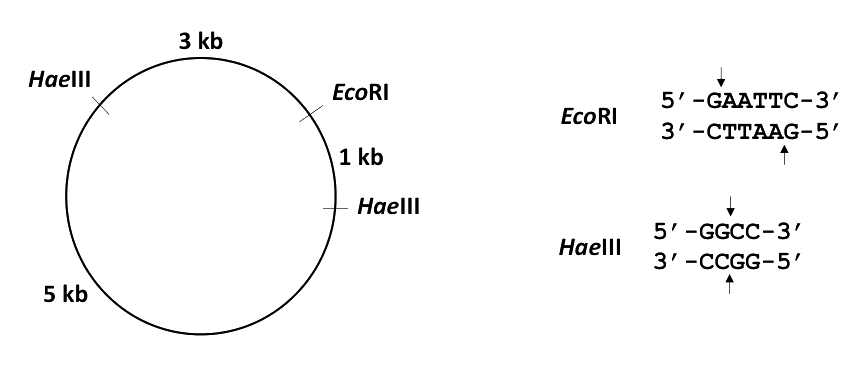
The product of complete digestion of the plasmid shown below with EcoRI and HaeIII was purified and used as a template in a reaction containing Klenow fragment of DNA polymerase, dNTPs and [α-³²P]-dATP in a suitable reaction buffer. The product thus obtained was purified and subjected to gel electrophoresis followed by autoradiography.
The number of bands that will appear on the X-ray film is ______

Question diagram

Open complete paper
18
2019 · Biotechnology · Recombinant DNA technology and Other Tools in Biotechnology · Molecular tools
Biotechnology (BT) 2019
For site-directed mutagenesis, which one of the following restriction enzymes is used to digest methylated DNA?
Open complete paper
19
2019 · Biotechnology · Recombinant DNA technology and Other Tools in Biotechnology · Molecular tools
Biotechnology (BT) 2019
Which of the following factors affect the fidelity of DNA polymerase in polymerase chain reaction?
P. Mg2+ concentration
Q. pH
R. Annealing temperature
Open complete paper
20
2019 · Biotechnology · Recombinant DNA technology and Other Tools in Biotechnology · Molecular tools
Biotechnology (BT) 2019
Antibody-producing hybridoma cells are generated by the fusion of a
Open complete paper

Showing 20 of 58 questions