Difficulty distribution
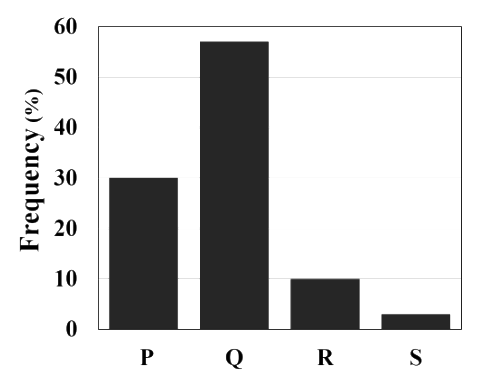
How the classified questions are distributed by difficulty.
Your cart is empty.
Practice Analytical tools - Recombinant DNA technology and Other Tools in Biotechnology - Biotechnology previous year questions organised from real papers, with year-wise coverage and clear topic navigation.
Every graph below is calculated only from this selection.
Compare question counts across years.
How the classified questions are distributed by difficulty.
MCQ, numerical, multiple-select and other formats found in these papers.
Top subjects by unique question coverage.
Top topics across the included previous year papers.
Top subtopics inside this exact selection.
Question coverage for the most populated papers. Every active PYP paper remains listed below.
Newest papers appear first. Search these papers or sort by year and name.
| Paper name | Year | Attempt | |
|---|---|---|---|
Biotechnology (BT) 20262026 | 2026 |
|
|
Biotechnology (BT) 20252025 | 2025 | |
|
Biotechnology (BT) 20242024 | 2024 | |
|
Biotechnology (BT) 20232023 | 2023 | |
|
Biotechnology (BT) 20222022 | 2022 | |
|
Biotechnology (BT) 20212021 | 2021 | |
|
Biotechnology (BT) 20192019 | 2019 | |
|
Biotechnology (BT) 20182018 | 2018 | |
|
Biotechnology (BT) 20172017 | 2017 | |
|
Biotechnology (BT) 20162016 | 2016 | |
|
Biotechnology (BT) 20122012 | 2012 | |
|
Biotechnology (BT) 20112011 | 2011 | |
|
Biotechnology (BT) 20102010 | 2010 | |
|
Practice every matching question in batches of 20, with every available option.
Which one of the following techniques relies on the spin angular momentum of a photon?


| Group I | Group II |
|---|---|
| P. Infrared | 1. Identification of functional groups |
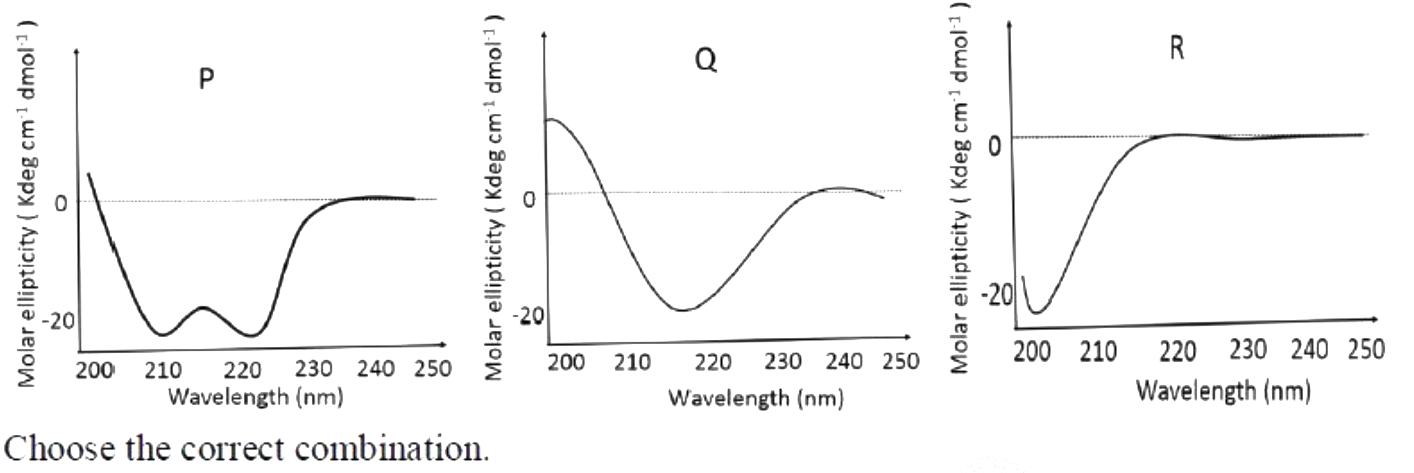
| Q. Circular Dichroism | 2. Determination of secondary structure |
| R. Nuclear Magnetic Resonance | 3. Estimation of molecular weight |
| 4. Determination of 3-D structure |
Match the stationary phase (Column I) with its corresponding chromatography technique (Column II).
| Column I | Column II |
|---|---|
| P. Protein A | 1. Size exclusion chromatography |
| Q. Sephadex | 2. Ion-exchange chromatography |
| R. Phenylsepharose | 3. Affinity chromatography |
| S. Diethylaminoethyl cellulose | 4. Hydrophobic interaction chromatography |
Which one of the following methods CANNOT be used to determine the secondary structure content of a protein?
| Column I | Column II |
|---|---|
| P. Blue laser | 1. Electron microscopy |
| Q. Tungsten filament | 2. Fluorescence activated cell sorting |
| R. \( ^{15}N \) labelled protein | 3. Electrophoresis |
| S. Polyacrylamide | 4. Nuclear magnetic resonance spectroscopy |
Which of the following methods is/are used for identifying histone modifications?
| Group I | Group II |
|---|---|
| P. Real Time-PCR | 1. Biochips |
| Q. 2-D Electrophoresis | 2. Syber Green |
| R. Affinity chromatography | 3. Antibody linked sephrose beads |
| S. Microarray | 4. Ampholytes |
Showing 20 of 22 questions