My Cart
Your Cart 0

    Your cart is empty.

  • Total (Amount) ₹0.00
Previous year question hub

Strength of materials - Structures - Aerospace Engineering Previous Year Questions

Practice Strength of materials - Structures - Aerospace Engineering previous year questions organised from real papers, with year-wise coverage and clear topic navigation.

20Papers
20Years
110Questions
1Topics

Strength of materials question pattern

Every graph below is calculated only from this selection.

Questions by year

Compare question counts across years.

Difficulty distribution

How the classified questions are distributed by difficulty.

Medium 59 53.6%
Easy 49 44.5%
Hard 2 1.8%
Question type distribution

MCQ, numerical, multiple-select and other formats found in these papers.

MCQ 56 50.9%
Numerical Answer Type (NAT) 44 40%
MSQ 9 8.2%
Fill in the blanks 1 0.9%

Subject weightage

Top subjects by unique question coverage.

Aerospace Engineering
110 Qs

Most asked topics

Top topics across the included previous year papers.

Structures
110 Qs

Subtopic coverage

Top subtopics inside this exact selection.

Strength of materials
110 Qs

Paper coverage

Question coverage for the most populated papers. Every active PYP paper remains listed below.

Aerospace Engineering (AE) 2026
7 Qs
Aerospace Engineering (AE) 2025
11 Qs
Aerospace Engineering (AE) 2024
8 Qs
Aerospace Engineering (AE) 2023
6 Qs
Aerospace Engineering (AE) 2022
11 Qs
Aerospace Engineering (AE) 2021
4 Qs
Aerospace Engineering (AE) 2020
10 Qs
Aerospace Engineering (AE) 2019
2 Qs
Aerospace Engineering (AE) 2018
6 Qs
Aerospace Engineering (AE) 2017
7 Qs
Aerospace Engineering (AE) 2016
9 Qs
Aerospace Engineering (AE) 2015
2 Qs
Aerospace Engineering (AE) 2014
6 Qs
Aerospace Engineering (AE) 2013
6 Qs
Aerospace Engineering (AE) 2012
5 Qs
Aerospace Engineering (AE) 2011
2 Qs
Aerospace Engineering (AE) 2010
3 Qs
Aerospace Engineering (AE) 2009
1 Qs
Aerospace Engineering (AE) 2008
1 Qs
Aerospace Engineering (AE) 2007
3 Qs

Included previous year papers

Newest papers appear first. Search these papers or sort by year and name.

Paper nameYearPDFAttempt
Aerospace Engineering (AE) 20262026
7 questions in this view
2026
Aerospace Engineering (AE) 20252025
11 questions in this view
2025
Aerospace Engineering (AE) 20242024
8 questions in this view
2024
Aerospace Engineering (AE) 20232023
6 questions in this view
2023
Aerospace Engineering (AE) 20222022
11 questions in this view
2022
Aerospace Engineering (AE) 20212021
4 questions in this view
2021
Aerospace Engineering (AE) 20202020
10 questions in this view
2020
Aerospace Engineering (AE) 20192019
2 questions in this view
2019
Aerospace Engineering (AE) 20182018
6 questions in this view
2018
Aerospace Engineering (AE) 20172017
7 questions in this view
2017
Aerospace Engineering (AE) 20162016
9 questions in this view
2016
Aerospace Engineering (AE) 20152015
2 questions in this view
2015
Aerospace Engineering (AE) 20142014
6 questions in this view
2014
Aerospace Engineering (AE) 20132013
6 questions in this view
2013
Aerospace Engineering (AE) 20122012
5 questions in this view
2012
Aerospace Engineering (AE) 20112011
2 questions in this view
2011
Aerospace Engineering (AE) 20102010
3 questions in this view
2010
Aerospace Engineering (AE) 20092009
1 questions in this view
2009
Aerospace Engineering (AE) 20082008
1 questions in this view
2008
Aerospace Engineering (AE) 20072007
3 questions in this view
2007

All Strength of materials previous year questions

Practice every matching question in batches of 20, with every available option.

1
2007 · Aerospace Engineering · Structures · Strength of materials
Aerospace Engineering (AE) 2007
For a plane strain problem in the \( x-y \) plane, in general, the non-zero stress terms are
Open complete paper
2
2007 · Aerospace Engineering · Structures · Strength of materials
Aerospace Engineering (AE) 2007

Total pressure at a point is defined as the pressure when the flow is brought to rest

Open complete paper
3
2007 · Aerospace Engineering · Structures · Strength of materials
Aerospace Engineering (AE) 2007
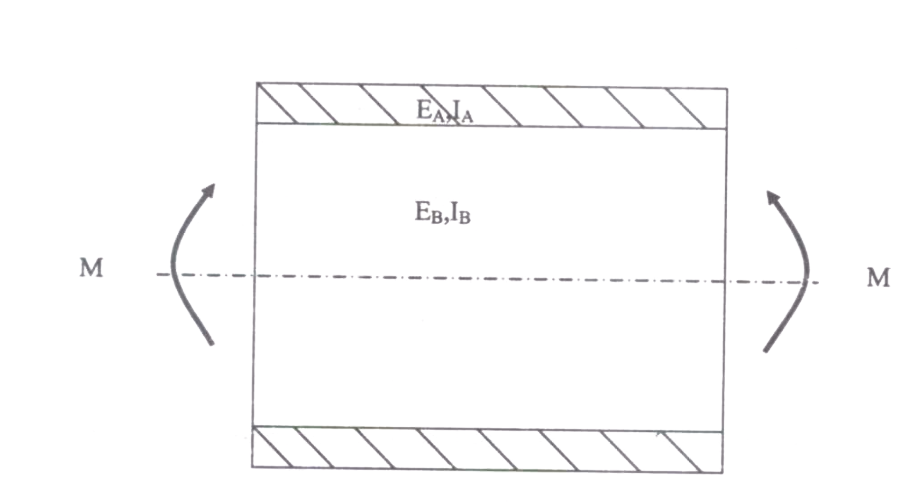
Shown in the figure below is a model of an Euler-Bernoulli beam made up of two materials subjected to pure bending moment M. The Young's modulus of material A and B are E_A and E_B respectively. The sectional moment of area, about the neutral axis, of the cross-sectional areas made of materials A and B, are I_A and I_B respectively. The radius of curvature ρ of the flexural deflection of this composite beam to the bending moment M is then

Question diagram

Open complete paper
4
2008 · Aerospace Engineering · Structures · Strength of materials
Aerospace Engineering (AE) 2008
In the absence of body moments, the symmetry of the stress tensor is derived from
Open complete paper
5
2009 · Aerospace Engineering · Structures · Strength of materials
Aerospace Engineering (AE) 2009
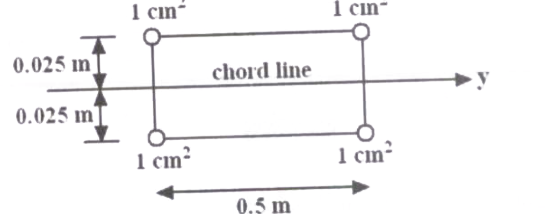
A wing root cross section is idealized using lumped areas (booms) as shown below.
The wing root bending moment in steady level flight is \(M_y = 10\) N-m. If the airplane flies at a load factor \(n = 3.5\), the maximum bending stress at the root is

Question diagram

Open complete paper
6
2010 · Aerospace Engineering · Structures · Strength of materials
Aerospace Engineering (AE) 2010
Isentropic efficiency \(\eta_d\) of a subsonic diffuser is defined as
(Note: 'a' represents the ambient, '2' represents the exit of the diffuser and 's' represents an isentropic process)
Open complete paper
7
2010 · Aerospace Engineering · Structures · Strength of materials
Aerospace Engineering (AE) 2010

For a flow across an oblique shock which of the following statements is true?

Open complete paper
8
2010 · Aerospace Engineering · Structures · Strength of materials
Aerospace Engineering (AE) 2010
What is the stagnation pressure at the inlet of the nozzle?
Open complete paper
9
2011 · Aerospace Engineering · Structures · Strength of materials
Aerospace Engineering (AE) 2011
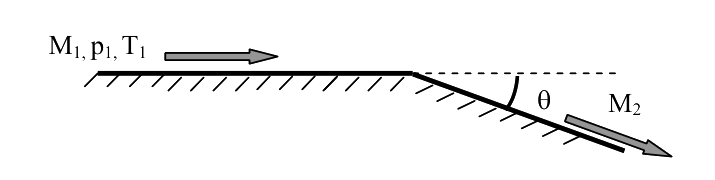
Consider the inviscid, adiabatic flow of air at free stream conditions, \( M_1 = 2 \), \( p_1 = 1 \) atm and \( T_1 = 288 \) K around a sharp expansion corner (\( \theta = 20^\circ \)) as shown below. The Prandtl-Meyer function, \( \nu \), is given as a function of Mach number, M, as \( \nu(M) = \sqrt{\frac{\gamma+1}{\gamma-1}} \tan^{-1} \sqrt{\frac{\gamma-1}{\gamma+1}(M^2-1)} - \tan^{-1} \sqrt{M^2-1} \). Assume air to be calorically perfect with \( \gamma = 1.4 \). The Mach number, \( M_2 \), downstream of the expansion corner is approximately

Question diagram

Open complete paper
10
2011 · Aerospace Engineering · Structures · Strength of materials
Aerospace Engineering (AE) 2011
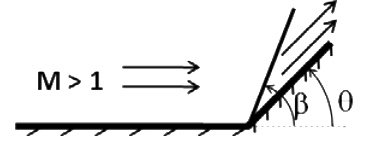
The shock angle \( \beta \) is

Question diagram

Open complete paper
11
2012 · Aerospace Engineering · Structures · Strength of materials
Aerospace Engineering (AE) 2012

The critical Mach number of an airfoil is attained when

Open complete paper
12
2012 · Aerospace Engineering · Structures · Strength of materials
Aerospace Engineering (AE) 2012

The shadowgraph flow visualization technique depends on

Open complete paper
13
2012 · Aerospace Engineering · Structures · Strength of materials
Aerospace Engineering (AE) 2012

The Mach angle for a flow at Mach 2.0 is

Open complete paper
14
2012 · Aerospace Engineering · Structures · Strength of materials
Aerospace Engineering (AE) 2012

The ideal static pressure coefficient of a diffuser with an area ratio of 2.0 is

Open complete paper
15
2012 · Aerospace Engineering · Structures · Strength of materials
Aerospace Engineering (AE) 2012
In a closed-circuit supersonic wind tunnel, the convergent-divergent (C-D) nozzle and test section are followed by a C-D diffuser to swallow the starting shock. Here, we should have the
Open complete paper
16
2014 · Aerospace Engineering · Structures · Strength of materials
Aerospace Engineering (AE) 2014

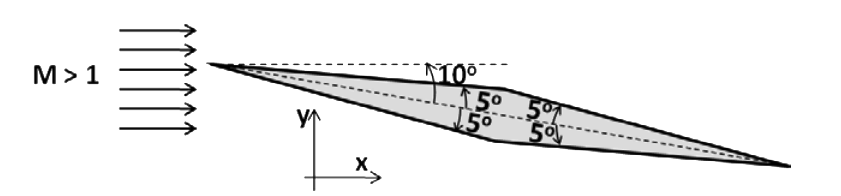
For inviscid, supersonic flow over a diamond shaped airfoil, shown in the figure, which statement is correct among the following?

Question diagram

Open complete paper
17
2014 · Aerospace Engineering · Structures · Strength of materials
Aerospace Engineering (AE) 2014
Consider supersonic flow near a corner (at an angle \( \theta \) from the horizontal) with an attached oblique shock (at an angle \( \beta \) with horizontal) as shown in figure. If Mach number \( M \) decreases gradually from a high supersonic value, which of the following statements is correct?

Question diagram

Open complete paper
18
2014 · Aerospace Engineering · Structures · Strength of materials
Aerospace Engineering (AE) 2014
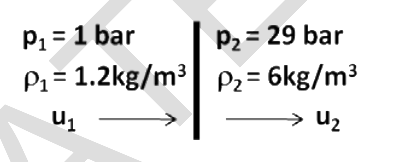
A student needs to find velocity across a stationary normal shock. He measures density and pressure across the shock as shown in the figure below. \(1\ bar = 10^5 Pa\). (No shock table is needed for the calculations). The value of \(u_1\) in m/s is ______.

Question diagram

Open complete paper
19
2014 · Aerospace Engineering · Structures · Strength of materials
Aerospace Engineering (AE) 2014
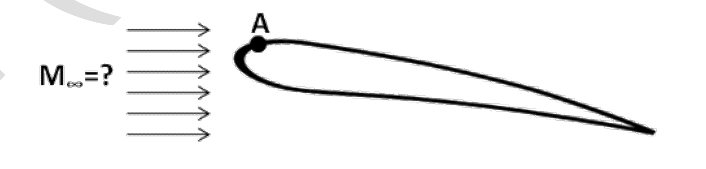
For inviscid, compressible flow past a thin airfoil, shown in the figure, free-stream Mach number and pressure are denoted by \(M_\infty\) and \(p_\infty\) respectively. Ratio of pressure at point A and \(p_\infty\) is 0.8 and specific heat ratio is 1.4. If the Mach number at point A is 1.0 and rest of the flow field is subsonic, the value of \(M_\infty\) is

Question diagram

Open complete paper
20
2014 · Aerospace Engineering · Structures · Strength of materials
Aerospace Engineering (AE) 2014
A cruise missile with an ideal ramjet engine is flying at Mach 4.0 at an altitude where the ambient temperature is 100K. Consider ratio of specific heats γ = 1.4 and specific gas constant R = 287 J/kgK. If the stagnation temperature in the combustion chamber is equal to 2310K, the speed of the exhaust gases (in m/s) is ______.
Open complete paper

Showing 20 of 110 questions