My Cart
Your Cart 0

    Your cart is empty.

  • Total (Amount) ₹0.00
Previous year question hub

Air Intakes and Nozzles - Propulsion - Aerospace Engineering Previous Year Questions

Practice Air Intakes and Nozzles - Propulsion - Aerospace Engineering previous year questions organised from real papers, with year-wise coverage and clear topic navigation.

1Papers
1Years
3Questions
1Topics

Air Intakes and Nozzles question pattern

Every graph below is calculated only from this selection.

Questions by year

Compare question counts across years.

Difficulty distribution

How the classified questions are distributed by difficulty.

Medium 3 100%

Question type distribution

MCQ, numerical, multiple-select and other formats found in these papers.

MCQ 1 33.3%
MSQ 1 33.3%
Numerical Answer Type (NAT) 1 33.3%

Subject weightage

Top subjects by unique question coverage.

Aerospace Engineering
3 Qs

Most asked topics

Top topics across the included previous year papers.

Propulsion
3 Qs

Subtopic coverage

Top subtopics inside this exact selection.

Air Intakes and Nozzles
3 Qs

Paper coverage

Question coverage for the most populated papers. Every active PYP paper remains listed below.

Aerospace Engineering (AE) 2026
3 Qs

Included previous year papers

Newest papers appear first. Search these papers or sort by year and name.

Paper nameYearPDFAttempt
Aerospace Engineering (AE) 20262026
3 questions in this view
2026

All Air Intakes and Nozzles previous year questions

Practice every matching question in batches of 20, with every available option.

1
2026 · Aerospace Engineering · Propulsion · Air Intakes and Nozzles
Aerospace Engineering (AE) 2026
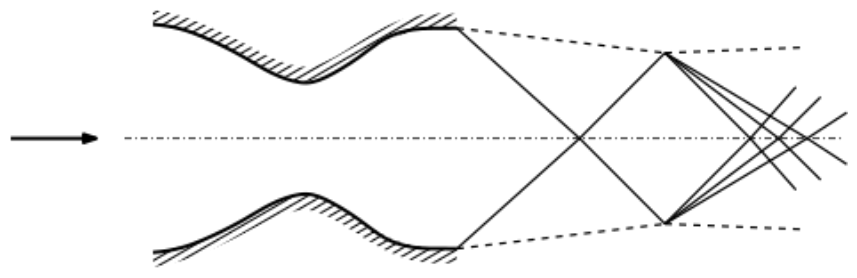
In the figure shown below, the flow at the nozzle exit is ______.

Question source image

Open complete paper
2
2026 · Aerospace Engineering · Propulsion · Air Intakes and Nozzles
Aerospace Engineering (AE) 2026
Which of the following process(es) is/are involved in the compression of air in an ideal ramjet engine?
Open complete paper
3
2026 · Aerospace Engineering · Propulsion · Air Intakes and Nozzles
Aerospace Engineering (AE) 2026
A Mach 1.5 air flow enters a round duct of length 20 cm and diameter 3 cm. If the flow exits with Mach number 1.1, the average Fanning friction factor \(f\) of the duct is __________ \(\times 10^{-3}\) (rounded off to 1 decimal place).
An excerpt from the Fanno flow table for air is given below.
\(M\)1.11.21.31.41.51.6
\(\frac{4fL^*}{D} \times 10^4\)99.35336.4648.3997.413611724
Open complete paper