My Cart
Your Cart 0

    Your cart is empty.

  • Total (Amount) ₹0.00
Previous year question hub

Space Dynamics - Flight Mechanics & Space Dynamics - Aerospace Engineering Previous Year Questions

Practice Space Dynamics - Flight Mechanics & Space Dynamics - Aerospace Engineering previous year questions organised from real papers, with year-wise coverage and clear topic navigation.

18Papers
18Years
39Questions
1Topics

Space Dynamics question pattern

Every graph below is calculated only from this selection.

Questions by year

Compare question counts across years.

Difficulty distribution

How the classified questions are distributed by difficulty.

Easy 27 69.2%
Medium 11 28.2%
Hard 1 2.6%
Question type distribution

MCQ, numerical, multiple-select and other formats found in these papers.

MCQ 24 61.5%
Numerical Answer Type (NAT) 13 33.3%
MSQ 2 5.1%

Subject weightage

Top subjects by unique question coverage.

Aerospace Engineering
39 Qs

Most asked topics

Top topics across the included previous year papers.

Flight Mechanics & Space Dynamics
39 Qs

Subtopic coverage

Top subtopics inside this exact selection.

Space Dynamics
39 Qs

Paper coverage

Question coverage for the most populated papers. Every active PYP paper remains listed below.

Aerospace Engineering (AE) 2026
2 Qs
Aerospace Engineering (AE) 2025
2 Qs
Aerospace Engineering (AE) 2024
3 Qs
Aerospace Engineering (AE) 2023
2 Qs
Aerospace Engineering (AE) 2022
1 Qs
Aerospace Engineering (AE) 2021
2 Qs
Aerospace Engineering (AE) 2020
3 Qs
Aerospace Engineering (AE) 2019
1 Qs
Aerospace Engineering (AE) 2018
4 Qs
Aerospace Engineering (AE) 2017
1 Qs
Aerospace Engineering (AE) 2016
1 Qs
Aerospace Engineering (AE) 2014
1 Qs
Aerospace Engineering (AE) 2012
1 Qs
Aerospace Engineering (AE) 2011
2 Qs
Aerospace Engineering (AE) 2010
2 Qs
Aerospace Engineering (AE) 2009
5 Qs
Aerospace Engineering (AE) 2008
3 Qs
Aerospace Engineering (AE) 2007
3 Qs

Included previous year papers

Newest papers appear first. Search these papers or sort by year and name.

Paper nameYearPDFAttempt
Aerospace Engineering (AE) 20262026
2 questions in this view
2026
Aerospace Engineering (AE) 20252025
2 questions in this view
2025
Aerospace Engineering (AE) 20242024
3 questions in this view
2024
Aerospace Engineering (AE) 20232023
2 questions in this view
2023
Aerospace Engineering (AE) 20222022
1 questions in this view
2022
Aerospace Engineering (AE) 20212021
2 questions in this view
2021
Aerospace Engineering (AE) 20202020
3 questions in this view
2020
Aerospace Engineering (AE) 20192019
1 questions in this view
2019
Aerospace Engineering (AE) 20182018
4 questions in this view
2018
Aerospace Engineering (AE) 20172017
1 questions in this view
2017
Aerospace Engineering (AE) 20162016
1 questions in this view
2016
Aerospace Engineering (AE) 20142014
1 questions in this view
2014
Aerospace Engineering (AE) 20122012
1 questions in this view
2012
Aerospace Engineering (AE) 20112011
2 questions in this view
2011
Aerospace Engineering (AE) 20102010
2 questions in this view
2010
Aerospace Engineering (AE) 20092009
5 questions in this view
2009
Aerospace Engineering (AE) 20082008
3 questions in this view
2008
Aerospace Engineering (AE) 20072007
3 questions in this view
2007

All Space Dynamics previous year questions

Practice every matching question in batches of 20, with every available option.

1
2007 · Aerospace Engineering · Flight Mechanics & Space Dynamics · Space Dynamics
Aerospace Engineering (AE) 2007
Two identical earth satellites A and B are in circular orbits at altitudes h_A and h_B above the earth's surface respectively, with h_A > h_B. If E denotes the total mechanical energy, T the kinetic energy and V the gravitational potential energy of a satellite, then:
Open complete paper
2
2007 · Aerospace Engineering · Flight Mechanics & Space Dynamics · Space Dynamics
Aerospace Engineering (AE) 2007
The lateral-directional characteristic equation for an airplane gave the following set of roots: λ_1 = -0.6, λ_2 = -0.002, λ_3,4 = -0.06 ± j1.5, where j = √-1. The damping ratio corresponding to the Dutch-roll mode will be
Open complete paper
3
2007 · Aerospace Engineering · Flight Mechanics & Space Dynamics · Space Dynamics
Aerospace Engineering (AE) 2007

The on-board rocket motor of a satellite of initial mass 2000 kg provides a specific impulse of 280 seconds. If this motor is fired to give a speed increment of 500 m/s along the direction of motion, the mass of propellant consumed is:

Open complete paper
4
2008 · Aerospace Engineering · Flight Mechanics & Space Dynamics · Space Dynamics
Aerospace Engineering (AE) 2008
To transfer a satellite from an elliptical orbit to a circular orbit having radius equal to the apogee distance of the elliptical orbit, the speed of the satellite should be
Open complete paper
5
2008 · Aerospace Engineering · Flight Mechanics & Space Dynamics · Space Dynamics
Aerospace Engineering (AE) 2008
Which of the following quantities remains constant for a satellite in an elliptical orbit around the earth?
Open complete paper
6
2008 · Aerospace Engineering · Flight Mechanics & Space Dynamics · Space Dynamics
Aerospace Engineering (AE) 2008
In the definition of the aircraft Euler angles \(\phi\) (roll), \(\theta\) (pitch), and \(\psi\) (yaw), the correct sequence of rotations required to make the inertial frame coincide with the aircraft body frame is
Open complete paper
7
2009 · Aerospace Engineering · Flight Mechanics & Space Dynamics · Space Dynamics
Aerospace Engineering (AE) 2009

The life of a geo-stationary communications satellite is limited by

Open complete paper
8
2009 · Aerospace Engineering · Flight Mechanics & Space Dynamics · Space Dynamics
Aerospace Engineering (AE) 2009
Let \(M_0\) be the total mass of a single stage rocket, \(M_P\) be the total mass of propellant, \(M_L\) be the mass of payload carried by the rocket and \(M_S\) be the mass of inert structural components. If \(I_{sp}\) is the specific impulse of the propulsion system (in seconds) and \(g\) is the acceleration due to gravity, then the maximum velocity that can be attained by the rocket vehicle in the absence of gravity and atmospheric drag is given by
Open complete paper
9
2009 · Aerospace Engineering · Flight Mechanics & Space Dynamics · Space Dynamics
Aerospace Engineering (AE) 2009

An airplane flying at 100 m/s is pitching at the rate of 0.2 deg/s. Due to this pitching, the horizontal tail surface located 4 metres behind the centre-of-mass of the airplane will experience a change in angle of attack, which is

Open complete paper
10
2009 · Aerospace Engineering · Flight Mechanics & Space Dynamics · Space Dynamics
Aerospace Engineering (AE) 2009
The linearized dynamics of an aircraft (which has no large rotating components) in straight and level flight is governed by the equations \[\frac{d\vec{x}}{dt} = \begin{bmatrix} [A] & [B] \\ [C] & [D] \end{bmatrix} \vec{x}\] where \(\vec{x} = [u \; w \; q \; \theta \; v \; p \; r \; \phi]^T\), \([\;]^T\) represents the transpose of a matrix, \([A], [B], [C]\) and \([D]\) are 4×4 matrices and \([0]\) is the 4×4 null matrix. Which of the following is true ?
Open complete paper
11
2009 · Aerospace Engineering · Flight Mechanics & Space Dynamics · Space Dynamics
Aerospace Engineering (AE) 2009
The velocity vector of an aircraft along its body-fixed axis is given by \(\vec{V} = \begin{bmatrix} u \\ v \\ w \end{bmatrix}\). If \(V\) is the magnitude of \(\vec{V}\), \(\alpha\) is the angle of attack and \(\beta\) is the angle of sideslip, which of the following set of relations is correct ?
Open complete paper
12
2010 · Aerospace Engineering · Flight Mechanics & Space Dynamics · Space Dynamics
Aerospace Engineering (AE) 2010
The angular momentum, about the centre of mass of the earth, of an artificial satellite in a highly elliptical orbit is :
Open complete paper
13
2010 · Aerospace Engineering · Flight Mechanics & Space Dynamics · Space Dynamics
Aerospace Engineering (AE) 2010
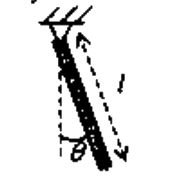
A uniform cross-section rigid rod of mass \(m\) and length \(l\) is hinged at its upper end and suspended like a pendulum. Its natural frequency for small oscillations is

Question diagram

Open complete paper
14
2011 · Aerospace Engineering · Flight Mechanics & Space Dynamics · Space Dynamics
Aerospace Engineering (AE) 2011

For an airplane to be statically stable, its centre of gravity must always be

Open complete paper
15
2011 · Aerospace Engineering · Flight Mechanics & Space Dynamics · Space Dynamics
Aerospace Engineering (AE) 2011
An elliptic orbit has its perigee at 400 km above the Earth’s surface and apogee at 3400 km above the Earth’s surface. For this orbit, the eccentricity and semi-major axis respectively are (assume radius of Earth = 6400 km)
Open complete paper
16
2012 · Aerospace Engineering · Flight Mechanics & Space Dynamics · Space Dynamics
Aerospace Engineering (AE) 2012
The maximum distance that the centre of gravity can be behind aerodynamic centre without destabilizing the wing-tail combination is
Open complete paper
17
2014 · Aerospace Engineering · Flight Mechanics & Space Dynamics · Space Dynamics
Aerospace Engineering (AE) 2014
Considering \(R\) as the radius of the moon, the ratio of the velocities of two spacecraft orbiting moon in circular orbit at altitudes \(R\) and \(2R\) above the surface of the moon is ______.
Open complete paper
18
2016 · Aerospace Engineering · Flight Mechanics & Space Dynamics · Space Dynamics
Aerospace Engineering (AE) 2016
A satellite is injected at an altitude of 350 km above the Earth’s surface, with a velocity of 8.0 km/s parallel to the local horizon. (Earth radius=6378 km, \(\mu_E\) (GM=Gravitational constant × Earth mass) = 3.986×10⁵ km³/s²). The satellite
Open complete paper
19
2017 · Aerospace Engineering · Flight Mechanics & Space Dynamics · Space Dynamics
Aerospace Engineering (AE) 2017
The period of revolution of earth about the sun is 365.256 days, approximately. The semi-major axis of the earth’s orbit is close to 1.4953 x 10¹¹ m. The semi-major axis of the orbit of Mars is 2.2783 x 10¹¹ m. The period of revolution of Mars, about the sun, is ________ Earth days (in three decimal place)
Open complete paper
20
2018 · Aerospace Engineering · Flight Mechanics & Space Dynamics · Space Dynamics
Aerospace Engineering (AE) 2018
The tangential velocity component ‘\( V \)’ of a spacecraft, which is in a circular orbit of radius ‘\( R \)’ around a spherical Earth (\( \mu = GM \) → gravitational parameter of Earth) is given by the following expression.
Open complete paper

Showing 20 of 39 questions