My Cart
Your Cart 0

    Your cart is empty.

  • Total (Amount) ₹0.00
Previous year question hub

Numerical Methods - Engineering Mathematics - Aerospace Engineering Previous Year Questions

Practice Numerical Methods - Engineering Mathematics - Aerospace Engineering previous year questions organised from real papers, with year-wise coverage and clear topic navigation.

13Papers
13Years
15Questions
1Topics

Numerical Methods question pattern

Every graph below is calculated only from this selection.

Questions by year

Compare question counts across years.

Difficulty distribution

How the classified questions are distributed by difficulty.

Easy 12 80%
Medium 3 20%

Question type distribution

MCQ, numerical, multiple-select and other formats found in these papers.

Numerical Answer Type (NAT) 7 46.7%
MCQ 6 40%
MSQ 2 13.3%

Subject weightage

Top subjects by unique question coverage.

Aerospace Engineering
15 Qs

Most asked topics

Top topics across the included previous year papers.

Engineering Mathematics
15 Qs

Subtopic coverage

Top subtopics inside this exact selection.

Numerical Methods
15 Qs

Paper coverage

Question coverage for the most populated papers. Every active PYP paper remains listed below.

Aerospace Engineering (AE) 2025
1 Qs
Aerospace Engineering (AE) 2024
1 Qs
Aerospace Engineering (AE) 2021
2 Qs
Aerospace Engineering (AE) 2020
1 Qs
Aerospace Engineering (AE) 2019
1 Qs
Aerospace Engineering (AE) 2017
1 Qs
Aerospace Engineering (AE) 2016
1 Qs
Aerospace Engineering (AE) 2014
1 Qs
Aerospace Engineering (AE) 2012
1 Qs
Aerospace Engineering (AE) 2011
1 Qs
Aerospace Engineering (AE) 2010
1 Qs
Aerospace Engineering (AE) 2009
1 Qs
Aerospace Engineering (AE) 2007
2 Qs

Included previous year papers

Newest papers appear first. Search these papers or sort by year and name.

Paper nameYearPDFAttempt
Aerospace Engineering (AE) 20252025
1 questions in this view
2025
Aerospace Engineering (AE) 20242024
1 questions in this view
2024
Aerospace Engineering (AE) 20212021
2 questions in this view
2021
Aerospace Engineering (AE) 20202020
1 questions in this view
2020
Aerospace Engineering (AE) 20192019
1 questions in this view
2019
Aerospace Engineering (AE) 20172017
1 questions in this view
2017
Aerospace Engineering (AE) 20162016
1 questions in this view
2016
Aerospace Engineering (AE) 20142014
1 questions in this view
2014
Aerospace Engineering (AE) 20122012
1 questions in this view
2012
Aerospace Engineering (AE) 20112011
1 questions in this view
2011
Aerospace Engineering (AE) 20102010
1 questions in this view
2010
Aerospace Engineering (AE) 20092009
1 questions in this view
2009
Aerospace Engineering (AE) 20072007
2 questions in this view
2007

All Numerical Methods previous year questions

Practice every matching question in batches of 20, with every available option.

1
2007 · Aerospace Engineering · Engineering Mathematics · Numerical Methods
Aerospace Engineering (AE) 2007
The Euler iteration formula for numerically integrating a first order nonlinear differential equation of the form \( \dot{x} = f(x) \), with a constant step size of \( \Delta t \) is
Open complete paper
2
2007 · Aerospace Engineering · Engineering Mathematics · Numerical Methods
Aerospace Engineering (AE) 2007
The Newton-Raphson iteration formula to find a cube root of a positive number \( c \) is
Open complete paper
3
2009 · Aerospace Engineering · Engineering Mathematics · Numerical Methods
Aerospace Engineering (AE) 2009
The value of the integral \(\int_0^{\pi} \frac{dx}{1+\sin x}\) evaluated using the trapezoidal rule with two equal intervals is approximately
Open complete paper
4
2010 · Aerospace Engineering · Engineering Mathematics · Numerical Methods
Aerospace Engineering (AE) 2010
In finding a root of the equation: \(x^2 - 6x + 5 = 0\) the Newton-Raphson method achieves an order of convergence equal to:
Open complete paper
5
2011 · Aerospace Engineering · Engineering Mathematics · Numerical Methods
Aerospace Engineering (AE) 2011
Consider the function \( f(x) = x - \sin(x) \). The Newton-Raphson iteration formula to find the root of the function starting from an initial guess \( x^{(0)} \) at iteration \( k \) is
Open complete paper
6
2012 · Aerospace Engineering · Engineering Mathematics · Numerical Methods
Aerospace Engineering (AE) 2012
The integration \(\int_0^1 x^3 dx\) computed using trapezoidal rule with \(n = 4\) intervals is ____.
Open complete paper
7
2014 · Aerospace Engineering · Engineering Mathematics · Numerical Methods
Aerospace Engineering (AE) 2014
The value of \( I = \int_0^1 1000 x^4 dx \), obtained by using Simpson’s rule with 2 equally spaced intervals is,
Open complete paper
8
2016 · Aerospace Engineering · Engineering Mathematics · Numerical Methods
Aerospace Engineering (AE) 2016
Use Newton-Raphson method to solve the equation: \(x e^x = 1\). Begin with the initial guess \(x_0 = 0.5\). The solution after one step is x = ______.
Open complete paper
9
2017 · Aerospace Engineering · Engineering Mathematics · Numerical Methods
Aerospace Engineering (AE) 2017
3-point Gaussian integration formula is given by: \(\int_{-1}^1 f(x)dx \approx \sum_{j=1}^3 A_j f(x_j)\) with \(x_1 = 0, x_2 = -x_3 = -\sqrt{\frac{3}{5}}, A_1 = \frac{8}{9}, A_2 = A_3 = \frac{5}{9}\). This formula exactly integrates
Open complete paper
10
2019 · Aerospace Engineering · Engineering Mathematics · Numerical Methods
Aerospace Engineering (AE) 2019

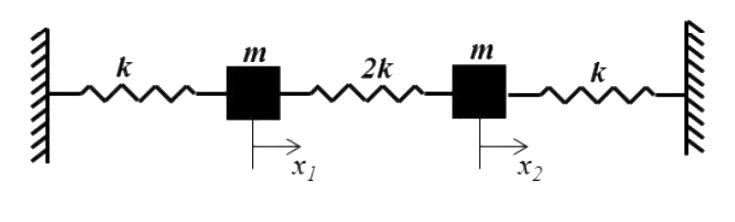
For the system of springs and masses shown below, k = 1250 N/m and m = 10 kg. The highest natural frequency, α of the system is ___ radians/s (round off to the nearest integer).

Question diagram

Open complete paper
11
2020 · Aerospace Engineering · Engineering Mathematics · Numerical Methods
Aerospace Engineering (AE) 2020
If \(\int_{0}^{1} (x^3 - 2x + 1) dx\) is evaluated numerically using trapezoidal rule with four intervals, the difference between the numerically evaluated value and the analytical value of the integral is equal to ____ (round off to three decimal places).
Open complete paper
12
2021 · Aerospace Engineering · Engineering Mathematics · Numerical Methods
Aerospace Engineering (AE) 2021
A two degree of freedom spring-mass system undergoing free vibration with generalized coordinates \( x_1 \) and \( x_2 \) has natural frequencies \( \omega_1 = 233.9 \) rad/s and \( \omega_2 = 324.5 \) rad/s, respectively. The corresponding mode shapes are \( \phi_1 = \begin{bmatrix} 1 \\ -3.16 \end{bmatrix} \) and \( \phi_2 = \begin{bmatrix} 1 \\ 3.16 \end{bmatrix} \). If the system is disturbed with certain deflections and zero initial velocities, then which of the following statement(s) is/are true?
Open complete paper
13
2021 · Aerospace Engineering · Engineering Mathematics · Numerical Methods
Aerospace Engineering (AE) 2021
The definite integral \( \int_1^5 x^3 dx \) is evaluated using four equal intervals by two methods – first by the trapezoidal rule and then by the Simpson’s one-third rule. The absolute value of the difference between the two calculations is _____ (round off to two decimal places).
Open complete paper
14
2024 · Aerospace Engineering · Engineering Mathematics · Numerical Methods
Aerospace Engineering (AE) 2024
Using Trapezoidal rule with one interval, the approximate value of the definite integral: \[ \int_{1}^{2} \frac{dx}{1+x^2} = \_\_\_\_ \] (rounded off to 2 decimal places).
Open complete paper
15
2025 · Aerospace Engineering · Engineering Mathematics · Numerical Methods
Aerospace Engineering (AE) 2025
An approximate solution of the equation \(x^3 - 17 = 0\) is to be obtained using the Newton-Raphson method. If the initial guess is \(x_0 = 2\), the value at the end of the first iteration is \(x_1 = \) ____ (rounded off to two decimal places).
Open complete paper