My Cart
Your Cart 0

    Your cart is empty.

  • Total (Amount) ₹0.00
Previous year question hub

Two-dimensional potential flow theory - Aerodynamics - Aerospace Engineering Previous Year Questions

Practice Two-dimensional potential flow theory - Aerodynamics - Aerospace Engineering previous year questions organised from real papers, with year-wise coverage and clear topic navigation.

12Papers
12Years
16Questions
1Topics

Two-dimensional potential flow theory question pattern

Every graph below is calculated only from this selection.

Questions by year

Compare question counts across years.

Difficulty distribution

How the classified questions are distributed by difficulty.

Medium 8 50%
Easy 8 50%

Question type distribution

MCQ, numerical, multiple-select and other formats found in these papers.

MCQ 13 81.3%
Numerical Answer Type (NAT) 2 12.5%
MSQ 1 6.3%

Subject weightage

Top subjects by unique question coverage.

Aerospace Engineering
16 Qs

Most asked topics

Top topics across the included previous year papers.

Aerodynamics
16 Qs

Subtopic coverage

Top subtopics inside this exact selection.

Two-dimensional potential flow theory
16 Qs

Paper coverage

Question coverage for the most populated papers. Every active PYP paper remains listed below.

Aerospace Engineering (AE) 2026
3 Qs
Aerospace Engineering (AE) 2025
2 Qs
Aerospace Engineering (AE) 2024
1 Qs
Aerospace Engineering (AE) 2023
2 Qs
Aerospace Engineering (AE) 2022
1 Qs
Aerospace Engineering (AE) 2020
1 Qs
Aerospace Engineering (AE) 2018
1 Qs
Aerospace Engineering (AE) 2016
1 Qs
Aerospace Engineering (AE) 2010
1 Qs
Aerospace Engineering (AE) 2009
1 Qs
Aerospace Engineering (AE) 2008
1 Qs
Aerospace Engineering (AE) 2007
1 Qs

Included previous year papers

Newest papers appear first. Search these papers or sort by year and name.

Paper nameYearPDFAttempt
Aerospace Engineering (AE) 20262026
3 questions in this view
2026
Aerospace Engineering (AE) 20252025
2 questions in this view
2025
Aerospace Engineering (AE) 20242024
1 questions in this view
2024
Aerospace Engineering (AE) 20232023
2 questions in this view
2023
Aerospace Engineering (AE) 20222022
1 questions in this view
2022
Aerospace Engineering (AE) 20202020
1 questions in this view
2020
Aerospace Engineering (AE) 20182018
1 questions in this view
2018
Aerospace Engineering (AE) 20162016
1 questions in this view
2016
Aerospace Engineering (AE) 20102010
1 questions in this view
2010
Aerospace Engineering (AE) 20092009
1 questions in this view
2009
Aerospace Engineering (AE) 20082008
1 questions in this view
2008
Aerospace Engineering (AE) 20072007
1 questions in this view
2007

All Two-dimensional potential flow theory previous year questions

Practice every matching question in batches of 20, with every available option.

1
2007 · Aerospace Engineering · Aerodynamics · Two-dimensional potential flow theory
Aerospace Engineering (AE) 2007
A circular cylinder is placed in a uniform stream of ideal fluid with its axis normal to the flow. Relative to the forward stagnation point, the angular positions along the circumference where the speed along the surface of the cylinder is equal to the free stream speed are
Open complete paper
2
2008 · Aerospace Engineering · Aerodynamics · Two-dimensional potential flow theory
Aerospace Engineering (AE) 2008
Consider 2-D flow with stream function \(\psi = \frac{1}{2} \ln (\sqrt{x^2 + y^2})\). The absolute value of circulation along a unit circle centered at \((x=0, y=0)\) is
Open complete paper
3
2009 · Aerospace Engineering · Aerodynamics · Two-dimensional potential flow theory
Aerospace Engineering (AE) 2009

For two-dimensional irrotational and incompressible flows

Open complete paper
4
2010 · Aerospace Engineering · Aerodynamics · Two-dimensional potential flow theory
Aerospace Engineering (AE) 2010
If \(\phi\) is the potential function for an incompressible irrotational flow, and u and v are the Cartesian velocity components, then which one of the following combinations is correct?
Open complete paper
5
2016 · Aerospace Engineering · Aerodynamics · Two-dimensional potential flow theory
Aerospace Engineering (AE) 2016
The maximum value of coefficient of lift (\( C_l \)) for a 2D circular cylinder, provided at least one stagnation point lies on the cylinder surface, is predicted by the potential flow theory to be
Open complete paper
6
2018 · Aerospace Engineering · Aerodynamics · Two-dimensional potential flow theory
Aerospace Engineering (AE) 2018

In a low-speed wind tunnel, the angular location(s) from the front stagnation point on a circular cylinder where the static pressure equals the free-stream static pressure, is

Open complete paper
7
2020 · Aerospace Engineering · Aerodynamics · Two-dimensional potential flow theory
Aerospace Engineering (AE) 2020
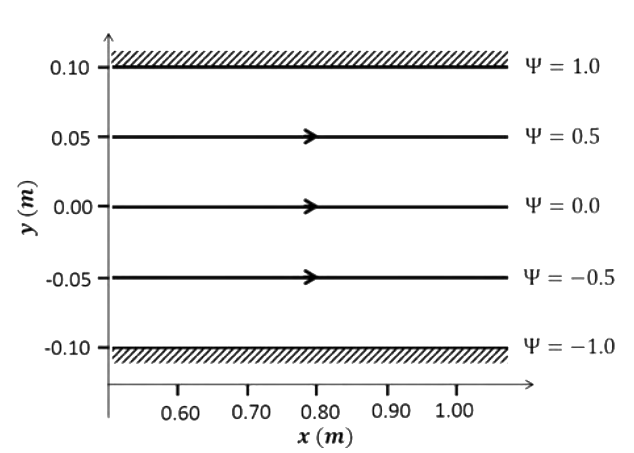
A pair of infinitely long, counter-rotating line vortices of the same circulation strength \( \Gamma \) are situated a distance \( h \) apart in a fluid, as shown in the figure. The vortices will

Question diagram

Open complete paper
8
2022 · Aerospace Engineering · Aerodynamics · Two-dimensional potential flow theory
Aerospace Engineering (AE) 2022
Consider a two-dimensional potential flow over a cylinder. If the freestream speed is $U_\infty$, the maximum speed on the cylinder surface is
Open complete paper
9
2023 · Aerospace Engineering · Aerodynamics · Two-dimensional potential flow theory
Aerospace Engineering (AE) 2023

In a two-dimensional potential flow, the doublet is a limit of the superposition of

Open complete paper
10
2023 · Aerospace Engineering · Aerodynamics · Two-dimensional potential flow theory
Aerospace Engineering (AE) 2023
In a potential flow, a uniform stream of strength \(U\) directed along the x-axis and four line sources (2-dimensional) of strengths \(\frac{\pi}{2}\), \(-\frac{\pi}{3}\), \(\frac{\pi}{4}\), \(-\frac{\pi}{5}\) are placed along the x-axis at \(x = 0, 1, 2, 3\), respectively. The strength of an additional line source to be placed at \(x = 4\) such that a closed streamline encircles all five sources is _____. (round off to two decimal places).
Open complete paper
11
2024 · Aerospace Engineering · Aerodynamics · Two-dimensional potential flow theory
Aerospace Engineering (AE) 2024
In the context of steady, inviscid, incompressible flows, consider the superposition of a uniform flow with speed \( U \) along the positive x-axis (from left to right), and a source of strength \( A \) located at the origin. Which one of the following statements is NOT true regarding the location of the stagnation point of the resulting flow?
Open complete paper
12
2025 · Aerospace Engineering · Aerodynamics · Two-dimensional potential flow theory
Aerospace Engineering (AE) 2025
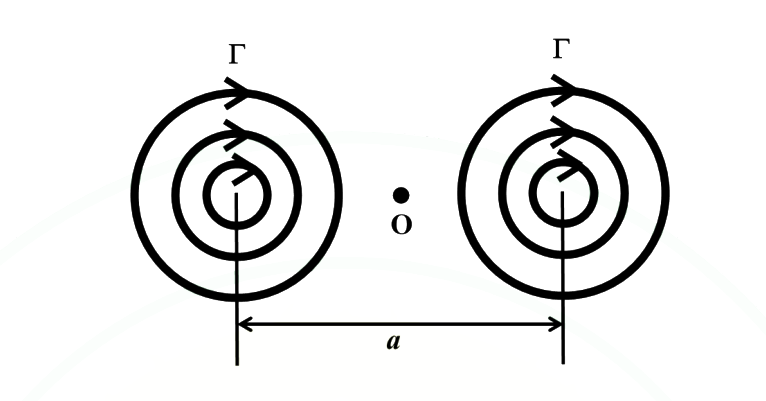
Consider a pair of point vortices with clockwise circulation \(\Gamma\) each. The distance between their centers is \(a\), as shown in the figure. Assume two-dimensional, incompressible, inviscid flow. Which one of the following options is correct?

Question diagram

Open complete paper
13
2025 · Aerospace Engineering · Aerodynamics · Two-dimensional potential flow theory
Aerospace Engineering (AE) 2025
The lift per unit span for a spinning circular cylinder in a potential flow is 6 N/m. The free-stream velocity is 30 m/s, and the density of air is 1.225 kg/m³. The circulation around the cylinder is ____ m²/s (rounded off to two decimal places).
Open complete paper
14
2026 · Aerospace Engineering · Aerodynamics · Two-dimensional potential flow theory
Aerospace Engineering (AE) 2026

In fluid dynamics, d’Alembert’s paradox refers to which one of the following?

Open complete paper
15
2026 · Aerospace Engineering · Aerodynamics · Two-dimensional potential flow theory
Aerospace Engineering (AE) 2026
The velocity potential function \( (\varphi) \) given below represents which one of the following? \[ \varphi = 5x - 12y \]
Open complete paper
16
2026 · Aerospace Engineering · Aerodynamics · Two-dimensional potential flow theory
Aerospace Engineering (AE) 2026
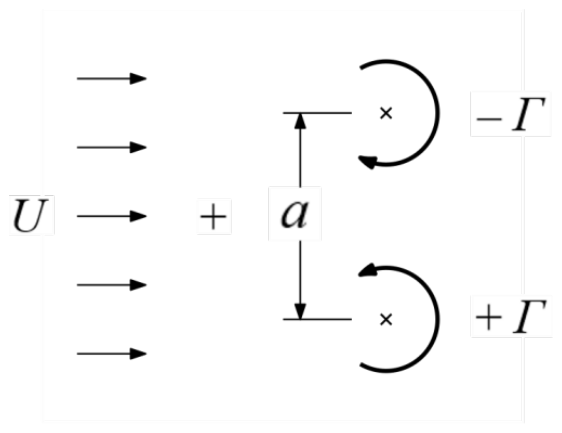
Consider the flow over an oval modeled using the elementary potential flows as shown below. U represents uniform flow velocity and Γ represents circulation around an irrotational line vortex.

Which of the following statements is/are TRUE for this model?

Question source image

Open complete paper