My Cart
Your Cart 0

    Your cart is empty.

  • Total (Amount) ₹0.00
Previous year question hub

Elementary ideas of viscous flows - Aerodynamics - Aerospace Engineering Previous Year Questions

Practice Elementary ideas of viscous flows - Aerodynamics - Aerospace Engineering previous year questions organised from real papers, with year-wise coverage and clear topic navigation.

17Papers
17Years
31Questions
1Topics

Elementary ideas of viscous flows question pattern

Every graph below is calculated only from this selection.

Questions by year

Compare question counts across years.

Difficulty distribution

How the classified questions are distributed by difficulty.

Easy 15 48.4%
Medium 15 48.4%
Hard 1 3.2%
Question type distribution

MCQ, numerical, multiple-select and other formats found in these papers.

MCQ 25 80.6%
Numerical Answer Type (NAT) 6 19.4%

Subject weightage

Top subjects by unique question coverage.

Aerospace Engineering
31 Qs

Most asked topics

Top topics across the included previous year papers.

Aerodynamics
31 Qs

Subtopic coverage

Top subtopics inside this exact selection.

Elementary ideas of viscous flows
31 Qs

Paper coverage

Question coverage for the most populated papers. Every active PYP paper remains listed below.

Aerospace Engineering (AE) 2025
1 Qs
Aerospace Engineering (AE) 2024
1 Qs
Aerospace Engineering (AE) 2023
1 Qs
Aerospace Engineering (AE) 2022
2 Qs
Aerospace Engineering (AE) 2021
3 Qs
Aerospace Engineering (AE) 2020
1 Qs
Aerospace Engineering (AE) 2019
2 Qs
Aerospace Engineering (AE) 2018
1 Qs
Aerospace Engineering (AE) 2017
1 Qs
Aerospace Engineering (AE) 2016
2 Qs
Aerospace Engineering (AE) 2014
4 Qs
Aerospace Engineering (AE) 2013
2 Qs
Aerospace Engineering (AE) 2012
4 Qs
Aerospace Engineering (AE) 2011
1 Qs
Aerospace Engineering (AE) 2010
3 Qs
Aerospace Engineering (AE) 2009
1 Qs
Aerospace Engineering (AE) 2007
1 Qs

Included previous year papers

Newest papers appear first. Search these papers or sort by year and name.

Paper nameYearPDFAttempt
Aerospace Engineering (AE) 20252025
1 questions in this view
2025
Aerospace Engineering (AE) 20242024
1 questions in this view
2024
Aerospace Engineering (AE) 20232023
1 questions in this view
2023
Aerospace Engineering (AE) 20222022
2 questions in this view
2022
Aerospace Engineering (AE) 20212021
3 questions in this view
2021
Aerospace Engineering (AE) 20202020
1 questions in this view
2020
Aerospace Engineering (AE) 20192019
2 questions in this view
2019
Aerospace Engineering (AE) 20182018
1 questions in this view
2018
Aerospace Engineering (AE) 20172017
1 questions in this view
2017
Aerospace Engineering (AE) 20162016
2 questions in this view
2016
Aerospace Engineering (AE) 20142014
4 questions in this view
2014
Aerospace Engineering (AE) 20132013
2 questions in this view
2013
Aerospace Engineering (AE) 20122012
4 questions in this view
2012
Aerospace Engineering (AE) 20112011
1 questions in this view
2011
Aerospace Engineering (AE) 20102010
3 questions in this view
2010
Aerospace Engineering (AE) 20092009
1 questions in this view
2009
Aerospace Engineering (AE) 20072007
1 questions in this view
2007

All Elementary ideas of viscous flows previous year questions

Practice every matching question in batches of 20, with every available option.

1
2007 · Aerospace Engineering · Aerodynamics · Elementary ideas of viscous flows
Aerospace Engineering (AE) 2007

The laminar boundary layer over a large flat plate held parallel to the freestream is 5 mm thick at a point 0.2 m downstream of the leading edge. The thickness of the boundary layer at a point 0.8 m downstream of the leading edge will be

Open complete paper
2
2009 · Aerospace Engineering · Aerodynamics · Elementary ideas of viscous flows
Aerospace Engineering (AE) 2009

The laminar boundary layer over a large flat plate held parallel to the flow is 7.2 mm thick at a point 0.33 m downstream of the leading edge. If the free stream speed is increased by 50%, then the new boundary layer thickness at this location will be approximately

Open complete paper
3
2010 · Aerospace Engineering · Aerodynamics · Elementary ideas of viscous flows
Aerospace Engineering (AE) 2010
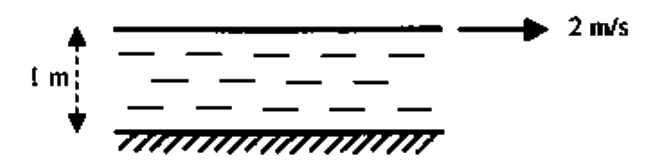
Consider an incompressible 2-D Couette flow of water between two walls spaced 1m apart. The lower wall is kept stationary. What is the shear stress acting on the lower wall if the upper wall is moving at a constant speed of 2 m/s? (\(\mu_{water} = 7 \times 10^{-4} N.s/m^2\))

Question diagram

Open complete paper
4
2010 · Aerospace Engineering · Aerodynamics · Elementary ideas of viscous flows
Aerospace Engineering (AE) 2010
Consider an incompressible 2-D viscous flow over a curved surface. Let the pressure distribution on the surface be \(p(s) = 2 + \sin\left(\frac{\pi}{2} s\right) N/m^2\), where s is the distance along the curved surface from the leading edge. The flow separates at
Open complete paper
5
2010 · Aerospace Engineering · Aerodynamics · Elementary ideas of viscous flows
Aerospace Engineering (AE) 2010
In a 2-D, steady, fully developed, laminar boundary layer over a flat plate, if x is the stream-wise coordinate, y is the wall normal coordinate and u is the stream-wise velocity component, which of the following is true:
Open complete paper
6
2011 · Aerospace Engineering · Aerodynamics · Elementary ideas of viscous flows
Aerospace Engineering (AE) 2011
Consider a steady two dimensional zero-pressure gradient laminar flow of air over a flat plate as shown below. The free stream conditions are \( U_\infty = 100 \text{ ms}^{-1} \), \( \rho_\infty = 1.2 \text{ kg m}^{-3} \), \( p_\infty = 1 \) atm and \( \mu_\infty = 1.8 \times 10^{-5} \text{ kg m}^{-1} \text{ s}^{-1} \). The ratio of displacement thickness to momentum thickness of the boundary layer at a distance of 2 m from the leading edge is

Question diagram

Open complete paper
7
2012 · Aerospace Engineering · Aerodynamics · Elementary ideas of viscous flows
Aerospace Engineering (AE) 2012
Bernoulli’s equation is valid under steady state
Open complete paper
8
2012 · Aerospace Engineering · Aerodynamics · Elementary ideas of viscous flows
Aerospace Engineering (AE) 2012

A vortex flowmeter works on the principle that the Strouhal number of 0.2 is a constant over a wide range of flow rates. If the bluff-body diameter in the flowmeter is 20 mm and the piezo-electric transducer registers the vortex shedding frequency to be 10 Hz, then the velocity of the flow would be measured as

Open complete paper
9
2012 · Aerospace Engineering · Aerodynamics · Elementary ideas of viscous flows
Aerospace Engineering (AE) 2012
What is the radial component of the fluid's velocity at a radial location 0.5 m from the pipe axis?
Open complete paper
10
2012 · Aerospace Engineering · Aerodynamics · Elementary ideas of viscous flows
Aerospace Engineering (AE) 2012
What is the tangential component of the fluid's velocity at the same radial location as above?
Open complete paper
11
2014 · Aerospace Engineering · Aerodynamics · Elementary ideas of viscous flows
Aerospace Engineering (AE) 2014
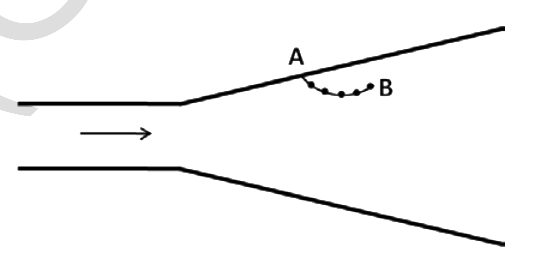
To observe unsteady separated flow in a diverging channel, bubbles are injected at each 10ms interval at point A as shown in figure. These bubbles act as tracer particles and follow the flow faithfully. The curved line AB shown at any instant represents:

Question diagram

Open complete paper
12
2014 · Aerospace Engineering · Aerodynamics · Elementary ideas of viscous flows
Aerospace Engineering (AE) 2014
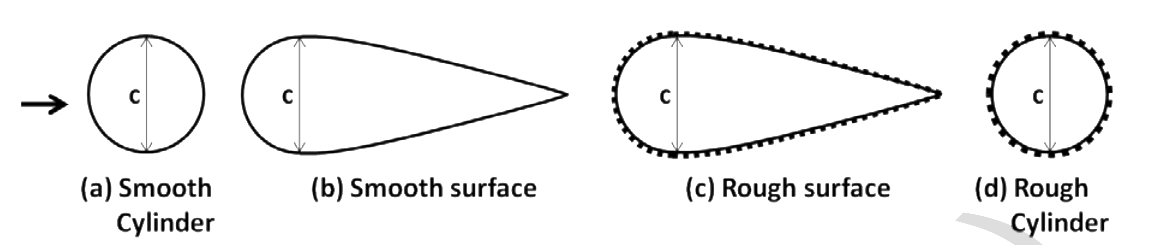
Figures (a) - (d) below show four objects. Dimensions and surface conditions of the objects are shown in the respective figures. All four objects are placed independently in a steady, uniform flow of same velocity and the direction of flow is from left to right as shown in (a). The flow field can be considered as 2-D, viscous and incompressible. Following statements are made regarding the drag that these objects experience.
(i) Drag of object (a) is more than the drag of object (d)
(ii) Drag of object (a) is less than the drag of object (d)
(iii) Drag of object (b) is more than the drag of object (c)
(iv) Drag of object (c) is more than the drag of object (b)
(v) Drag of object (a) is more than the drag of object (b)
Choose the correct combination of statements from the options given above.

Question diagram

Open complete paper
13
2014 · Aerospace Engineering · Aerodynamics · Elementary ideas of viscous flows
Aerospace Engineering (AE) 2014
A student can measure free-stream velocity of a low-speed wind tunnel using
    i. Pitot tube alone aligned with the flow direction.
    ii. Pitot tube aligned with the flow direction with static pressure measurement at an appropriate position on the tunnel wall.
    iii. Pitot tube aligned with the flow direction along with barometer pressure reading of the outside ambient.
    iv. Pitot static tube alone aligned with the flow direction.
Considering the above statements, which of the following options is correct?
Open complete paper
14
2014 · Aerospace Engineering · Aerodynamics · Elementary ideas of viscous flows
Aerospace Engineering (AE) 2014
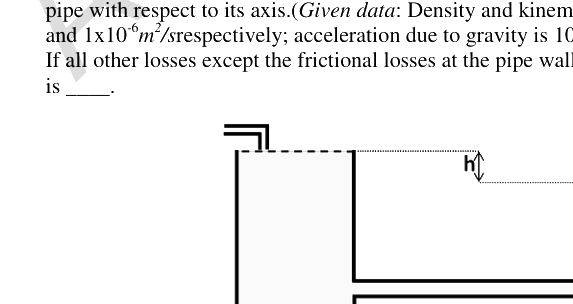
Two overflowing water reservoirs are connected with a 100m long pipe of circular cross-section (of radius, R≅0.02m), such that height difference h remains constant as shown in the figure below. The centerline velocity in the pipe is 10m/s. The velocity profile inside the pipe over the entire length is u = - (R2/(4μ) dp/dx) [1 - r2/R2], where, dp/dx is a constant pressure gradient along the pipe length, x is measured from the left end of the pipe along its central axis and r is radial location inside the pipe with respect to its axis.(Given data: Density and kinematic viscosity of water are 1000kg/m3 and 1x10⁻⁶ m2/s respectively; acceleration due to gravity is 10m/s2).
If all other losses except the frictional losses at the pipe wall are neglected, the value of h in meter is____.

Question diagram

Open complete paper
15
2016 · Aerospace Engineering · Aerodynamics · Elementary ideas of viscous flows
Aerospace Engineering (AE) 2016
For a laminar incompressible flow past a flat plate at zero angle of attack, the variation of skin friction drag coefficient (\( C_f \)) with Reynolds number based on the chord length (\( Re_c \)) can be expressed as
Open complete paper
16
2016 · Aerospace Engineering · Aerodynamics · Elementary ideas of viscous flows
Aerospace Engineering (AE) 2016

Air, with a Prandtl number of 0.7, flows over a flat plate at a high Reynolds number. Which of the following statement is TRUE?

Open complete paper
17
2017 · Aerospace Engineering · Aerodynamics · Elementary ideas of viscous flows
Aerospace Engineering (AE) 2017
Which one of the following statements is NOT true
Open complete paper
18
2018 · Aerospace Engineering · Aerodynamics · Elementary ideas of viscous flows
Aerospace Engineering (AE) 2018
The boundary layer thickness at the location of a sensor on a flat plate in an incompressible, laminar flow of air is required to be restricted to 1 mm for an effective measurement. If the flow velocity is 20 m/s with 1 bar pressure, 300 K temperature, and \( 1.789 \times 10^{-5} \) kg/(m·s) viscosity, the maximum distance (in mm) of the sensor location from the leading edge is ________ (accurate to one decimal place).
Open complete paper
19
2019 · Aerospace Engineering · Aerodynamics · Elementary ideas of viscous flows
Aerospace Engineering (AE) 2019
To simulate the aerodynamic forces on a cylinder of 1 m diameter due to a uniform air flow of 1 m/s at standard temperature and pressure (STP), low-speed wind tunnel experiments at STP are conducted on a 0.1 m diameter cylinder. The free stream air speed in the wind tunnel experiments should be ______ m/s (round off to the nearest integer).
Open complete paper
20
2019 · Aerospace Engineering · Aerodynamics · Elementary ideas of viscous flows
Aerospace Engineering (AE) 2019
A two-dimensional, incompressible fluid flow is described by the stream function \(\Psi = xy^3\) m²/s on the Cartesian \(x-y\) plane. If the density and dynamic viscosity of the fluid are 1 kg/m³ and 0.1 kg/m-s, respectively, the magnitude of the pressure gradient in the \(x\) direction at \(x=1\) m and \(y=1\) m is __________ N/m³ (round off to 1 decimal place).
Open complete paper

Showing 20 of 31 questions