My Cart
Your Cart 0

    Your cart is empty.

  • Total (Amount) ₹0.00
Previous year question hub

Basic fluid mechanics - Aerodynamics - Aerospace Engineering Previous Year Questions

Practice Basic fluid mechanics - Aerodynamics - Aerospace Engineering previous year questions organised from real papers, with year-wise coverage and clear topic navigation.

18Papers
18Years
39Questions
1Topics

Basic fluid mechanics question pattern

Every graph below is calculated only from this selection.

Questions by year

Compare question counts across years.

Difficulty distribution

How the classified questions are distributed by difficulty.

Easy 20 51.3%
Medium 18 46.2%
Hard 1 2.6%
Question type distribution

MCQ, numerical, multiple-select and other formats found in these papers.

MCQ 22 56.4%
Numerical Answer Type (NAT) 16 41%
Fill in the blanks 1 2.6%

Subject weightage

Top subjects by unique question coverage.

Aerospace Engineering
39 Qs

Most asked topics

Top topics across the included previous year papers.

Aerodynamics
39 Qs

Subtopic coverage

Top subtopics inside this exact selection.

Basic fluid mechanics
39 Qs

Paper coverage

Question coverage for the most populated papers. Every active PYP paper remains listed below.

Aerospace Engineering (AE) 2026
1 Qs
Aerospace Engineering (AE) 2025
1 Qs
Aerospace Engineering (AE) 2024
2 Qs
Aerospace Engineering (AE) 2023
2 Qs
Aerospace Engineering (AE) 2022
3 Qs
Aerospace Engineering (AE) 2021
1 Qs
Aerospace Engineering (AE) 2020
3 Qs
Aerospace Engineering (AE) 2019
2 Qs
Aerospace Engineering (AE) 2017
4 Qs
Aerospace Engineering (AE) 2016
2 Qs
Aerospace Engineering (AE) 2014
1 Qs
Aerospace Engineering (AE) 2013
1 Qs
Aerospace Engineering (AE) 2012
2 Qs
Aerospace Engineering (AE) 2011
2 Qs
Aerospace Engineering (AE) 2010
2 Qs
Aerospace Engineering (AE) 2009
2 Qs
Aerospace Engineering (AE) 2008
4 Qs
Aerospace Engineering (AE) 2007
4 Qs

Included previous year papers

Newest papers appear first. Search these papers or sort by year and name.

Paper nameYearPDFAttempt
Aerospace Engineering (AE) 20262026
1 questions in this view
2026
Aerospace Engineering (AE) 20252025
1 questions in this view
2025
Aerospace Engineering (AE) 20242024
2 questions in this view
2024
Aerospace Engineering (AE) 20232023
2 questions in this view
2023
Aerospace Engineering (AE) 20222022
3 questions in this view
2022
Aerospace Engineering (AE) 20212021
1 questions in this view
2021
Aerospace Engineering (AE) 20202020
3 questions in this view
2020
Aerospace Engineering (AE) 20192019
2 questions in this view
2019
Aerospace Engineering (AE) 20172017
4 questions in this view
2017
Aerospace Engineering (AE) 20162016
2 questions in this view
2016
Aerospace Engineering (AE) 20142014
1 questions in this view
2014
Aerospace Engineering (AE) 20132013
1 questions in this view
2013
Aerospace Engineering (AE) 20122012
2 questions in this view
2012
Aerospace Engineering (AE) 20112011
2 questions in this view
2011
Aerospace Engineering (AE) 20102010
2 questions in this view
2010
Aerospace Engineering (AE) 20092009
2 questions in this view
2009
Aerospace Engineering (AE) 20082008
4 questions in this view
2008
Aerospace Engineering (AE) 20072007
4 questions in this view
2007

All Basic fluid mechanics previous year questions

Practice every matching question in batches of 20, with every available option.

1
2007 · Aerospace Engineering · Aerodynamics · Basic fluid mechanics
Aerospace Engineering (AE) 2007

An artificial satellite remains in orbit and does not fall to the earth because

Open complete paper
2
2007 · Aerospace Engineering · Aerodynamics · Basic fluid mechanics
Aerospace Engineering (AE) 2007
The earth's radius is 6.37×10^6 m and the acceleration due to gravity on its surface is 9.81 m/s^2. A satellite is in a circular orbit at a height of 6.30×10^5 m above the earth's surface. The minimum additional speed it needs to escape from the earth's gravitational field is
Open complete paper
3
2007 · Aerospace Engineering · Aerodynamics · Basic fluid mechanics
Aerospace Engineering (AE) 2007
The radius of the earth is 6.37×10^6 m and the acceleration due to gravity at its surface is 9.81 m/s^2. A satellite is in circular orbit at a height of 35.9×10^6 m above the earth's surface. This orbit is inclined at 10.5 degrees to the equator. The velocity change needed to make the orbit equatorial is:
Open complete paper
4
2007 · Aerospace Engineering · Aerodynamics · Basic fluid mechanics
Aerospace Engineering (AE) 2007
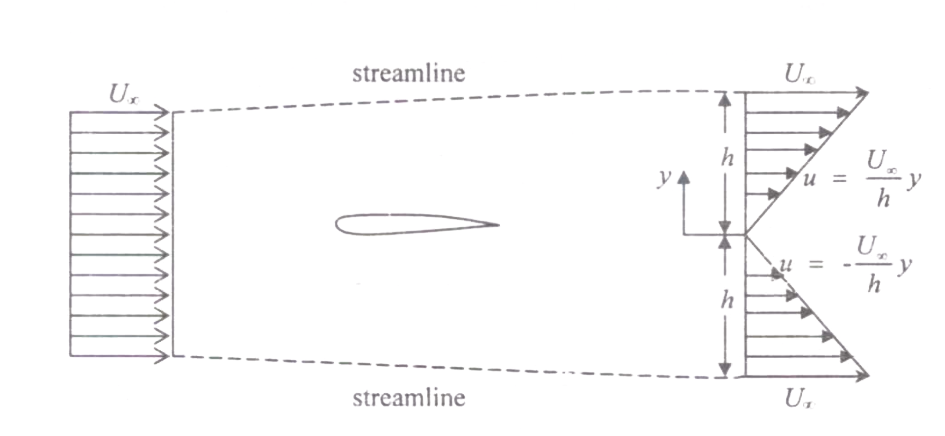
For the control volume shown in the figure below, the velocities are measured both at the upstream and the downstream ends. The flow of density \( \rho \) is incompressible, two dimensional and steady. The pressure is \( p_\infty \) over the entire surface of the control volume. The drag on the airfoil is given by,

Question diagram

Open complete paper
5
2008 · Aerospace Engineering · Aerodynamics · Basic fluid mechanics
Aerospace Engineering (AE) 2008
The maximum possible value of pressure coefficient \( C_p \) in incompressible flow is
Open complete paper
6
2008 · Aerospace Engineering · Aerodynamics · Basic fluid mechanics
Aerospace Engineering (AE) 2008
An irrotational and inviscid flow can become rotational on passing through a
Open complete paper
7
2008 · Aerospace Engineering · Aerodynamics · Basic fluid mechanics
Aerospace Engineering (AE) 2008
A planet is observed to be at its slowest when it is at a distance \( r_1 \) from the sun and at its fastest when it is at a distance \( r_2 \) from the sun. The eccentricity \( e \) of the planet's orbit is given by
Open complete paper
8
2008 · Aerospace Engineering · Aerodynamics · Basic fluid mechanics
Aerospace Engineering (AE) 2008
The velocity required for a spacecraft to escape earth's gravitational field depends on
Open complete paper
9
2009 · Aerospace Engineering · Aerodynamics · Basic fluid mechanics
Aerospace Engineering (AE) 2009

The acceleration due to gravity on the surface of Mars is 0.385 times that on earth, and the diameter of Mars is 0.532 times that of earth. The ratio of the escape velocity from the surface of Mars to the escape velocity from the surface of earth is approximately

Open complete paper
10
2009 · Aerospace Engineering · Aerodynamics · Basic fluid mechanics
Aerospace Engineering (AE) 2009
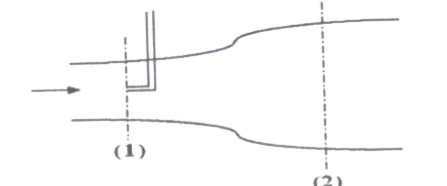
Consider an ideal flow of density \(\rho\) through a variable area duct as shown in the figure below : Let the cross-sectional areas at sections (1) and (2) be \(A_1\) and \(A_2\) respectively. The velocity measured at section (1) using a Pitot static probe is \(V_1\). Then the static pressure drop \(p_2 - p_1\) is

Question diagram

Open complete paper
11
2010 · Aerospace Engineering · Aerodynamics · Basic fluid mechanics
Aerospace Engineering (AE) 2010
A spacecraft of mass 100 kg, moving at an instantaneous speed of \(1.8 \times 10^4\) m/s, picks up interstellar dust at the rate of \(3.2 \times 10^{-8}\) kg/s. Assuming that the dust was initially at rest, the instantaneous rate of retardation of the spacecraft is:
Open complete paper
12
2010 · Aerospace Engineering · Aerodynamics · Basic fluid mechanics
Aerospace Engineering (AE) 2010
A two stage chemical rocket, having the same specific impulse (\(I_{sp}\)) of 300 s for both the stages is designed in such a way that the payload ratio and the structural ratio are same for both the stages. The second stage of the rocket has following mass distribution : Propellant Mass = 10208 kg Structural Mass = 1134 kg Payload Mass = 1700 kg \(g_0 = 9.8\) m/s² If the rocket is fired from rest and it flies in a zero gravity field and a drag free environment, the final velocity attained by the payload is
Open complete paper
13
2011 · Aerospace Engineering · Aerodynamics · Basic fluid mechanics
Aerospace Engineering (AE) 2011

An impulsive launch of a rocket minimizes the loss of burn-out velocity due to

Open complete paper
14
2011 · Aerospace Engineering · Aerodynamics · Basic fluid mechanics
Aerospace Engineering (AE) 2011
A low speed wind tunnel has a contraction ratio of 14:1 and the cross-sectional area of the test section is 1 m². The static pressure difference between the settling chamber and the test section is 40 cm of water column. Assume \( g = 9.81 \text{ m/s}^2 \), \( \rho_{air} = 1.2 \text{ kg/m}^3 \) and \( \rho_{water} = 1000 \text{ kg/m}^3 \). The speed of air in the test section (in m/s) is
Open complete paper
15
2012 · Aerospace Engineering · Aerodynamics · Basic fluid mechanics
Aerospace Engineering (AE) 2012

The Hohmann ellipse used as earth-Mars transfer orbit has

Open complete paper
16
2012 · Aerospace Engineering · Aerodynamics · Basic fluid mechanics
Aerospace Engineering (AE) 2012
The propellant in a single stage sounding rocket occupies 60% of its initial mass. If all of it is expended instantaneously at an equivalent exhaust velocity of 3000 m/s, what would be the altitude attained by the payload when launched vertically? [Neglect drag and assume acceleration due to gravity to be constant at 9.81 m/s².]
Open complete paper
17
2014 · Aerospace Engineering · Aerodynamics · Basic fluid mechanics
Aerospace Engineering (AE) 2014
A stationary two stage rocket with initial mass of 16000kg, carrying a payload of 1000kg, is fired in a vertical trajectory from the surface of the earth. Both the stages of the rocket have same specific impulse, Isp of 300s and same structural coefficient of 0.14. The acceleration due to gravity is 9.8m/s2. Neglecting drag and gravity effects and considering both the stages with same payload ratio, the terminal velocity attained by the payload in m/s is ______.
Open complete paper
18
2016 · Aerospace Engineering · Aerodynamics · Basic fluid mechanics
Aerospace Engineering (AE) 2016
Due to a body in potential flow, the velocity at a point A in the flow field is 20 m/s while the free stream velocity is only 10 m/s. The value of coefficient of pressure (\( C_p \)) at the point A is ______.
Open complete paper
19
2016 · Aerospace Engineering · Aerodynamics · Basic fluid mechanics
Aerospace Engineering (AE) 2016
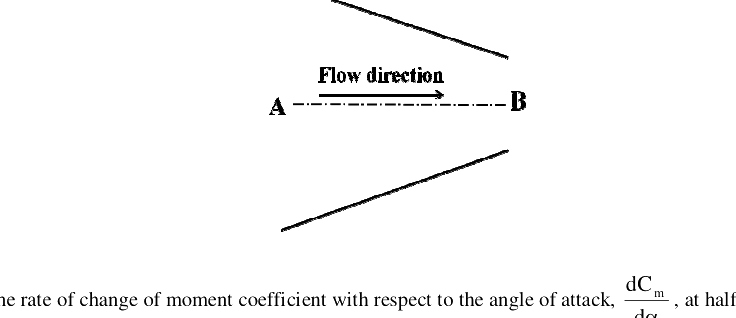
The nozzle AB, as shown below, leading to the test section of a low speed subsonic wind tunnel, has a contraction ratio of 10:1. The pressure difference across the nozzle is maintained at 1000 N/m² and the density of air is 1.23 kg/m³. Assuming one-dimensional, steady, inviscid flow, the velocity in the test section as measured at point B is ______ m/s.

Question diagram

Open complete paper
20
2017 · Aerospace Engineering · Aerodynamics · Basic fluid mechanics
Aerospace Engineering (AE) 2017
Consider an incompressible flow over a flat plate with the following approximation to the velocity profile: \(\frac{u(y)}{U} = \begin{cases} \frac{y}{\delta} & \text{for } y \leq \delta \\ 1 & \text{for } y > \delta \end{cases}\) where \(\delta\) is the boundary layer thickness and \(U\) the free-stream speed. The normalized momentum thickness (\(\theta/\delta\)) for this profile is __________ (in three decimal places).
Open complete paper

Showing 20 of 39 questions