My Cart
Your Cart 0

    Your cart is empty.

  • Total (Amount) ₹0.00
Previous year question hub

Airfoils and wings - Aerodynamics - Aerospace Engineering Previous Year Questions

Practice Airfoils and wings - Aerodynamics - Aerospace Engineering previous year questions organised from real papers, with year-wise coverage and clear topic navigation.

12Papers
12Years
58Questions
1Topics

Airfoils and wings question pattern

Every graph below is calculated only from this selection.

Questions by year

Compare question counts across years.

Difficulty distribution

How the classified questions are distributed by difficulty.

Medium 33 56.9%
Easy 23 39.7%
Hard 2 3.4%
Question type distribution

MCQ, numerical, multiple-select and other formats found in these papers.

MCQ 39 67.2%
Numerical Answer Type (NAT) 16 27.6%
MSQ 3 5.2%

Subject weightage

Top subjects by unique question coverage.

Aerospace Engineering
58 Qs

Most asked topics

Top topics across the included previous year papers.

Aerodynamics
58 Qs

Subtopic coverage

Top subtopics inside this exact selection.

Airfoils and wings
58 Qs

Paper coverage

Question coverage for the most populated papers. Every active PYP paper remains listed below.

Aerospace Engineering (AE) 2026
8 Qs
Aerospace Engineering (AE) 2025
4 Qs
Aerospace Engineering (AE) 2024
5 Qs
Aerospace Engineering (AE) 2023
4 Qs
Aerospace Engineering (AE) 2022
4 Qs
Aerospace Engineering (AE) 2020
3 Qs
Aerospace Engineering (AE) 2018
3 Qs
Aerospace Engineering (AE) 2017
3 Qs
Aerospace Engineering (AE) 2016
4 Qs
Aerospace Engineering (AE) 2009
4 Qs
Aerospace Engineering (AE) 2008
9 Qs
Aerospace Engineering (AE) 2007
7 Qs

Included previous year papers

Newest papers appear first. Search these papers or sort by year and name.

Paper nameYearPDFAttempt
Aerospace Engineering (AE) 20262026
8 questions in this view
2026
Aerospace Engineering (AE) 20252025
4 questions in this view
2025
Aerospace Engineering (AE) 20242024
5 questions in this view
2024
Aerospace Engineering (AE) 20232023
4 questions in this view
2023
Aerospace Engineering (AE) 20222022
4 questions in this view
2022
Aerospace Engineering (AE) 20202020
3 questions in this view
2020
Aerospace Engineering (AE) 20182018
3 questions in this view
2018
Aerospace Engineering (AE) 20172017
3 questions in this view
2017
Aerospace Engineering (AE) 20162016
4 questions in this view
2016
Aerospace Engineering (AE) 20092009
4 questions in this view
2009
Aerospace Engineering (AE) 20082008
9 questions in this view
2008
Aerospace Engineering (AE) 20072007
7 questions in this view
2007

All Airfoils and wings previous year questions

Practice every matching question in batches of 20, with every available option.

1
2007 · Aerospace Engineering · Aerodynamics · Airfoils and wings
Aerospace Engineering (AE) 2007

The Joukowskii airfoil is studied in aerodynamics because

Open complete paper
2
2007 · Aerospace Engineering · Aerodynamics · Airfoils and wings
Aerospace Engineering (AE) 2007

Two airfoils of the same family are operating at the same angle of attack. The dimensions of one airfoil are twice as large as the other one. The ratio of the minimum pressure coefficient of the larger airfoil to the minimum pressure coefficient of the smaller airfoil is

Open complete paper
3
2007 · Aerospace Engineering · Aerodynamics · Airfoils and wings
Aerospace Engineering (AE) 2007

Wing A has a constant chord c and span b. Wing B is identical but has a span 4b. When both wings are operating at the same geometric angle of attack at subsonic speed, then:

Open complete paper
4
2007 · Aerospace Engineering · Aerodynamics · Airfoils and wings
Aerospace Engineering (AE) 2007

A turbulent boundary layer remains attached over a longer distance on the upper surface of an airfoil than does a laminar boundary layer, because

Open complete paper
5
2007 · Aerospace Engineering · Aerodynamics · Airfoils and wings
Aerospace Engineering (AE) 2007
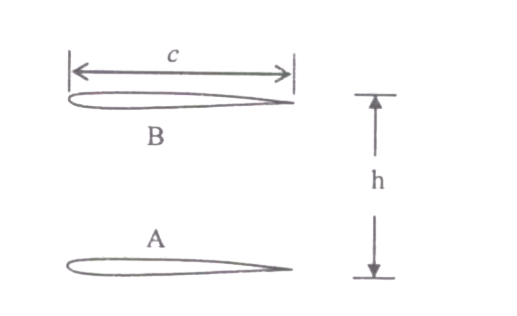
An airfoil section is known to generate lift when placed in a uniform stream of speed \( U_\infty \) at an incidence \( \alpha \). A biplane consisting of two such sections of identical chord \( c \), separated by a distance h is shown in the following figure: With regard to this biplane, which of the following statements is true?

Question diagram

Open complete paper
6
2007 · Aerospace Engineering · Aerodynamics · Airfoils and wings
Aerospace Engineering (AE) 2007
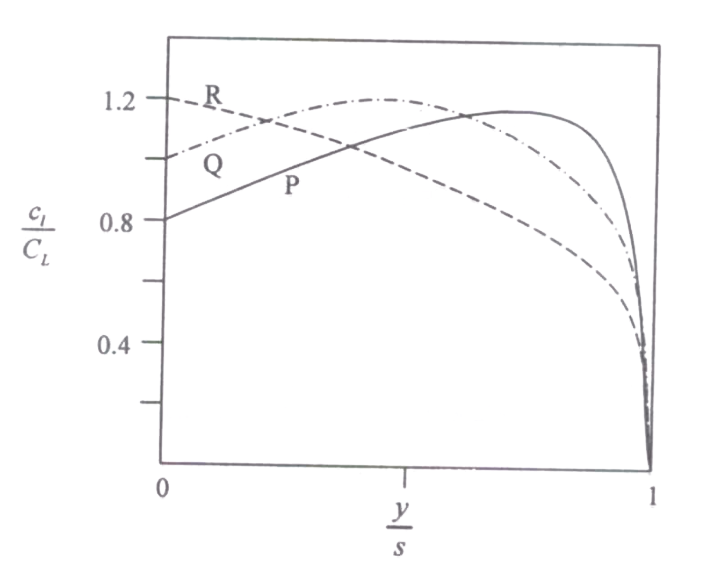
The span-wise lift distribution for three wings is shown in the following figure:
In the above figure, \( c_l \) refers to the section lift coefficient, \( C_L \) refers to the lift coefficient of the wing, \( y \) is the coordinate along the span and \( s \) is the span of the wing. A designer prefers to use a wing for which the stall begins at the root. Which of the wings will he choose?

Question diagram

Open complete paper
7
2007 · Aerospace Engineering · Aerodynamics · Airfoils and wings
Aerospace Engineering (AE) 2007
The lift curve slope of this wing is
Open complete paper
8
2008 · Aerospace Engineering · Aerodynamics · Airfoils and wings
Aerospace Engineering (AE) 2008
The maximum thickness to chord ratio for the NACA 24012 airfoil is
Open complete paper
9
2008 · Aerospace Engineering · Aerodynamics · Airfoils and wings
Aerospace Engineering (AE) 2008
Laminar flow airfoils are used to reduce
Open complete paper
10
2008 · Aerospace Engineering · Aerodynamics · Airfoils and wings
Aerospace Engineering (AE) 2008

Consider a symmetric airfoil at an angle of attack of 4 degrees. Using thin airfoil theory, the magnitude of the moment coefficient about the leading edge is

Open complete paper
11
2008 · Aerospace Engineering · Aerodynamics · Airfoils and wings
Aerospace Engineering (AE) 2008

The variation of downwash along the span of an untwisted wing of elliptic planform is

Open complete paper
12
2008 · Aerospace Engineering · Aerodynamics · Airfoils and wings
Aerospace Engineering (AE) 2008

Flow past an airfoil is to be modeled using a vortex sheet. The strength of the vortex sheet at the trailing edge will be

Open complete paper
13
2008 · Aerospace Engineering · Aerodynamics · Airfoils and wings
Aerospace Engineering (AE) 2008

The geometrical features of a supercritical airfoil are

Open complete paper
14
2008 · Aerospace Engineering · Aerodynamics · Airfoils and wings
Aerospace Engineering (AE) 2008

Which one of the following high lift device results in higher stalling angle?

Open complete paper
15
2008 · Aerospace Engineering · Aerodynamics · Airfoils and wings
Aerospace Engineering (AE) 2008
The wing lift coefficient \(C_L\) is
Open complete paper
16
2008 · Aerospace Engineering · Aerodynamics · Airfoils and wings
Aerospace Engineering (AE) 2008
The induced drag coefficient of the wing \(C_{Di}\) is
Open complete paper
17
2009 · Aerospace Engineering · Aerodynamics · Airfoils and wings
Aerospace Engineering (AE) 2009

A trailing edge plain flap deflected downward increases the lift coefficient of an airfoil by

Open complete paper
18
2009 · Aerospace Engineering · Aerodynamics · Airfoils and wings
Aerospace Engineering (AE) 2009
Thin airfoil theory predicts that the lift slope is \(\frac{dC_l}{d\alpha} = 2\pi\) for
Open complete paper
19
2009 · Aerospace Engineering · Aerodynamics · Airfoils and wings
Aerospace Engineering (AE) 2009
A model airfoil in a wind tunnel that is operating at 50 m/s develops a minimum pressure co-efficient of – 6.29 at some point on its upper surface. The local airspeed at that point is
Open complete paper
20
2009 · Aerospace Engineering · Aerodynamics · Airfoils and wings
Aerospace Engineering (AE) 2009
A symmetrical airfoil section produces a lift coefficient of 0.53 at an angle of attack of 5 degrees measured from its chord line. An untwisted wing of elliptical planform and aspect ratio 6 is made of this airfoil. At an angle of attack of 5 degrees relative to its chordal plane, this wing would produce a lift coefficient of
Open complete paper

Showing 20 of 58 questions