My Cart
Your Cart 0

    Your cart is empty.

  • Total (Amount) ₹0.00
Previous year question hub

Free and Forced Vibration with Damping - Vibrations - Engineering Sciences Previous Year Questions

Practice Free and Forced Vibration with Damping - Vibrations - Engineering Sciences previous year questions organised from real papers, with year-wise coverage and clear topic navigation.

18Papers
18Years
30Questions
1Topics

Free and Forced Vibration with Damping question pattern

Every graph below is calculated only from this selection.

Questions by year

Year-wise coverage for Free and Forced Vibration with Damping. Each bar uses a separate theme-derived color.

Difficulty distribution

How the classified questions are distributed by difficulty.

Medium 20 66.7%
Easy 10 33.3%

Question type distribution

MCQ, numerical, multiple-select and other formats found in these papers.

MCQ 23 76.7%
Numerical Answer Type (NAT) 6 20%
MSQ 1 3.3%

Subject weightage

Top subjects by unique question coverage.

Engineering Sciences
30 Qs

Most asked topics

Top topics across the included previous year papers.

Vibrations
30 Qs

Subtopic coverage

Top subtopics inside this exact selection.

Free and Forced Vibration with Damping
30 Qs

Paper coverage

Question coverage for the most populated papers. Every active PYP paper remains listed below.

Engineering Sciences (XE) 2026
2 Qs
Engineering Sciences (XE) 2025
3 Qs
Engineering Sciences (XE) 2024
1 Qs
Engineering Sciences (XE) 2023
1 Qs
Engineering Sciences (XE) 2022
1 Qs
Engineering Sciences (XE) 2021
2 Qs
Engineering Sciences (XE) 2020
1 Qs
Engineering Sciences (XE) 2019
1 Qs
Engineering Sciences (XE) 2018
2 Qs
Engineering Sciences (XE) 2017
2 Qs
Engineering Sciences (XE) 2016
2 Qs
Engineering Sciences (XE) 2013
1 Qs
Engineering Sciences (XE) 2012
2 Qs
Engineering Sciences (XE) 2011
1 Qs
Engineering Sciences (XE) 2010
1 Qs
Engineering Sciences (XE) 2009
1 Qs
Engineering Sciences (XE) 2008
4 Qs
Engineering Sciences (XE) 2007
2 Qs

Included previous year papers

Newest papers appear first. Sort by year, question coverage or name.

PaperYear / sessionQuestions in this viewOpen
Engineering Sciences (XE) 202620262View paper
Engineering Sciences (XE) 202520253View paper
Engineering Sciences (XE) 202420241View paper
Engineering Sciences (XE) 202320231View paper
Engineering Sciences (XE) 202220221View paper
Engineering Sciences (XE) 202120212View paper
Engineering Sciences (XE) 202020201View paper
Engineering Sciences (XE) 201920191View paper
Engineering Sciences (XE) 201820182View paper
Engineering Sciences (XE) 201720172View paper
Engineering Sciences (XE) 201620162View paper
Engineering Sciences (XE) 201320131View paper
Engineering Sciences (XE) 201220122View paper
Engineering Sciences (XE) 201120111View paper
Engineering Sciences (XE) 201020101View paper
Engineering Sciences (XE) 200920091View paper
Engineering Sciences (XE) 200820084View paper
Engineering Sciences (XE) 200720072View paper

All Free and Forced Vibration with Damping previous year questions

Practice every matching question in batches of 20, with every available option.

1
2007 · Engineering Sciences · Vibrations · Free and Forced Vibration with Damping
Engineering Sciences (XE) 2007

A transistor oscillator uses a 3-section R-C phase shift circuit. Each section uses same R and C values. The gain of the circuit is adjusted for oscillation. The required oscillation frequency is 10 k rad/s. The suitable R-C combination is

Open complete paper
2
2007 · Engineering Sciences · Vibrations · Free and Forced Vibration with Damping
Engineering Sciences (XE) 2007
A single degree freedom system consisting of 2 springs and a mass is shown in the figure.

The natural frequency of the system in radians/sec is given by
Open complete paper
3
2008 · Engineering Sciences · Vibrations · Free and Forced Vibration with Damping
Engineering Sciences (XE) 2008

If a mass attached to the free end of a linear spring is so constrained that it executes vertical undamped oscillations, its acceleration at the instant when it occupies the static equilibrium position is

Open complete paper
4
2008 · Engineering Sciences · Vibrations · Free and Forced Vibration with Damping
Engineering Sciences (XE) 2008
The natural frequency of vibration is
Open complete paper
5
2008 · Engineering Sciences · Vibrations · Free and Forced Vibration with Damping
Engineering Sciences (XE) 2008
The magnitude of velocity when the body has moved half way towards the static equilibrium position from its initial position is
Open complete paper
6
2008 · Engineering Sciences · Vibrations · Free and Forced Vibration with Damping
Engineering Sciences (XE) 2008
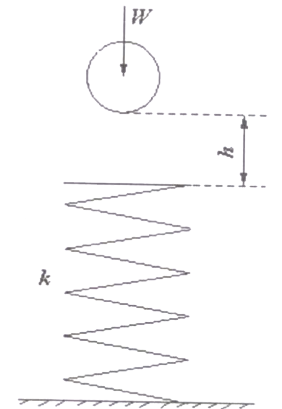
When a ball of weight \( W \) rests on a spring of constant \( k \), it produces a static deflection of 3 cm. If the ball is now dropped from a height of \( h = 30 \) cm as shown in the figure, the spring will get compressed by

Question diagram

Open complete paper
7
2009 · Engineering Sciences · Vibrations · Free and Forced Vibration with Damping
Engineering Sciences (XE) 2009
In the ensuing Simple Harmonic Motion of the body, the magnitude of maximum acceleration is
Open complete paper
8
2010 · Engineering Sciences · Vibrations · Free and Forced Vibration with Damping
Engineering Sciences (XE) 2010

A spring-mass system shown in the figure is vibrating with very small amplitude. The natural frequency of the system is

Open complete paper
9
2011 · Engineering Sciences · Vibrations · Free and Forced Vibration with Damping
Engineering Sciences (XE) 2011
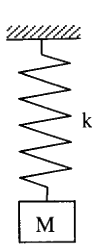
A simple mass-spring system shown has a natural frequency of 5 Hz. The static deflection of the spring due to the mass is (acceleration due to gravity is 9.81 m/s² and mass of the spring is negligible)

Question diagram

Open complete paper
10
2012 · Engineering Sciences · Vibrations · Free and Forced Vibration with Damping
Engineering Sciences (XE) 2012
A rocket in the atmosphere is accelerating upwards with acceleration \(a\) m/s². The natural frequency of a spring-mass system (with mass \(m\) kg and spring constant \(k\) N/m), suspended vertically inside the rocket, is (take \(g\) m/s² to be the acceleration due to gravity)
Open complete paper
11
2012 · Engineering Sciences · Vibrations · Free and Forced Vibration with Damping
Engineering Sciences (XE) 2012
For small oscillations, the natural frequency of the system in terms of \(K\), \(a\), \(b\) and \(M\) is (assuming ideal joints and mass-less rigid rod ABC)
Open complete paper
12
2013 · Engineering Sciences · Vibrations · Free and Forced Vibration with Damping
Engineering Sciences (XE) 2013
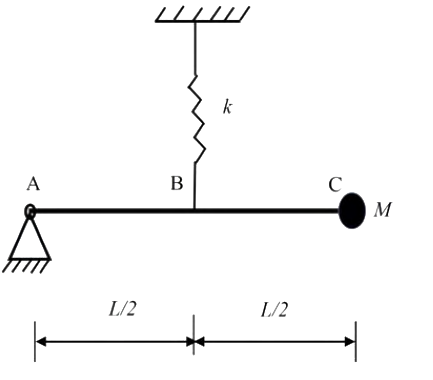
A rigid massless rod ABC is hinged at A and carries a point mass M (in kg) at C. Point B is connected to a linear spring with spring constant \(k\) (in N/m) as shown in the figure. The length AB and AC area and \(L\), respectively. Neglecting the effect of gravity, the natural frequency of this spring-mass system in rad/s is
Open complete paper
13
2016 · Engineering Sciences · Vibrations · Free and Forced Vibration with Damping
Engineering Sciences (XE) 2016
A single degree of freedom vibrating system has mass of 5 kg, stiffness of 500 N/m and damping coefficient of 100 N-s/m. To make the system critically damped
Open complete paper
14
2016 · Engineering Sciences · Vibrations · Free and Forced Vibration with Damping
Engineering Sciences (XE) 2016
The vibrating system shown in the figure carries a mass of 10 kg at the free end, where the static deflection is 1 mm. This system is to be replaced by an equivalent vibrating spring mass system having equivalent mass of 2 kg (assume \(g=10~m/s^2\)). The natural frequency (in rad/s) and the stiffness (in kN/m) of the equivalent system respectively are
Open complete paper
15
2017 · Engineering Sciences · Vibrations · Free and Forced Vibration with Damping
Engineering Sciences (XE) 2017
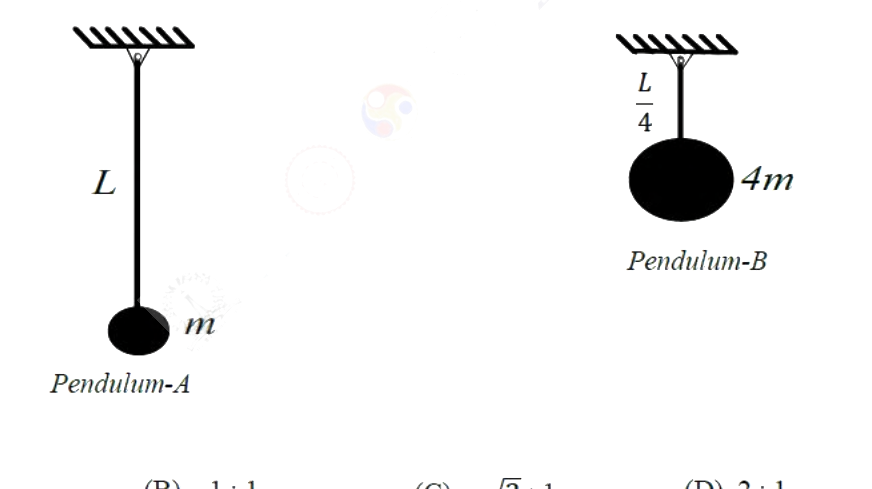
Two pendulums are shown below. \(Pendulum-A\) carries a bob of mass \(m\), hung using a hinged massless rigid rod of length \(L\) whereas \(Pendulum-B\) carries a bob of mass \(4m\) and length \(L/4\). The ratio of the natural frequencies of \(Pendulum-A\) and \(Pendulum-B\) is given by

Question diagram

Open complete paper
16
2017 · Engineering Sciences · Vibrations · Free and Forced Vibration with Damping
Engineering Sciences (XE) 2017
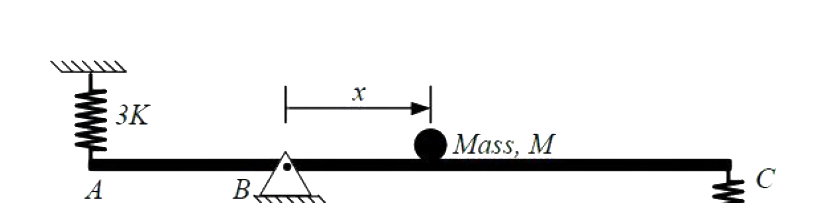
Consider the system shown below. Mass \(M\) is fixed to the rod \(AC\) at a distance \(x\) from the hinge point at \(B\). Two springs of stiffness \(3K\) and \(K\) are attached to the rod at points \(A\) and \(C\), respectively. The natural frequency of angular oscillation of the system about \(B\) is 20 rad/s. Assume the rod to be rigid and massless. Magnitude of \(x\) (in metres) is __________. (\(M = 30\text{kg}\), and \(K = 1\text{kN/m}\)).

Question diagram

Open complete paper
17
2018 · Engineering Sciences · Vibrations · Free and Forced Vibration with Damping
Engineering Sciences (XE) 2018
A cantilever beam with length, L = 1 m, modulus of elasticity, E = 210 GPa, and area moment of inertia, I = 1.2 × 10⁻⁷ m⁴ carries a concentrated mass m = 100 kg at its free-end. By idealizing it as a single degree-of-freedom system and neglecting the mass of the cantilever beam, the natural frequency (in rad/s) of small transverse oscillations of the mass m is ……. [up to two decimal places]
Open complete paper
18
2018 · Engineering Sciences · Vibrations · Free and Forced Vibration with Damping
Engineering Sciences (XE) 2018
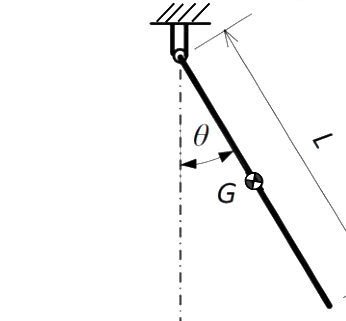
A rigid uniform rod with mass \( m \), length \( L \) and center of gravity \( G \) is freely suspended from a hinge as shown in the figure. The rod is given a small angular displacement \( \theta \) in the counter-clockwise direction from the position in which it hangs vertically (\( \theta = 0 \)). If \( g \) is the acceleration due to gravity, the natural frequency of oscillations (in rad/s) is

Question diagram

Open complete paper
19
2019 · Engineering Sciences · Vibrations · Free and Forced Vibration with Damping
Engineering Sciences (XE) 2019
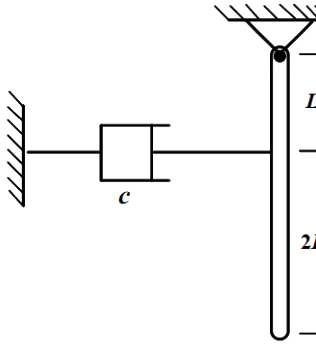
The uniform pendulum rod, having mass 10 kg and length L = 5 m, is attached to a viscous damper having damping coefficient c. Use acceleration due to gravity g = 10 m/s². The least value of c (in N-s/m) such that small motions of the pendulum rod decay without oscillations is ______

Question diagram

Open complete paper
20
2020 · Engineering Sciences · Vibrations · Free and Forced Vibration with Damping
Engineering Sciences (XE) 2020
A rigid bar ABC of mass m and length L is hinged at A and has a point mass M attached at C. An elastic spring with linear stiffness k is attached at B as shown. Ignore the effect of gravity and damping. The natural frequency of small oscillations of this system is ______________.

Question diagram

Open complete paper

Showing 20 of 30 questions