My Cart
Your Cart 0

    Your cart is empty.

  • Total (Amount) ₹0.00
Previous year question hub

Vibrations - Engineering Sciences Previous Year Questions

Practice Vibrations - Engineering Sciences previous year questions organised from real papers, with year-wise coverage and clear topic navigation.

13Papers
13Years
21Questions
1Topics

Vibrations question pattern

Every graph below is calculated only from this selection.

Questions by year

Year-wise coverage for Vibrations. Each bar uses a separate theme-derived color.

Difficulty distribution

How the classified questions are distributed by difficulty.

Medium 13 61.9%
Easy 8 38.1%

Question type distribution

MCQ, numerical, multiple-select and other formats found in these papers.

MCQ 14 66.7%
Numerical Answer Type (NAT) 6 28.6%
MSQ 1 4.8%

Subject weightage

Top subjects by unique question coverage.

Engineering Sciences
21 Qs

Most asked topics

Top topics across the included previous year papers.

Vibrations
21 Qs

Subtopic coverage

Top subtopics inside this exact selection.

Free and Forced Vibration with Damping
21 Qs

Paper coverage

Question coverage for the most populated papers. Every active PYP paper remains listed below.

Engineering Sciences (XE) 2026
2 Qs
Engineering Sciences (XE) 2025
3 Qs
Engineering Sciences (XE) 2024
1 Qs
Engineering Sciences (XE) 2023
1 Qs
Engineering Sciences (XE) 2022
1 Qs
Engineering Sciences (XE) 2021
2 Qs
Engineering Sciences (XE) 2020
1 Qs
Engineering Sciences (XE) 2019
1 Qs
Engineering Sciences (XE) 2018
2 Qs
Engineering Sciences (XE) 2017
2 Qs
Engineering Sciences (XE) 2016
2 Qs
Engineering Sciences (XE) 2013
1 Qs
Engineering Sciences (XE) 2012
2 Qs

Browse by subtopics

Open a focused page built from the same verified paper data.

Included previous year papers

Newest papers appear first. Sort by year, question coverage or name.

PaperYear / sessionQuestions in this viewOpen
Engineering Sciences (XE) 202620262View paper
Engineering Sciences (XE) 202520253View paper
Engineering Sciences (XE) 202420241View paper
Engineering Sciences (XE) 202320231View paper
Engineering Sciences (XE) 202220221View paper
Engineering Sciences (XE) 202120212View paper
Engineering Sciences (XE) 202020201View paper
Engineering Sciences (XE) 201920191View paper
Engineering Sciences (XE) 201820182View paper
Engineering Sciences (XE) 201720172View paper
Engineering Sciences (XE) 201620162View paper
Engineering Sciences (XE) 201320131View paper
Engineering Sciences (XE) 201220122View paper

Sample previous year questions

A varied preview from the papers represented in this selection, with every available option.

1
2012 · Engineering Sciences · Vibrations · Free and Forced Vibration with Damping
Engineering Sciences (XE) 2012
A rocket in the atmosphere is accelerating upwards with acceleration \(a\) m/s². The natural frequency of a spring-mass system (with mass \(m\) kg and spring constant \(k\) N/m), suspended vertically inside the rocket, is (take \(g\) m/s² to be the acceleration due to gravity)
Open complete paper
2
2013 · Engineering Sciences · Vibrations · Free and Forced Vibration with Damping
Engineering Sciences (XE) 2013
A rigid massless rod ABC is hinged at A and carries a point mass M (in kg) at C. Point B is connected to a linear spring with spring constant \(k\) (in N/m) as shown in the figure. The length AB and AC area and \(L\), respectively. Neglecting the effect of gravity, the natural frequency of this spring-mass system in rad/s is
Open complete paper
3
2016 · Engineering Sciences · Vibrations · Free and Forced Vibration with Damping
Engineering Sciences (XE) 2016
A single degree of freedom vibrating system has mass of 5 kg, stiffness of 500 N/m and damping coefficient of 100 N-s/m. To make the system critically damped
Open complete paper
4
2017 · Engineering Sciences · Vibrations · Free and Forced Vibration with Damping
Engineering Sciences (XE) 2017
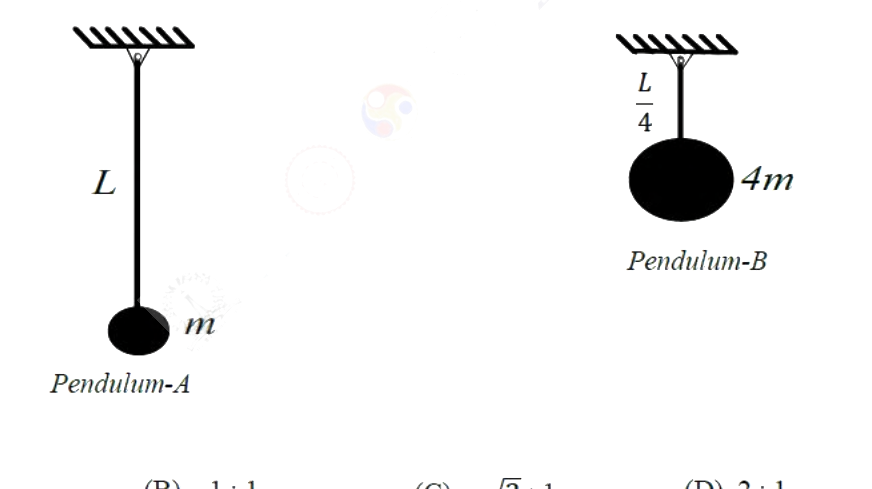
Two pendulums are shown below. \(Pendulum-A\) carries a bob of mass \(m\), hung using a hinged massless rigid rod of length \(L\) whereas \(Pendulum-B\) carries a bob of mass \(4m\) and length \(L/4\). The ratio of the natural frequencies of \(Pendulum-A\) and \(Pendulum-B\) is given by

Question diagram

Open complete paper
5
2018 · Engineering Sciences · Vibrations · Free and Forced Vibration with Damping
Engineering Sciences (XE) 2018
A cantilever beam with length, L = 1 m, modulus of elasticity, E = 210 GPa, and area moment of inertia, I = 1.2 × 10⁻⁷ m⁴ carries a concentrated mass m = 100 kg at its free-end. By idealizing it as a single degree-of-freedom system and neglecting the mass of the cantilever beam, the natural frequency (in rad/s) of small transverse oscillations of the mass m is ……. [up to two decimal places]
Open complete paper
6
2019 · Engineering Sciences · Vibrations · Free and Forced Vibration with Damping
Engineering Sciences (XE) 2019
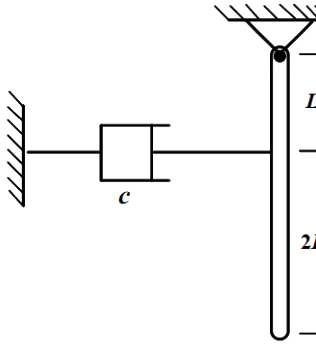
The uniform pendulum rod, having mass 10 kg and length L = 5 m, is attached to a viscous damper having damping coefficient c. Use acceleration due to gravity g = 10 m/s². The least value of c (in N-s/m) such that small motions of the pendulum rod decay without oscillations is ______

Question diagram

Open complete paper