My Cart
Your Cart 0

    Your cart is empty.

  • Total (Amount) ₹0.00
Previous year question hub

Statics, Trusses and Friction - Mechanics of Rigid Bodies - Engineering Sciences Previous Year Questions

Practice Statics, Trusses and Friction - Mechanics of Rigid Bodies - Engineering Sciences previous year questions organised from real papers, with year-wise coverage and clear topic navigation.

19Papers
19Years
67Questions
1Topics

Statics, Trusses and Friction question pattern

Every graph below is calculated only from this selection.

Questions by year

Year-wise coverage for Statics, Trusses and Friction. Each bar uses a separate theme-derived color.

Difficulty distribution

How the classified questions are distributed by difficulty.

Medium 52 77.6%
Easy 14 20.9%
Hard 1 1.5%
Question type distribution

MCQ, numerical, multiple-select and other formats found in these papers.

MCQ 47 70.1%
Numerical Answer Type (NAT) 20 29.9%

Subject weightage

Top subjects by unique question coverage.

Engineering Sciences
67 Qs

Most asked topics

Top topics across the included previous year papers.

Mechanics of Rigid Bodies
67 Qs

Subtopic coverage

Top subtopics inside this exact selection.

Statics, Trusses and Friction
67 Qs

Paper coverage

Question coverage for the most populated papers. Every active PYP paper remains listed below.

Engineering Sciences (XE) 2026
5 Qs
Engineering Sciences (XE) 2025
5 Qs
Engineering Sciences (XE) 2024
6 Qs
Engineering Sciences (XE) 2023
4 Qs
Engineering Sciences (XE) 2022
3 Qs
Engineering Sciences (XE) 2021
5 Qs
Engineering Sciences (XE) 2020
3 Qs
Engineering Sciences (XE) 2019
3 Qs
Engineering Sciences (XE) 2018
3 Qs
Engineering Sciences (XE) 2017
4 Qs
Engineering Sciences (XE) 2016
3 Qs
Engineering Sciences (XE) 2015
4 Qs
Engineering Sciences (XE) 2014
2 Qs
Engineering Sciences (XE) 2012
2 Qs
Engineering Sciences (XE) 2011
3 Qs
Engineering Sciences (XE) 2010
3 Qs
Engineering Sciences (XE) 2009
2 Qs
Engineering Sciences (XE) 2008
5 Qs
Engineering Sciences (XE) 2007
2 Qs

Included previous year papers

Newest papers appear first. Sort by year, question coverage or name.

PaperYear / sessionQuestions in this viewOpen
Engineering Sciences (XE) 202620265View paper
Engineering Sciences (XE) 202520255View paper
Engineering Sciences (XE) 202420246View paper
Engineering Sciences (XE) 202320234View paper
Engineering Sciences (XE) 202220223View paper
Engineering Sciences (XE) 202120215View paper
Engineering Sciences (XE) 202020203View paper
Engineering Sciences (XE) 201920193View paper
Engineering Sciences (XE) 201820183View paper
Engineering Sciences (XE) 201720174View paper
Engineering Sciences (XE) 201620163View paper
Engineering Sciences (XE) 201520154View paper
Engineering Sciences (XE) 201420142View paper
Engineering Sciences (XE) 201220122View paper
Engineering Sciences (XE) 201120113View paper
Engineering Sciences (XE) 201020103View paper
Engineering Sciences (XE) 200920092View paper
Engineering Sciences (XE) 200820085View paper
Engineering Sciences (XE) 200720072View paper

All Statics, Trusses and Friction previous year questions

Practice every matching question in batches of 20, with every available option.

1
2007 · Engineering Sciences · Mechanics of Rigid Bodies · Statics, Trusses and Friction
Engineering Sciences (XE) 2007

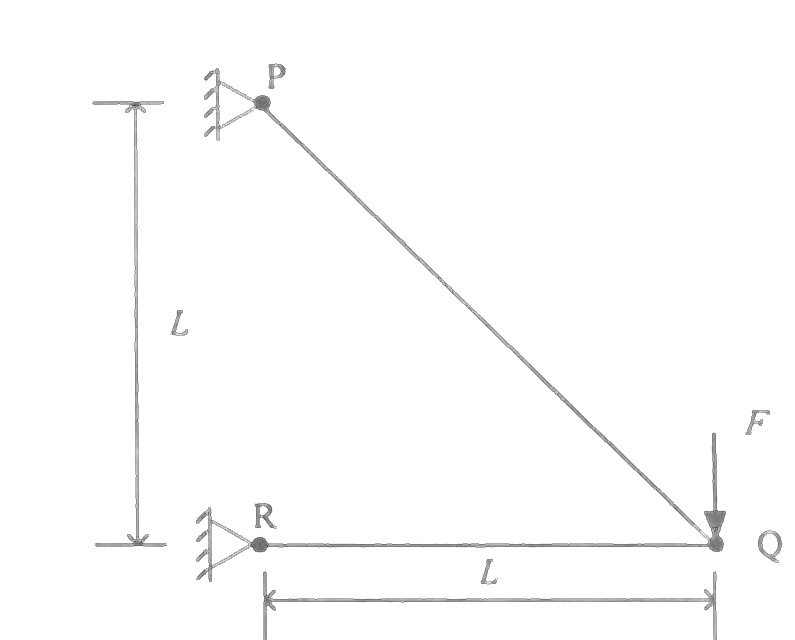
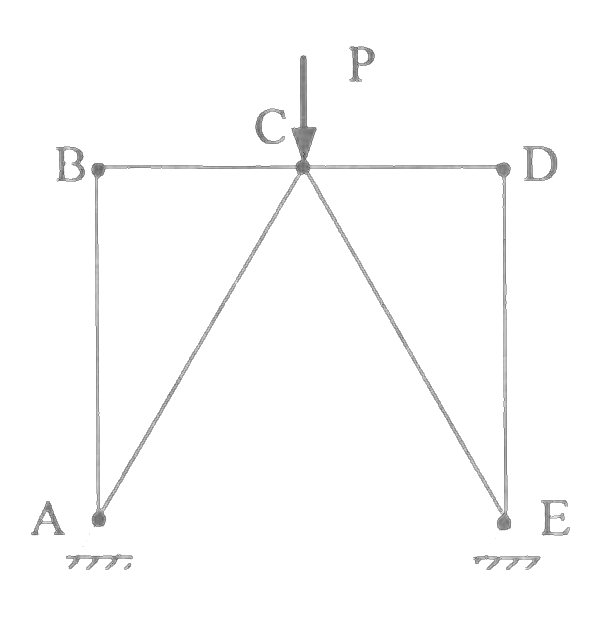
The truss shown in the figure is

Open complete paper
2
2007 · Engineering Sciences · Mechanics of Rigid Bodies · Statics, Trusses and Friction
Engineering Sciences (XE) 2007
The reaction at the roller support is
Open complete paper
3
2008 · Engineering Sciences · Mechanics of Rigid Bodies · Statics, Trusses and Friction
Engineering Sciences (XE) 2008

If three nonparallel forces are in equilibrium they

Open complete paper
4
2008 · Engineering Sciences · Mechanics of Rigid Bodies · Statics, Trusses and Friction
Engineering Sciences (XE) 2008

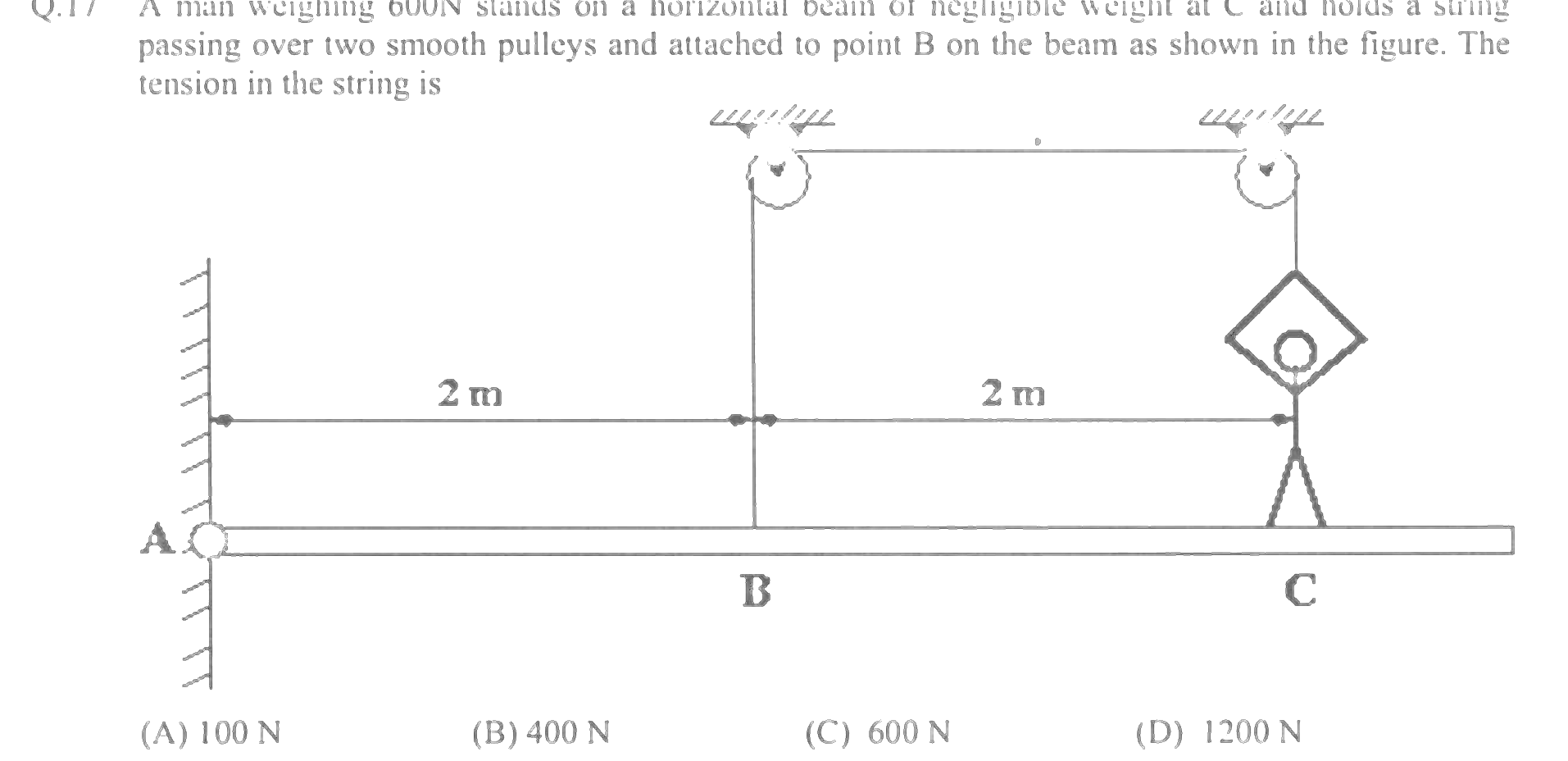
A man weighing 600N stands on a horizontal beam of negligible weight at C and holds a string passing over two smooth pulleys and attached to point B on the beam as shown in the figure. The tension in the string is

Open complete paper
5
2008 · Engineering Sciences · Mechanics of Rigid Bodies · Statics, Trusses and Friction
Engineering Sciences (XE) 2008

A homogeneous cubic block of side L and weight 200 N resting on a horizontal floor is acted upon by a force of 100 N at an angle of 60° to the horizontal as shown in the figure. If the coefficient of friction is 0.3, the magnitude of the frictional force between the block and the floor is

Open complete paper
6
2008 · Engineering Sciences · Mechanics of Rigid Bodies · Statics, Trusses and Friction
Engineering Sciences (XE) 2008

A block of weight 500 N is about to move up the plane due to a horizontal force of 800 N. The coefficient of static friction between the contact surfaces is

Open complete paper
7
2008 · Engineering Sciences · Mechanics of Rigid Bodies · Statics, Trusses and Friction
Engineering Sciences (XE) 2008

The forces in the members of a truss ABCD as shown in the figure are (T stands for tension and C for compression)

Open complete paper
8
2009 · Engineering Sciences · Mechanics of Rigid Bodies · Statics, Trusses and Friction
Engineering Sciences (XE) 2009
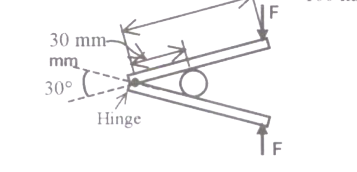
A small spherical ball fails at a normal load of 10 kN under the arrangement as shown below. The vertical force F required to crush the ball is

Question diagram

Open complete paper
9
2009 · Engineering Sciences · Mechanics of Rigid Bodies · Statics, Trusses and Friction
Engineering Sciences (XE) 2009
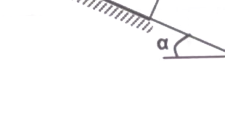
A block of length \(a\) and height \(b\) rests on a rough inclined plane (coefficient of friction \(\mu\)) as shown below. The angle \(\alpha\) of the inclined plane is slowly increased. The condition that the block will topple due to its own weight before it begins to slide is

Question diagram

Open complete paper
10
2010 · Engineering Sciences · Mechanics of Rigid Bodies · Statics, Trusses and Friction
Engineering Sciences (XE) 2010
Three forces acting on a particle are given as
\(F_1 = (5\mathbf{i} + 6\mathbf{j})\) N, \(F_2 = (-\mathbf{i} + 4\mathbf{k})\) N and \(F_3 = (\mathbf{i} + 6\mathbf{j} + 16\mathbf{k})\) N,
where \(\mathbf{i}, \mathbf{j}, \mathbf{k}\) are the unit vectors along Cartesian coordinate axes. Which one of the following statements is true?
Open complete paper
11
2010 · Engineering Sciences · Mechanics of Rigid Bodies · Statics, Trusses and Friction
Engineering Sciences (XE) 2010

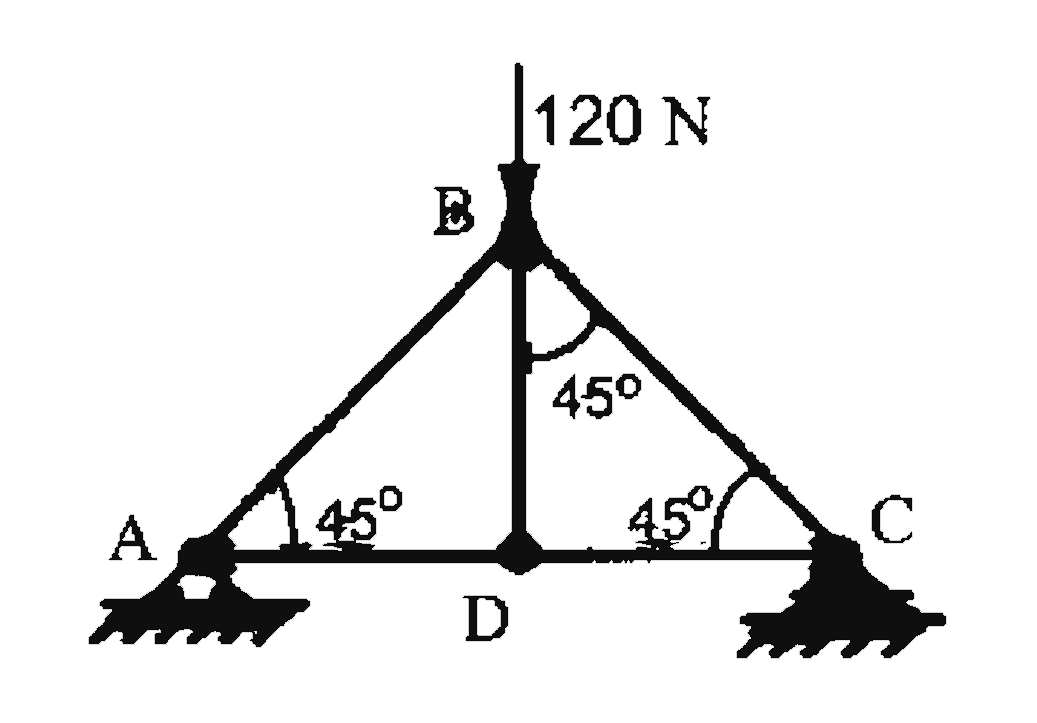
A truss consisting of members AD, DC, AB, BD and BC is subjected to a vertical force of 120 N at joint B as shown in the figure. The members AD, DC and BD are each of 1 meter length. The magnitude of force in the member BD is

Open complete paper
12
2010 · Engineering Sciences · Mechanics of Rigid Bodies · Statics, Trusses and Friction
Engineering Sciences (XE) 2010

Two rigid bodies A and B are each weighing 30 N. Body A is kept on a floor and body B is kept on body A as shown in the figure. The coefficient of friction between two bodies, and between body A and the floor is 0.1. If a horizontal force of 2 N is applied on body A, the friction force at the interface of body A and body B will be

Open complete paper
13
2011 · Engineering Sciences · Mechanics of Rigid Bodies · Statics, Trusses and Friction
Engineering Sciences (XE) 2011
The magnitude of the reaction force at the wall is
Open complete paper
14
2011 · Engineering Sciences · Mechanics of Rigid Bodies · Statics, Trusses and Friction
Engineering Sciences (XE) 2011
A 10 kg rectangular steel block is placed over a smooth cast iron surface. The coefficient of friction between steel and cast iron is 0.4. Acceleration due to gravity is 10 m/s². If a force of 20 N is applied to the block parallel to the surface, the frictional resistance (in N) offered by the surface to the block is
Open complete paper
15
2011 · Engineering Sciences · Mechanics of Rigid Bodies · Statics, Trusses and Friction
Engineering Sciences (XE) 2011
A non-magnetic light rigid frame with two magnets attached to its legs rests on a mild steel plate as shown. A spring, compressed by an amount \(\delta\) from its unstretched length, connects the steel plate to the center of the frame as shown. Which of the figures below represents the CORRECT free-body diagram?
Open complete paper
16
2012 · Engineering Sciences · Mechanics of Rigid Bodies · Statics, Trusses and Friction
Engineering Sciences (XE) 2012
A block of weight W, connected to two springs with spring constants k₁ and k₂, rests initially on a horizontal frictional surface. The coefficient of static friction between the block and the surface is μ. Both springs are initially undeformed. The magnitude of force F, applied to the second spring, is now gradually increased. The block will start to slide when F becomes
Open complete paper
17
2012 · Engineering Sciences · Mechanics of Rigid Bodies · Statics, Trusses and Friction
Engineering Sciences (XE) 2012
An irregular planar body in space is acted upon by a force \(\vec{F} = (2\hat{i} + \hat{j})N\) at position \(\vec{r_1} = (\vec{i} + 2\vec{j})m\) and a moment \(\vec{M} = 3\hat{k}Nm\) at position \(\vec{r_2} = (-2\hat{i})m\). The corresponding equivalent force \(\vec{F_o}\) and moment \(\vec{M_o}\) at the origin are
Open complete paper
18
2014 · Engineering Sciences · Mechanics of Rigid Bodies · Statics, Trusses and Friction
Engineering Sciences (XE) 2014
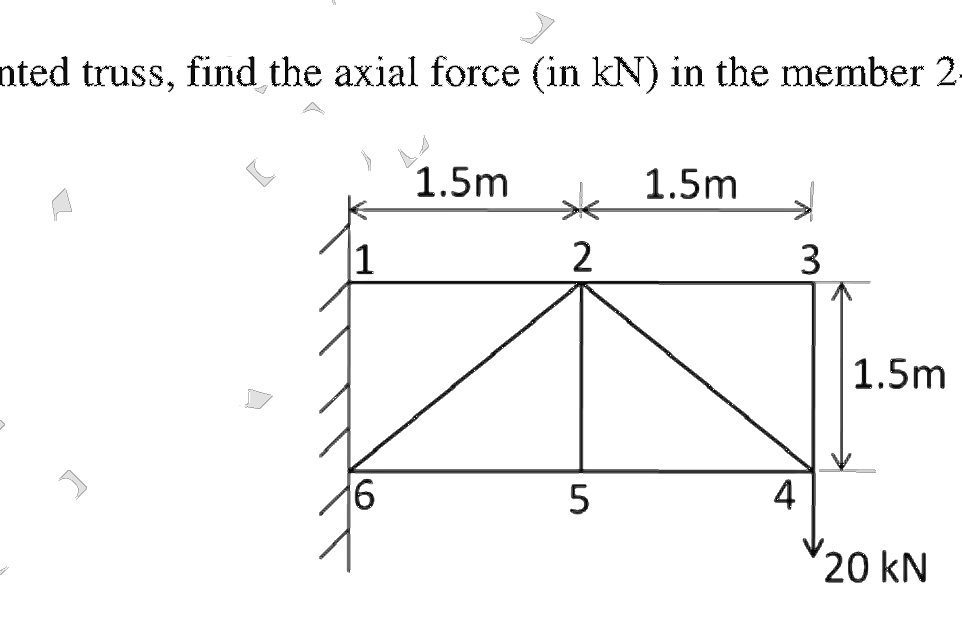
For the pin jointed truss, find the axial force (in kN) in the member 2-5.
Open complete paper
19
2014 · Engineering Sciences · Mechanics of Rigid Bodies · Statics, Trusses and Friction
Engineering Sciences (XE) 2014
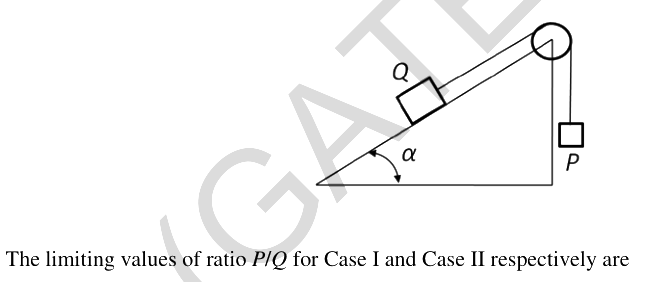
A block of weight $Q$ rests on an inclined plane and is attached to a string which runs over a frictionless pulley to carry a block of weight $P$ at its other end. The coefficient of friction between the block of weight $Q$ and the inclined plane is $\mu$. Consider the following cases:
Case I: weight $Q$ starts moving down the inclined plane
Case II: weight $P$ starts falling down
The limiting values of ratio $P/Q$ for Case I and Case II respectively are

Question diagram

Open complete paper
20
2015 · Engineering Sciences · Mechanics of Rigid Bodies · Statics, Trusses and Friction
Engineering Sciences (XE) 2015

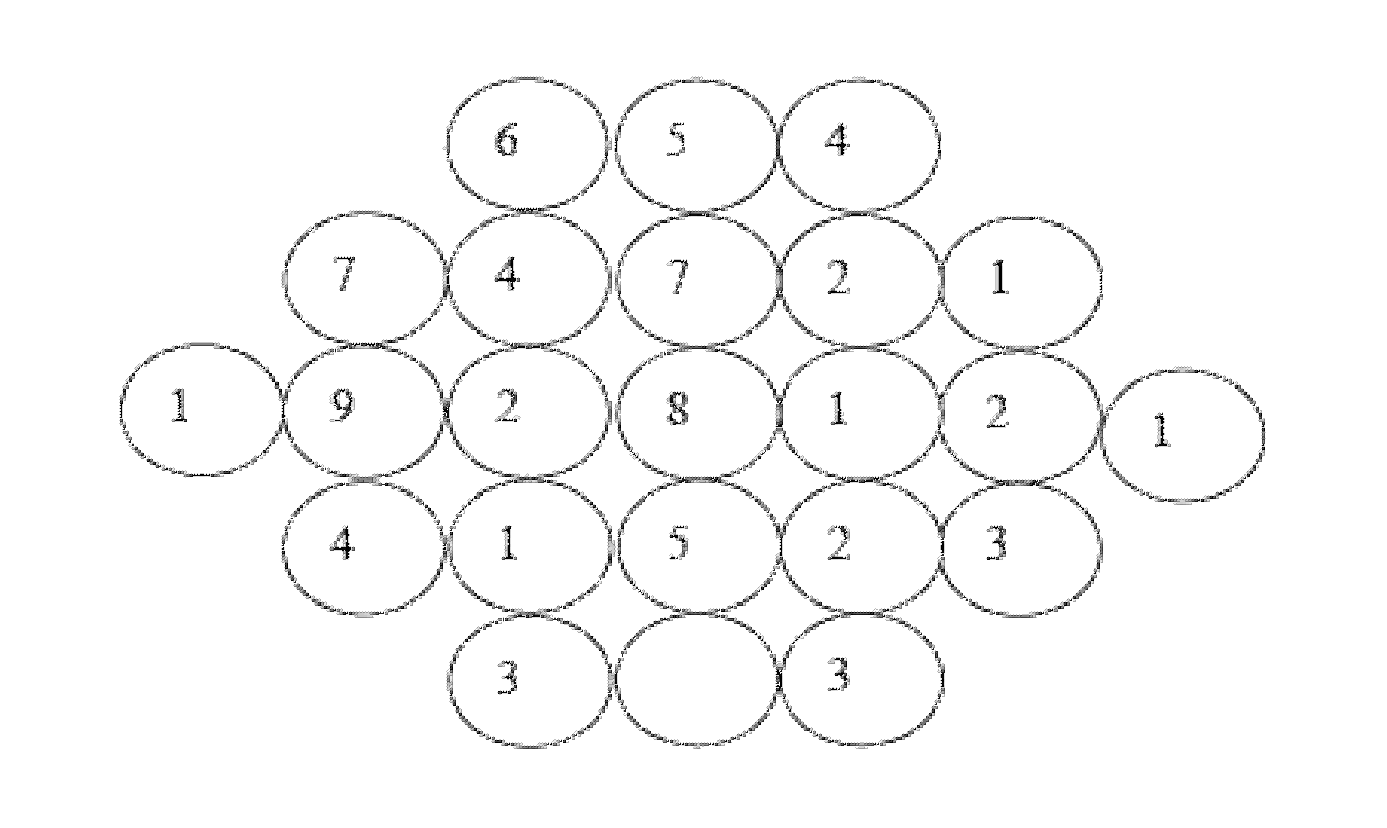
Fill in the missing value

Open complete paper

Showing 20 of 67 questions