My Cart
Your Cart 0

    Your cart is empty.

  • Total (Amount) ₹0.00
Previous year question hub

Particle and Rigid-body Dynamics - Mechanics of Rigid Bodies - Engineering Sciences Previous Year Questions

Practice Particle and Rigid-body Dynamics - Mechanics of Rigid Bodies - Engineering Sciences previous year questions organised from real papers, with year-wise coverage and clear topic navigation.

20Papers
20Years
100Questions
1Topics

Particle and Rigid-body Dynamics question pattern

Every graph below is calculated only from this selection.

Questions by year

Year-wise coverage for Particle and Rigid-body Dynamics. Each bar uses a separate theme-derived color.

Difficulty distribution

How the classified questions are distributed by difficulty.

Medium 63 63%
Easy 33 33%
Hard 4 4%
Question type distribution

MCQ, numerical, multiple-select and other formats found in these papers.

MCQ 64 64%
Numerical Answer Type (NAT) 29 29%
MSQ 4 4%
Fill in the blanks 3 3%

Subject weightage

Top subjects by unique question coverage.

Engineering Sciences
100 Qs

Most asked topics

Top topics across the included previous year papers.

Mechanics of Rigid Bodies
100 Qs

Subtopic coverage

Top subtopics inside this exact selection.

Particle and Rigid-body Dynamics
100 Qs

Paper coverage

Question coverage for the most populated papers. Every active PYP paper remains listed below.

Engineering Sciences (XE) 2026
2 Qs
Engineering Sciences (XE) 2025
5 Qs
Engineering Sciences (XE) 2024
4 Qs
Engineering Sciences (XE) 2023
4 Qs
Engineering Sciences (XE) 2022
7 Qs
Engineering Sciences (XE) 2021
4 Qs
Engineering Sciences (XE) 2020
4 Qs
Engineering Sciences (XE) 2019
3 Qs
Engineering Sciences (XE) 2018
4 Qs
Engineering Sciences (XE) 2017
3 Qs
Engineering Sciences (XE) 2016
5 Qs
Engineering Sciences (XE) 2015
5 Qs
Engineering Sciences (XE) 2014
4 Qs
Engineering Sciences (XE) 2013
5 Qs
Engineering Sciences (XE) 2012
4 Qs
Engineering Sciences (XE) 2011
7 Qs
Engineering Sciences (XE) 2010
7 Qs
Engineering Sciences (XE) 2009
10 Qs
Engineering Sciences (XE) 2008
4 Qs
Engineering Sciences (XE) 2007
9 Qs

Included previous year papers

Newest papers appear first. Sort by year, question coverage or name.

PaperYear / sessionQuestions in this viewOpen
Engineering Sciences (XE) 202620262View paper
Engineering Sciences (XE) 202520255View paper
Engineering Sciences (XE) 202420244View paper
Engineering Sciences (XE) 202320234View paper
Engineering Sciences (XE) 202220227View paper
Engineering Sciences (XE) 202120214View paper
Engineering Sciences (XE) 202020204View paper
Engineering Sciences (XE) 201920193View paper
Engineering Sciences (XE) 201820184View paper
Engineering Sciences (XE) 201720173View paper
Engineering Sciences (XE) 201620165View paper
Engineering Sciences (XE) 201520155View paper
Engineering Sciences (XE) 201420144View paper
Engineering Sciences (XE) 201320135View paper
Engineering Sciences (XE) 201220124View paper
Engineering Sciences (XE) 201120117View paper
Engineering Sciences (XE) 201020107View paper
Engineering Sciences (XE) 2009200910View paper
Engineering Sciences (XE) 200820084View paper
Engineering Sciences (XE) 200720079View paper

All Particle and Rigid-body Dynamics previous year questions

Practice every matching question in batches of 20, with every available option.

1
2007 · Engineering Sciences · Mechanics of Rigid Bodies · Particle and Rigid-body Dynamics
Engineering Sciences (XE) 2007
A D flip-flop is converted to T flip-flop by connecting a logic circuit at the input as shown in the figure.
The logic circuit is
Open complete paper
2
2007 · Engineering Sciences · Mechanics of Rigid Bodies · Particle and Rigid-body Dynamics
Engineering Sciences (XE) 2007
The frictional force acting on the cylinder is given by

Question diagram

Open complete paper
3
2007 · Engineering Sciences · Mechanics of Rigid Bodies · Particle and Rigid-body Dynamics
Engineering Sciences (XE) 2007
The angular acceleration of the cylinder is given by
Open complete paper
4
2007 · Engineering Sciences · Mechanics of Rigid Bodies · Particle and Rigid-body Dynamics
Engineering Sciences (XE) 2007
In a three-phase, Y-connected squirrel cage induction motor, if \(N_s\) is the synchronous speed, \(N_r\) is the rotor speed and \(s\) is the slip, then the speeds of the airgap field and the rotor field with respect to the stator structure will respectively be
Open complete paper
5
2007 · Engineering Sciences · Mechanics of Rigid Bodies · Particle and Rigid-body Dynamics
Engineering Sciences (XE) 2007
Two masses are attached to the two ends of a cable which passes over two frictionless pulleys as shown in the figure. (acceleration due to gravity = g)

The acceleration of the 100 kg mass is
Open complete paper
6
2007 · Engineering Sciences · Mechanics of Rigid Bodies · Particle and Rigid-body Dynamics
Engineering Sciences (XE) 2007
A mass \(m_1\) with velocity \(v_1\) impacts with a mass \(m_2\) at rest. After the impact, the mass \(m_1\) comes to rest. Then the coefficient of restitution \(e\) should be
Open complete paper
7
2007 · Engineering Sciences · Mechanics of Rigid Bodies · Particle and Rigid-body Dynamics
Engineering Sciences (XE) 2007
A mass of 2 kg is hung by a string of length 1.5m as shown in the figure. The mass revolves in a horizontal circular path at 50 revolutions per minute.
The tension in the string in Newtons is
Open complete paper
8
2007 · Engineering Sciences · Mechanics of Rigid Bodies · Particle and Rigid-body Dynamics
Engineering Sciences (XE) 2007
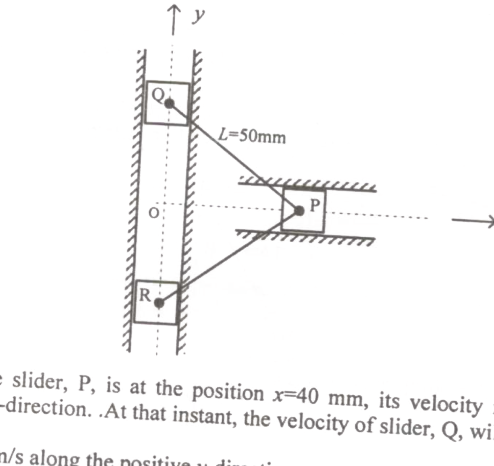
The rigid links PQ and PR of length \( L \) each are connected to 3 sliders P, Q and R, by pin-joints as shown in the figure. The sliders, Q and R, slide in the y-direction while by the slider, P, slides in the x-direction.
When the slider, P, is at the position \( x=40 \) mm, its velocity is 30 mm/s along the positive x-direction. At that instant, the velocity of slider, Q, will be

Question diagram

Open complete paper
9
2007 · Engineering Sciences · Mechanics of Rigid Bodies · Particle and Rigid-body Dynamics
Engineering Sciences (XE) 2007
A cylinder of radius $r$ and mass $m$ is placed with no initial velocity on a conveyor belt at B. There is a frictional contact between the cylinder and the belt away. A vertical stopper with a smooth surface prevents the cylinder from rolling away. ($I$, is the moment of inertia of the cylinder; $\alpha$, is the angular acceleration of the cylinder; $\mu$, is the coefficient of friction between the cylinder and the belt and, $g$, is the acceleration due to gravity)

The valid free-body diagram of the cylinder just after placing it on the belt (that shows inertial forces also) is
Open complete paper
10
2008 · Engineering Sciences · Mechanics of Rigid Bodies · Particle and Rigid-body Dynamics
Engineering Sciences (XE) 2008
A ball is thrown vertically upwards with a velocity of 10 m/s from a height of 40 m from the ground. If the air resistance is neglected and g = 9.8 m/s², the time taken by the ball to reach the ground is
Open complete paper
11
2008 · Engineering Sciences · Mechanics of Rigid Bodies · Particle and Rigid-body Dynamics
Engineering Sciences (XE) 2008
A ceiling fan of diameter, \( D \), and weight, \( W \), is suspended at a distance, \( L \), below the ceiling by a support rod. When the fan spins at high speed and creates a downward flow the force exerted by the fan on the support rod is
Open complete paper
12
2008 · Engineering Sciences · Mechanics of Rigid Bodies · Particle and Rigid-body Dynamics
Engineering Sciences (XE) 2008
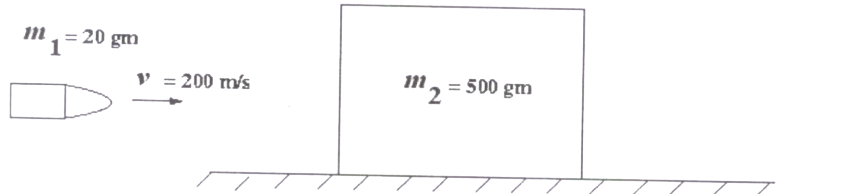
A bullet of mass \( m_1 = 20 \) gm fired horizontally with a velocity of \( v = 200 \) m/s hits a wooden block of mass \( m_2 = 500 \) gm (take \( g = 9.8 \) m/s²) resting on a horizontal plane as shown in the figure and the bullet remains embedded in the block after the impact. If the coefficient of friction between the surfaces in contact remains constant at 0.3, the distance the block will move before coming to rest is

Question diagram

Open complete paper
13
2008 · Engineering Sciences · Mechanics of Rigid Bodies · Particle and Rigid-body Dynamics
Engineering Sciences (XE) 2008
A lift originally moving downwards at 10 m/s is brought to rest with a constant retardation in a distance of 25m. The force with which the feet of a passenger of mass 80 kg ( take \(g = 9.8 m/s^2\)) press downwards on the floor of the lift is
Open complete paper
14
2009 · Engineering Sciences · Mechanics of Rigid Bodies · Particle and Rigid-body Dynamics
Engineering Sciences (XE) 2009
Which of the following statements are true ?
P : In Case 1, the system moves to the left
Q : In Case 1, the system moves to the right
R : In Case 2, the system moves to the left
S : In Case 2, the system moves to the right
Open complete paper
15
2009 · Engineering Sciences · Mechanics of Rigid Bodies · Particle and Rigid-body Dynamics
Engineering Sciences (XE) 2009
A projectile is fired from point P at an angle of 45° with horizontal as shown below. If g is the acceleration due to gravity, then the speed required to reach a point Q lying on the horizontal surface at a distance of R from point P is

Question diagram

Open complete paper
16
2009 · Engineering Sciences · Mechanics of Rigid Bodies · Particle and Rigid-body Dynamics
Engineering Sciences (XE) 2009
During plastic impact of two bodies, which of the following statement is correct ?
Open complete paper
17
2009 · Engineering Sciences · Mechanics of Rigid Bodies · Particle and Rigid-body Dynamics
Engineering Sciences (XE) 2009

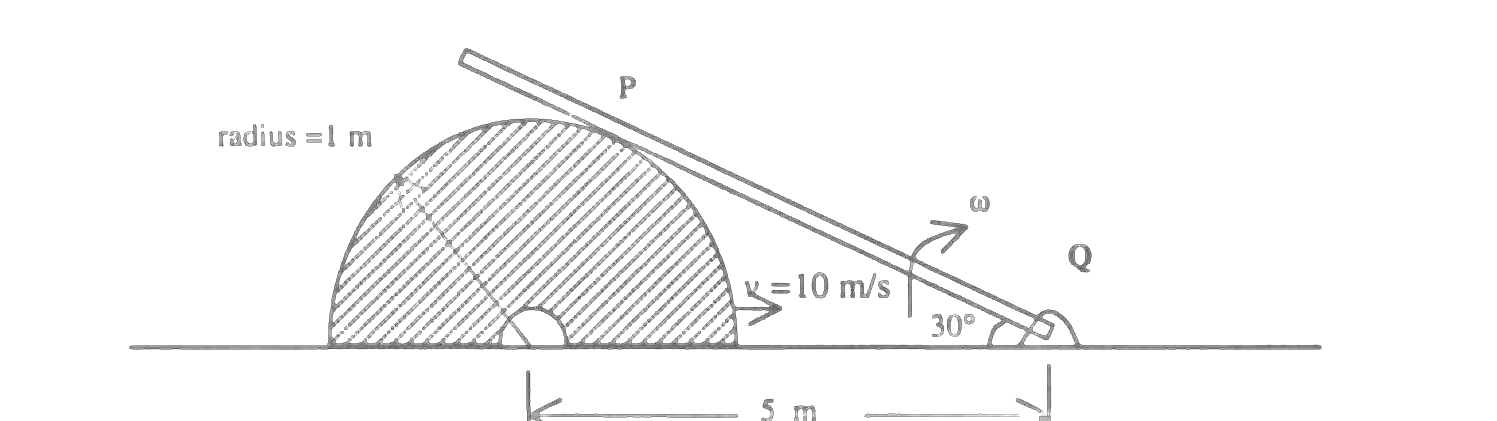
Rod PQ, whose end Q is hinged, touches a semi-circular cylinder at point P as shown below. There is no friction between the cylindrical surface and the rod. If the cylinder moves with a constant velocity of 10 m/s in the horizontal direction as shown, then the angular velocity ω of the rod PQ at that instant is

Open complete paper
18
2009 · Engineering Sciences · Mechanics of Rigid Bodies · Particle and Rigid-body Dynamics
Engineering Sciences (XE) 2009
The maximum compression of the spring is

Question diagram

Open complete paper
19
2009 · Engineering Sciences · Mechanics of Rigid Bodies · Particle and Rigid-body Dynamics
Engineering Sciences (XE) 2009
A disc of radius 1 m is rolling on the ground without slip as shown below. At a certain instant the center of the disc is moving with a velocity of 10 m/s and an acceleration of a = + 10 m/s2. The magnitude of acceleration of point P on the disc instantaneously touching the ground is
Open complete paper
20
2009 · Engineering Sciences · Mechanics of Rigid Bodies · Particle and Rigid-body Dynamics
Engineering Sciences (XE) 2009
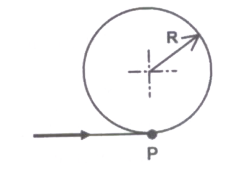
A particle enters into a smooth frictionless circular loop of radius \(R\), at point P as shown below. If \(g\) is the acceleration due to gravity, then the minimum speed with which the particle should enter the circular loop such that it can complete one full circular revolution is

Question diagram

Open complete paper

Showing 20 of 100 questions