Difficulty distribution
How the classified questions are distributed by difficulty.
Your cart is empty.
Practice Molecular Evolution and Phylogenetics - Evolution - Ecology and Evolution previous year questions organised from real papers, with year-wise coverage and clear topic navigation.
Every graph below is calculated only from this selection.
Year-wise coverage for Molecular Evolution and Phylogenetics. Each bar uses a separate theme-derived color.
How the classified questions are distributed by difficulty.
MCQ, numerical, multiple-select and other formats found in these papers.
Top subjects by unique question coverage.
Top topics across the included previous year papers.
Top subtopics inside this exact selection.
Question coverage for the most populated papers. Every active PYP paper remains listed below.
Newest papers appear first. Sort by year, question coverage or name.
| Paper | Year / session | Questions in this view | Open |
|---|---|---|---|
| Ecology and Evolution (EY) 2025 | 2025 | 4 | View paper |
| Ecology and Evolution (EY) 2024 | 2024 | 2 | View paper |
| Ecology and Evolution (EY) 2023 | 2023 | 2 | View paper |
| Ecology and Evolution (EY) 2022 | 2022 | 3 | View paper |
| Ecology and Evolution (EY) 2021 | 2021 | 3 | View paper |
| Ecology and Evolution (EY) 2020 | 2020 | 5 | View paper |
| Ecology and Evolution (EY) 2019 | 2019 | 5 | View paper |
| Ecology and Evolution (EY) 2018 | 2018 | 2 | View paper |
| Ecology and Evolution (EY) 2016 | 2016 | 2 | View paper |
| Ecology and Evolution (EY) 2015 | 2015 | 1 | View paper |
| Ecology and Evolution (EY) 2014 | 2014 | 2 | View paper |
Practice every matching question in batches of 20, with every available option.
Copies of genes that arrive in a particular genome by horizontal gene transfer are known as
| P | Q | R | S | |
|---|---|---|---|---|
| i) | 0 | 1 | 0 | 0 |
| ii) | 1 | 1 | 0 | 0 |
| iii) | 1 | 1 | 1 | 0 |
| iv) | 1 | 1 | 0 | 0 |
| v) | 1 | 1 | 1 | 0 |
| vi) | 0 | 1 | 0 | 0 |
| vii) | 1 | 1 | 1 | 0 |
| viii) | 0 | 1 | 0 | 0 |
| ix) | 1 | 1 | 1 | 0 |
The rates of non-synonymous and synonymous change per site are dN and dS respectively. Which of the following mechanisms explains the evolution of a gene with dN/dS = 0.2?
Which of the following assumptions allows us to use molecular clocks to estimate species divergence times?
Match species in column A to its phylogenetically closest relative in column B.
| Column A | Column B |
|---|---|
| (P) Sperm whale | (V) Sea anemone |
| (Q) Corals | (W) Guinea Pig |
| (R) Platypus | (X) Cuttlefish |
| (S) Sea hare | (Y) Hippopotamus |
| (T) Prairie dog | (Z) Echidna |

A particular gene sequence from two different species shows molecular clock-like evolution. Which of the following statements is consistent with this observation?
For a given gene there is 5% DNA sequence divergence between two species, however the protein coded by this gene has identical sequences in the two species. Which of the following types of mutations best explains this pattern in the DNA sequence?
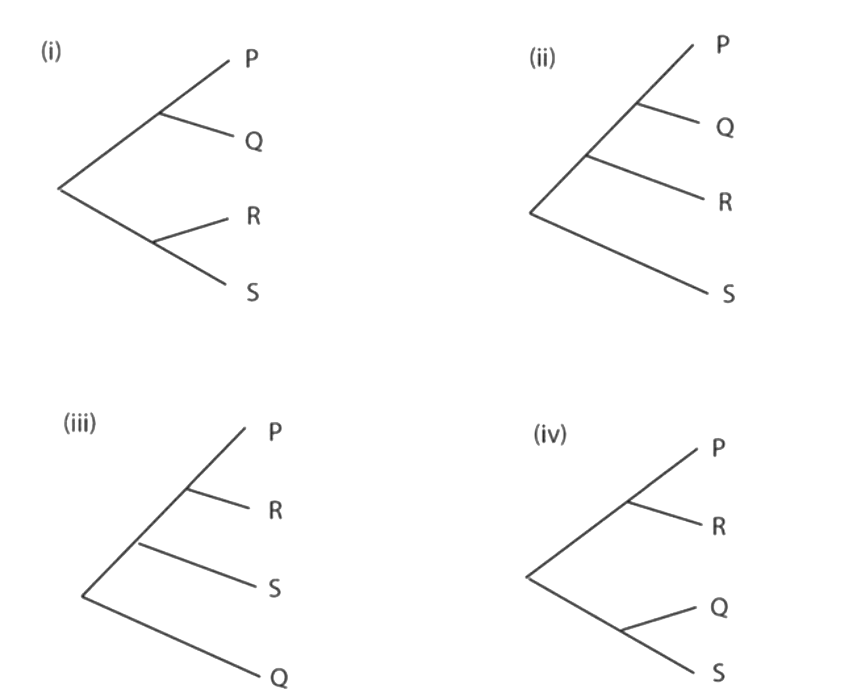
Among four related bird species P, Q, R, and S, species P and Q are nectar feeding with long thin beaks, whereas species R and S are seed eaters with short thick beaks. Which of the following phylogenies unambiguously suggests that seed eating habit was the ancestral state?

Following a gene duplication event, the duplicated copy often loses function and is called a pseudogene. In the absence of positive selection, which of the following is true about these genes?


Showing 20 of 31 questions