My Cart
Your Cart 0

    Your cart is empty.

  • Total (Amount) ₹0.00
Previous year question hub

Macroevolution - Evolution - Ecology and Evolution Previous Year Questions

Practice Macroevolution - Evolution - Ecology and Evolution previous year questions organised from real papers, with year-wise coverage and clear topic navigation.

7Papers
7Years
7Questions
1Topics

Macroevolution question pattern

Every graph below is calculated only from this selection.

Questions by year

Year-wise coverage for Macroevolution. Each bar uses a separate theme-derived color.

Difficulty distribution

How the classified questions are distributed by difficulty.

Easy 3 42.9%
Medium 3 42.9%
Hard 1 14.3%
Question type distribution

MCQ, numerical, multiple-select and other formats found in these papers.

MCQ 5 71.4%
MSQ 2 28.6%

Subject weightage

Top subjects by unique question coverage.

Ecology and Evolution
7 Qs

Most asked topics

Top topics across the included previous year papers.

Evolution
7 Qs

Subtopic coverage

Top subtopics inside this exact selection.

Macroevolution
7 Qs

Paper coverage

Question coverage for the most populated papers. Every active PYP paper remains listed below.

Ecology and Evolution (EY) 2025
1 Qs
Ecology and Evolution (EY) 2024
1 Qs
Ecology and Evolution (EY) 2023
1 Qs
Ecology and Evolution (EY) 2022
1 Qs
Ecology and Evolution (EY) 2019
1 Qs
Ecology and Evolution (EY) 2018
1 Qs
Ecology and Evolution (EY) 2016
1 Qs

Included previous year papers

Newest papers appear first. Sort by year, question coverage or name.

PaperYear / sessionQuestions in this viewOpen
Ecology and Evolution (EY) 202520251View paper
Ecology and Evolution (EY) 202420241View paper
Ecology and Evolution (EY) 202320231View paper
Ecology and Evolution (EY) 202220221View paper
Ecology and Evolution (EY) 201920191View paper
Ecology and Evolution (EY) 201820181View paper
Ecology and Evolution (EY) 201620161View paper

All Macroevolution previous year questions

Practice every matching question in batches of 20, with every available option.

1
2018 · Ecology and Evolution · Evolution · Macroevolution
Ecology and Evolution (EY) 2018
During the Pleistocene, which of the following groups experienced the largest mass extinction?
Open complete paper
2
2019 · Ecology and Evolution · Evolution · Macroevolution
Ecology and Evolution (EY) 2019

A phylogenetic study finds that certain plants of peninsular India are more closely related to those in Australia than to those in China. Which of the following statements best explains this result?

Open complete paper
3
2024 · Ecology and Evolution · Evolution · Macroevolution
Ecology and Evolution (EY) 2024

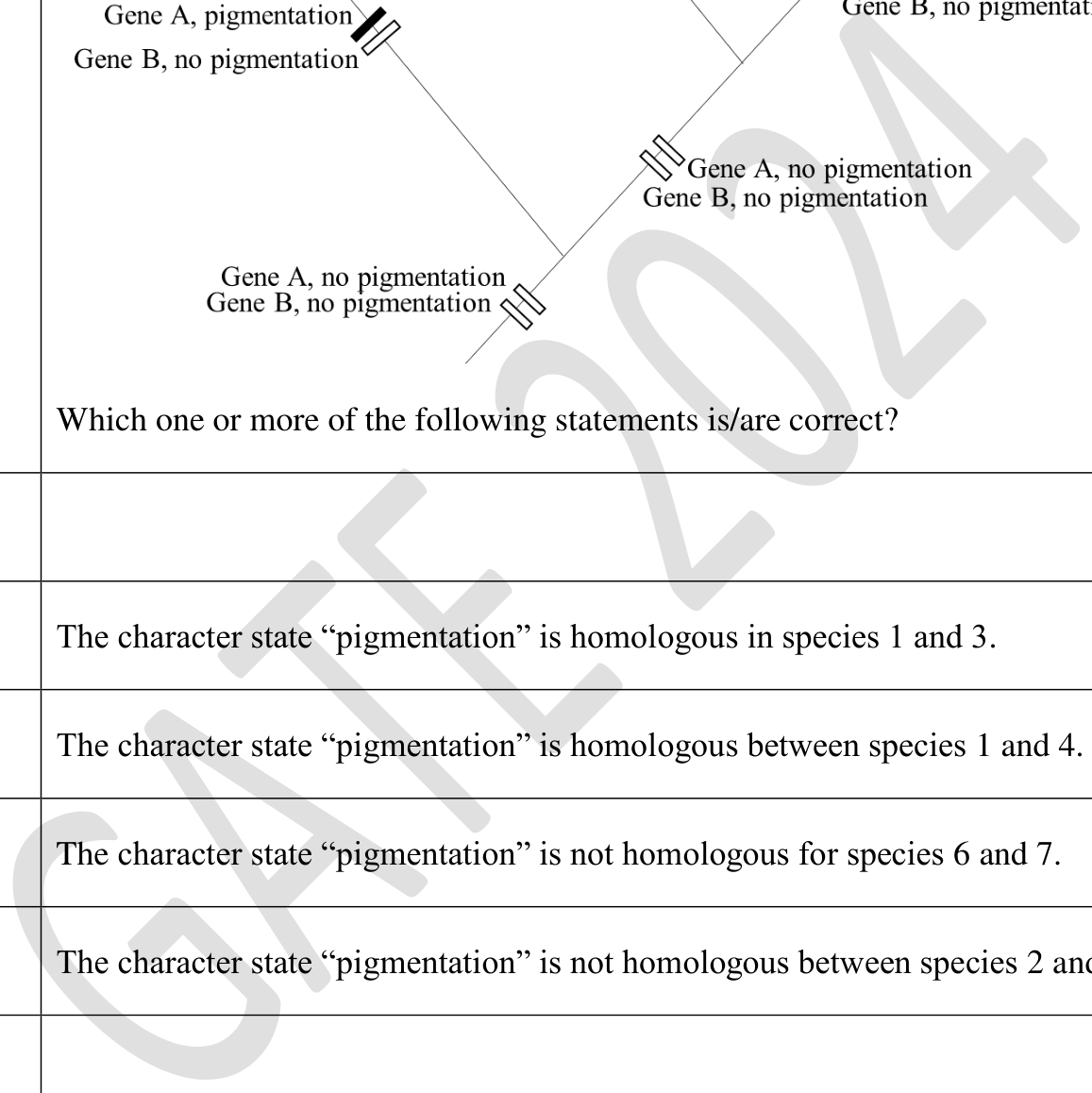
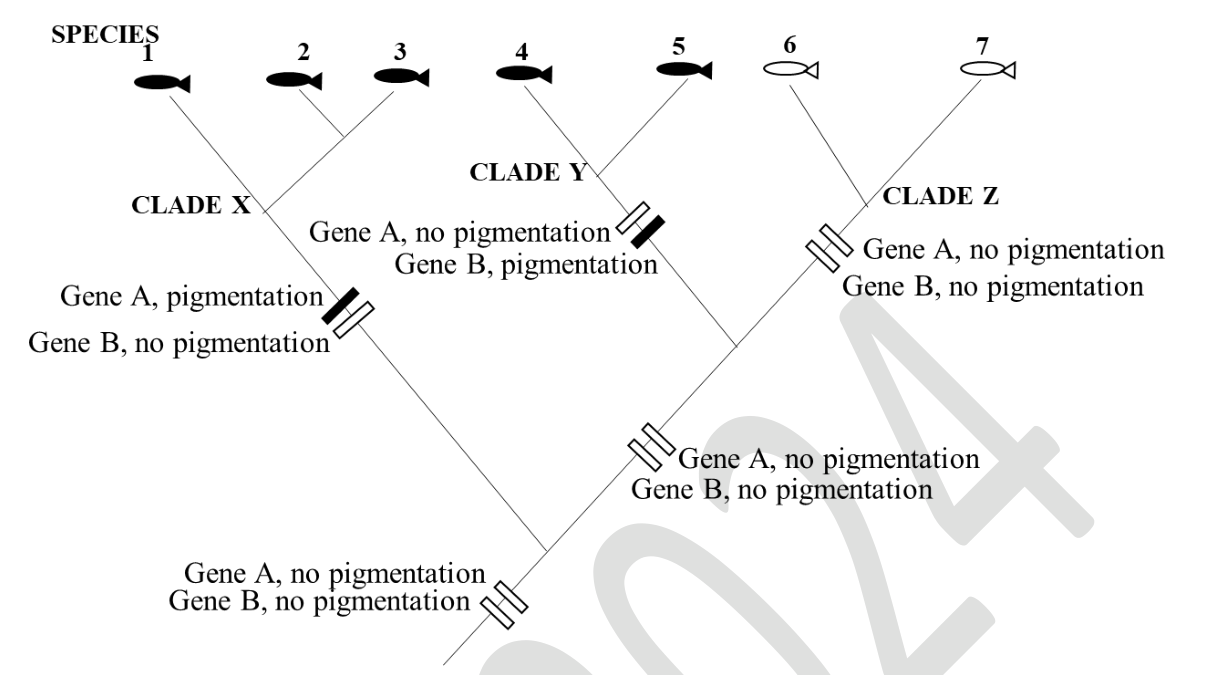
A phylogenetic tree for the evolution of two pigmentation traits in species of fish is shown for clades X, Y and Z. Genes A and/or B, if mutated, can cause dark pigmentation in the body. Which one or more of the following statements is/are correct?

Source question diagram

Source question diagram

Open complete paper
4
2025 · Ecology and Evolution · Evolution · Macroevolution
Ecology and Evolution (EY) 2025
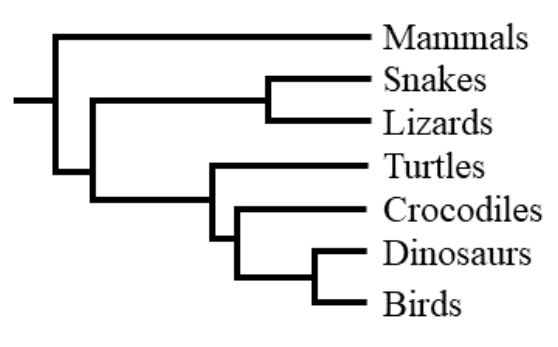
A phylogenetic tree representing the evolutionary relationship between various vertebrates is shown below.

Given this tree topology, which one or more of the following statements is/are correct?

Source question diagram

Open complete paper
5
2016 · Ecology and Evolution · Evolution · Macroevolution
Ecology and Evolution (EY) 2016
Fresh water fish belonging to the family Galaxiidae are found exclusively in the southern parts of the continents of South America, Africa and Australia. This pattern is explained by the theory proposed by:
Open complete paper
6
2022 · Ecology and Evolution · Evolution · Macroevolution
Ecology and Evolution (EY) 2022
Which one or more of the following reasons has/have been invoked to explain island gigantism?
Open complete paper
7
2023 · Ecology and Evolution · Evolution · Macroevolution
Ecology and Evolution (EY) 2023
The mode of speciation in snakes in the Western Ghats is predominantly allopatric. A researcher wants to quantify diversification of snakes in this range. From the options given, choose the most cost and time efficient way to sample snakes.
Open complete paper