My Cart
Your Cart 0

    Your cart is empty.

  • Total (Amount) ₹0.00
Previous year question hub

Fundamentals - Evolution - Ecology and Evolution Previous Year Questions

Practice Fundamentals - Evolution - Ecology and Evolution previous year questions organised from real papers, with year-wise coverage and clear topic navigation.

11Papers
11Years
40Questions
1Topics

Fundamentals question pattern

Every graph below is calculated only from this selection.

Questions by year

Year-wise coverage for Fundamentals. Each bar uses a separate theme-derived color.

Difficulty distribution

How the classified questions are distributed by difficulty.

Easy 30 75%
Medium 10 25%

Question type distribution

MCQ, numerical, multiple-select and other formats found in these papers.

MCQ 31 77.5%
MSQ 7 17.5%
Numerical Answer Type (NAT) 2 5%

Subject weightage

Top subjects by unique question coverage.

Ecology and Evolution
40 Qs

Most asked topics

Top topics across the included previous year papers.

Evolution
40 Qs

Subtopic coverage

Top subtopics inside this exact selection.

Fundamentals
40 Qs

Paper coverage

Question coverage for the most populated papers. Every active PYP paper remains listed below.

Ecology and Evolution (EY) 2026
4 Qs
Ecology and Evolution (EY) 2025
4 Qs
Ecology and Evolution (EY) 2024
1 Qs
Ecology and Evolution (EY) 2023
3 Qs
Ecology and Evolution (EY) 2022
3 Qs
Ecology and Evolution (EY) 2021
5 Qs
Ecology and Evolution (EY) 2020
4 Qs
Ecology and Evolution (EY) 2019
4 Qs
Ecology and Evolution (EY) 2018
5 Qs
Ecology and Evolution (EY) 2016
2 Qs
Ecology and Evolution (EY) 2014
5 Qs

Included previous year papers

Newest papers appear first. Sort by year, question coverage or name.

PaperYear / sessionQuestions in this viewOpen
Ecology and Evolution (EY) 202620264View paper
Ecology and Evolution (EY) 202520254View paper
Ecology and Evolution (EY) 202420241View paper
Ecology and Evolution (EY) 202320233View paper
Ecology and Evolution (EY) 202220223View paper
Ecology and Evolution (EY) 202120215View paper
Ecology and Evolution (EY) 202020204View paper
Ecology and Evolution (EY) 201920194View paper
Ecology and Evolution (EY) 201820185View paper
Ecology and Evolution (EY) 201620162View paper
Ecology and Evolution (EY) 201420145View paper

All Fundamentals previous year questions

Practice every matching question in batches of 20, with every available option.

1
2014 · Ecology and Evolution · Evolution · Fundamentals
Ecology and Evolution (EY) 2014
Darwin's ideas on evolution by natural selection were influenced by
Open complete paper
2
2014 · Ecology and Evolution · Evolution · Fundamentals
Ecology and Evolution (EY) 2014

Phenotypic plasticity refers to

Open complete paper
3
2014 · Ecology and Evolution · Evolution · Fundamentals
Ecology and Evolution (EY) 2014

Death feigning behaviour (i.e., pretending to be dead when attacked) is found in snakes and millipedes. This similarity in behaviour between snakes and millipedes is an example of

Open complete paper
4
2014 · Ecology and Evolution · Evolution · Fundamentals
Ecology and Evolution (EY) 2014

Which of the following conditions is NOT necessary for evolution by natural selection?

Open complete paper
5
2014 · Ecology and Evolution · Evolution · Fundamentals
Ecology and Evolution (EY) 2014
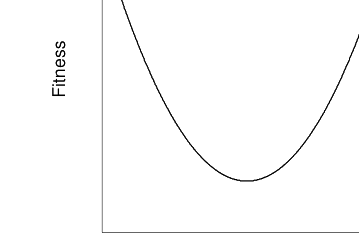
The figure below shows how reproductive fitness varies with tail length in a bird species. Given this pattern, what kind of selection is most likely to act on tail length in this population?

Question diagram

Open complete paper
6
2018 · Ecology and Evolution · Evolution · Fundamentals
Ecology and Evolution (EY) 2018

Which of the following is NOT an example of phenotypic plasticity?

Open complete paper
7
2018 · Ecology and Evolution · Evolution · Fundamentals
Ecology and Evolution (EY) 2018

Identify the graph in which natural selection on beak size is LEAST likely to be occurring? For each of the graphs, the slope of the regression line and the associated p-value is given.

Question diagram

Open complete paper
8
2018 · Ecology and Evolution · Evolution · Fundamentals
Ecology and Evolution (EY) 2018

Moth ears typically consist of a membranous eardrum backed by an air cavity. Ears in different phylogenetic groups of moths have evolved on different body parts. Moth ears are thus best described as

Open complete paper
9
2018 · Ecology and Evolution · Evolution · Fundamentals
Ecology and Evolution (EY) 2018

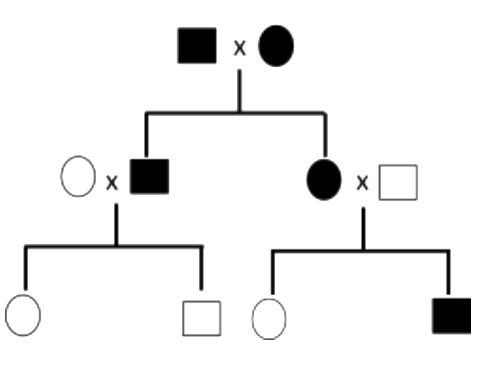
The pedigree below details a late onset genetic disease among humans. Males are represented as squares and females as circles. Individuals with the disease are depicted as black, and those without it are depicted as white. Which of the following best describes the pattern of inheritance of the disease-causing gene?

Question diagram

Open complete paper
10
2018 · Ecology and Evolution · Evolution · Fundamentals
Ecology and Evolution (EY) 2018
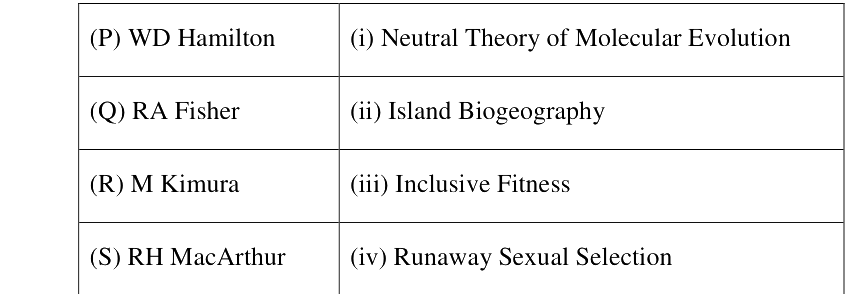
Match the following scientists with the concepts or theories they are associated with.

Question diagram

Open complete paper
11
2019 · Ecology and Evolution · Evolution · Fundamentals
Ecology and Evolution (EY) 2019

The evolutionary change in the timing of development is known as

Open complete paper
12
2019 · Ecology and Evolution · Evolution · Fundamentals
Ecology and Evolution (EY) 2019

While developing his theory of evolution by natural selection, Charles Darwin was influenced by the work of

Open complete paper
13
2019 · Ecology and Evolution · Evolution · Fundamentals
Ecology and Evolution (EY) 2019

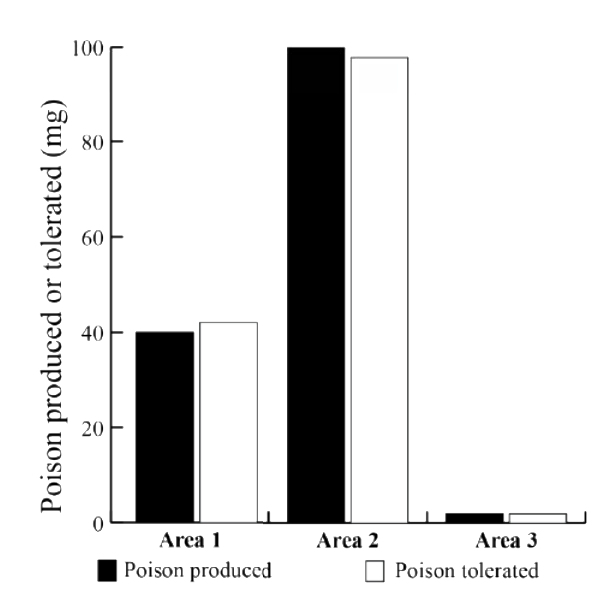
Garter snakes have evolved resistance to the poisonous secretions of the rough-skinned newts. The following figure describes poison production in newts and the resistance (measured as amount of poison tolerated) in garter snakes in three different geographical areas. Given this information, which of the following statements is correct regarding the evolution of poison resistance in garter snakes?

Question diagram

Open complete paper
14
2019 · Ecology and Evolution · Evolution · Fundamentals
Ecology and Evolution (EY) 2019
In a recently discovered fossil, only 0.39% of \(C^{14}\) found in living fossils is present. If the half-life of \(C^{14}\) is 5730 years, the age of the fossil is expected to be ________ years (round off to the nearest integer).
Open complete paper
15
2020 · Ecology and Evolution · Evolution · Fundamentals
Ecology and Evolution (EY) 2020
Who among the following was a strong public supporter of Darwin’s theory of evolution by natural selection?
Open complete paper
16
2020 · Ecology and Evolution · Evolution · Fundamentals
Ecology and Evolution (EY) 2020

Which of the following criteria is used to define species under the biological species concept?

Open complete paper
17
2020 · Ecology and Evolution · Evolution · Fundamentals
Ecology and Evolution (EY) 2020
A fragment of double stranded DNA has 30% Adenine. The % GC content in this fragment is ____ .
Open complete paper
18
2020 · Ecology and Evolution · Evolution · Fundamentals
Ecology and Evolution (EY) 2020

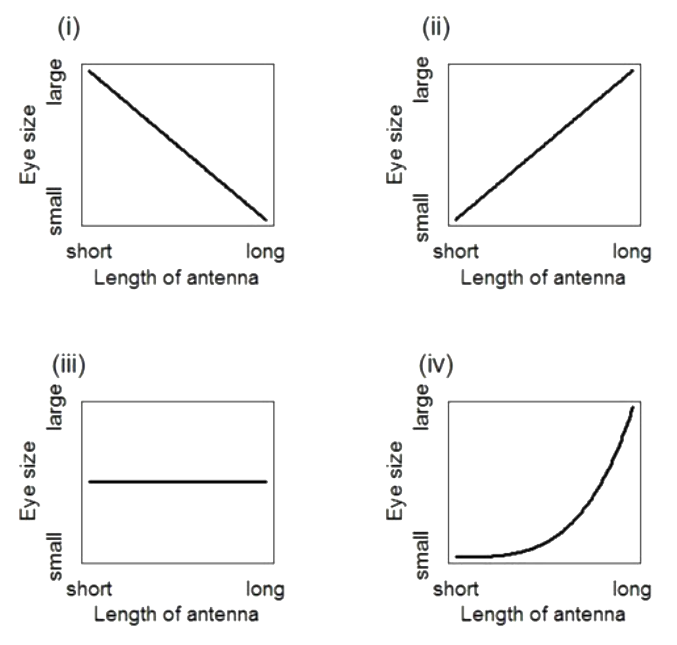
In a nocturnal moth species (X), individuals with longer antennae have smaller eyes. This indicates a sensory trade-off. In a closely related but diurnal moth species (Y), individuals exhibit the same obligate sensory trade-off. Which of the following figures describes the relationship between these two traits in moth species Y, if it relies more on vision than olfaction?

Question diagram

Open complete paper
19
2021 · Ecology and Evolution · Evolution · Fundamentals
Ecology and Evolution (EY) 2021
The theory of evolution by natural selection was proposed by which one (or more) of the following?
Open complete paper
20
2021 · Ecology and Evolution · Evolution · Fundamentals
Ecology and Evolution (EY) 2021
Which of the following is/are necessary condition(s) for natural selection to shape limb lengths in a population?
Open complete paper

Showing 20 of 40 questions