Interactions - Ecology - Ecology and Evolution Previous Year Questions
Practice Interactions - Ecology - Ecology and Evolution previous year questions organised from real papers, with year-wise coverage and clear topic navigation.
10Papers
10Years
46Questions
1Topics
Interactions question pattern
Every graph below is calculated only from this selection.
Questions by year
Year-wise coverage for Interactions. Each bar uses a separate theme-derived color.
Difficulty distribution
How the classified questions are distributed by difficulty.
46questions
Medium32
69.6%
Easy14
30.4%
Question type distribution
MCQ, numerical, multiple-select and other formats found in these papers.
46questions
MCQ39
84.8%
MSQ6
13%
Numerical Answer Type (NAT)1
2.2%
Subject weightage
Top subjects by unique question coverage.
Ecology and Evolution
46 Qs
Most asked topics
Top topics across the included previous year papers.
Ecology
46 Qs
Subtopic coverage
Top subtopics inside this exact selection.
Interactions
46 Qs
Paper coverage
Question coverage for the most populated papers. Every active PYP paper remains listed below.
Ecology and Evolution (EY) 2025
5 Qs
Ecology and Evolution (EY) 2024
5 Qs
Ecology and Evolution (EY) 2023
6 Qs
Ecology and Evolution (EY) 2022
4 Qs
Ecology and Evolution (EY) 2021
2 Qs
Ecology and Evolution (EY) 2020
6 Qs
Ecology and Evolution (EY) 2019
1 Qs
Ecology and Evolution (EY) 2018
6 Qs
Ecology and Evolution (EY) 2016
6 Qs
Ecology and Evolution (EY) 2014
5 Qs
Included previous year papers
Newest papers appear first. Sort by year, question coverage or name.
Practice every matching question in batches of 20, with every available option.
1
2014 · Ecology and Evolution · Ecology · Interactions
Ecology and Evolution (EY) 2014
Grazing by large herbivores can increase plant diversity by which of the following mechanisms? (i) Reducing abundance of dominant plants and favouring rare species (ii) Accelerating rates of nutrient cycling in the ecosystem (iii) Promoting photo-respiration by increasing ambient CO2 concentration (iv) Decreasing stomatal conductance which promotes biomass production
2014 · Ecology and Evolution · Ecology · Interactions
Ecology and Evolution (EY) 2014
The figure panels below show population growth in two species, when they are grown alone, and also when they are grown together. From the nature of their growth curves, one can infer that the interaction between these species is an example of
2014 · Ecology and Evolution · Ecology · Interactions
Ecology and Evolution (EY) 2014
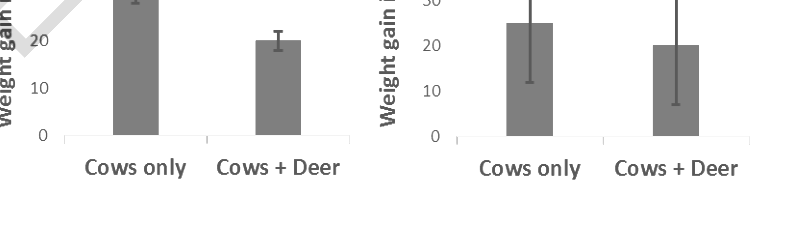
In an experiment, cows were allowed to graze in closed pastures either with wild deer or without wild deer. This experiment was done in the rainy and dry seasons. The results for weight gain in the cows (mean and 95% confidence interval) are shown in the figure below. Based on these results which of the following statements is true?
2014 · Ecology and Evolution · Ecology · Interactions
Ecology and Evolution (EY) 2014
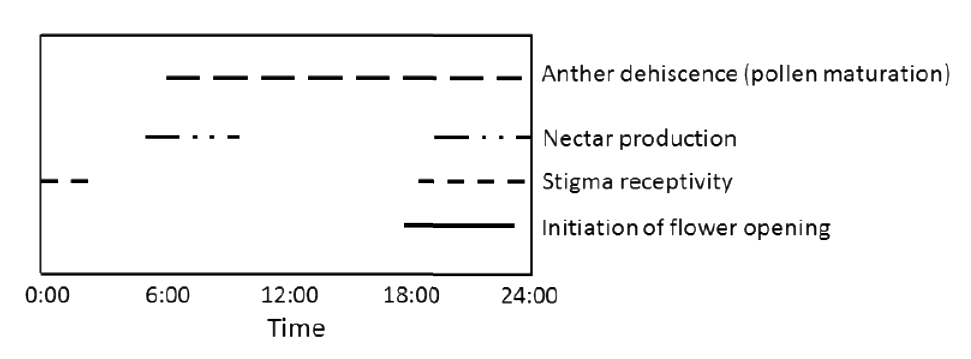
Species P and Species Q are respectively self-pollinated and cross-pollinated plants that are closely related. Their flowers are visited by bees. Correctly identify which sets of traits are characteristic of Species P relative to the traits of Species Q
2018 · Ecology and Evolution · Ecology · Interactions
Ecology and Evolution (EY) 2018
A non-venomous, non-toxic species of snake is brightly coloured and closely resembles a venomous snake species in the same habitat. This is most likely a case of
2018 · Ecology and Evolution · Ecology · Interactions
Ecology and Evolution (EY) 2018
A study examined the effect of neighbours on plants when grown at low or high altitudes. The researcher measured Relative Neighbour Effect (RNE), defined as: RNE = Biomass with neighbours – Biomass without neighbours.
2018 · Ecology and Evolution · Ecology · Interactions
Ecology and Evolution (EY) 2018
The probability that a bush has a cricket is 0.1. The probability of a spider being present on a bush is 0.2. When both a spider and a cricket are present on a bush, the probability of encountering each other is 0.2. The probability of a spider consuming a cricket it encounters is 0.5. Assuming that predation only occurs on bushes, the probability that a cricket is preyed on by a spider is ____ (answer up to 3 decimal places).
2020 · Ecology and Evolution · Ecology · Interactions
Ecology and Evolution (EY) 2020
Beetles of one species have the option of eating plant species X or Y in their environment. Plant species X and Y have the same nutritional quality. When beetle diets comprise a greater proportion of plant X, the population size of beetles increases faster than when beetle diets are dominated by plant Y. Which of the following is NOT a probable explanation for this outcome?
2020 · Ecology and Evolution · Ecology · Interactions
Ecology and Evolution (EY) 2020
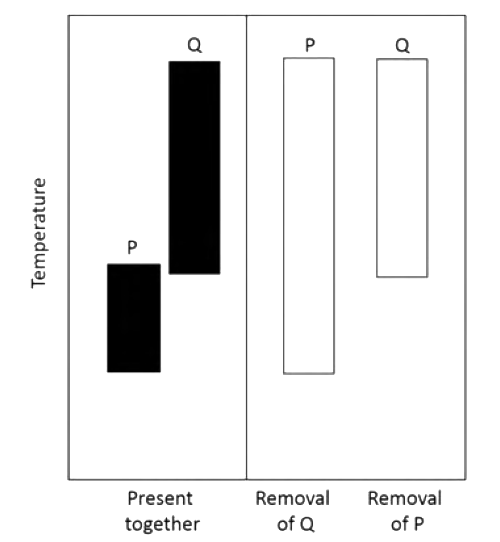
Two species of snails, P and Q, are found in rivers across a range of temperatures that vary from upstream to downstream. An experiment was conducted in which P was removed from a river and the distribution of Q was measured after a few weeks. In another similar river, the reciprocal experiment was conducted in which Q was removed, and the distribution of P was measured after a few weeks. In the graph below, the filled bars plot the distribution of P and Q when both species are present in a river. The open bars plot the distribution of P when Q is removed, and Q when P is removed. Which of the following statements is true?
2020 · Ecology and Evolution · Ecology · Interactions
Ecology and Evolution (EY) 2020
An internal parasite of a mammal does not generate its own heat and yet it can maintain a constant body temperature. Which characteristics describe this parasite?
2021 · Ecology and Evolution · Ecology · Interactions
Ecology and Evolution (EY) 2021
Hunting is a major source of mortality for large frugivorous birds. These birds disperse the seeds of forest trees and are the primary contributors to forest regeneration. The graphs show the distribution of different age-classes of a frugivore-dispersed tree species at two isolated sites.
Based on the graphs, select the most likely conclusion.
2021 · Ecology and Evolution · Ecology · Interactions
Ecology and Evolution (EY) 2021
In an Arctic Ocean food chain, killer whales feed on sea otters, which feed on sea urchins, which in turn feed on kelp (a type of seaweed). An increase in the abundance of killer whales causes sea otter abundance to decline, leading to higher sea urchin densities, which in turn reduces the abundance of kelp. Which one of the following terms describes this phenomenon?