Fundamental Concepts - Ecology - Ecology and Evolution Previous Year Questions
Practice Fundamental Concepts - Ecology - Ecology and Evolution previous year questions organised from real papers, with year-wise coverage and clear topic navigation.
10Papers
10Years
33Questions
1Topics
Fundamental Concepts question pattern
Every graph below is calculated only from this selection.
Questions by year
Year-wise coverage for Fundamental Concepts. Each bar uses a separate theme-derived color.
Difficulty distribution
How the classified questions are distributed by difficulty.
33questions
Easy26
78.8%
Medium7
21.2%
Question type distribution
MCQ, numerical, multiple-select and other formats found in these papers.
33questions
MCQ28
84.8%
MSQ5
15.2%
Subject weightage
Top subjects by unique question coverage.
Ecology and Evolution
33 Qs
Most asked topics
Top topics across the included previous year papers.
Ecology
33 Qs
Subtopic coverage
Top subtopics inside this exact selection.
Fundamental Concepts
33 Qs
Paper coverage
Question coverage for the most populated papers. Every active PYP paper remains listed below.
Ecology and Evolution (EY) 2025
2 Qs
Ecology and Evolution (EY) 2024
3 Qs
Ecology and Evolution (EY) 2023
6 Qs
Ecology and Evolution (EY) 2022
3 Qs
Ecology and Evolution (EY) 2021
3 Qs
Ecology and Evolution (EY) 2020
4 Qs
Ecology and Evolution (EY) 2019
2 Qs
Ecology and Evolution (EY) 2018
2 Qs
Ecology and Evolution (EY) 2016
4 Qs
Ecology and Evolution (EY) 2014
4 Qs
Included previous year papers
Newest papers appear first. Sort by year, question coverage or name.
2014 · Ecology and Evolution · Ecology · Fundamental Concepts
Ecology and Evolution (EY) 2014
Christian Bergmann, a 19th century biologist, observed that related taxa showed increasing body size with increasing latitude. One explanation for this pattern, also called ‘Bergmann’s Rule’, is
2014 · Ecology and Evolution · Ecology · Fundamental Concepts
Ecology and Evolution (EY) 2014
Temperate organisms have wider tolerance ranges for temperature than do tropical organisms. If temperatures increase across the globe by 2°C, which of the following is possible?
2019 · Ecology and Evolution · Ecology · Fundamental Concepts
Ecology and Evolution (EY) 2019
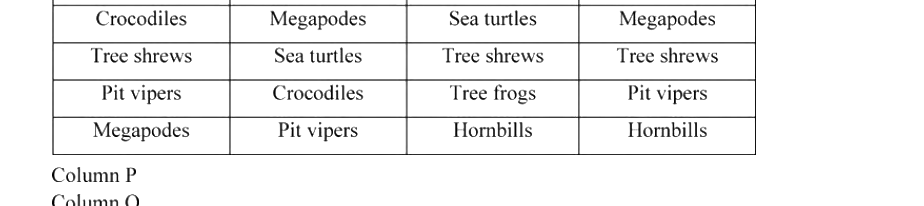
Gut passage time is defined as the time taken from ingestion to excretion of a food item. Which among the following animals has the longest gut passage time?
2019 · Ecology and Evolution · Ecology · Fundamental Concepts
Ecology and Evolution (EY) 2019
Bergmann's rule describes the increase in body size observed in related organisms as we go from the equator to the poles. Which of the following is a possible explanation for this pattern?
2020 · Ecology and Evolution · Ecology · Fundamental Concepts
Ecology and Evolution (EY) 2020
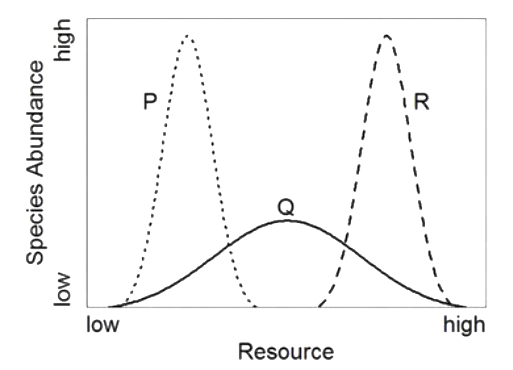
The abundances of three species (P, Q, and R) were measured along a resource gradient. The resultant pattern is summarized in the figure. Which of the following statements can be inferred from niche theory?
2021 · Ecology and Evolution · Ecology · Fundamental Concepts
Ecology and Evolution (EY) 2021
In an island chain, species richness (S) increases with island area (A) according to the equation, \( S = 4.3 A^{0.55} \). Which one of the following graphs best represents this equation?
2021 · Ecology and Evolution · Ecology · Fundamental Concepts
Ecology and Evolution (EY) 2021
Consider 1000 terrestrial species that have geographical ranges of different shapes and sizes. If the Earth were entirely covered by land (no oceans), and the ranges of these species were overlaid on the surface of the Earth at random, which one of the following patterns is expected?
2024 · Ecology and Evolution · Ecology · Fundamental Concepts
Ecology and Evolution (EY) 2024
Terrestrial plants conduct gas exchange through stomata. Having only few stomata on the leaf surface is a common adaptation to which one of the following conditions?
2024 · Ecology and Evolution · Ecology · Fundamental Concepts
Ecology and Evolution (EY) 2024
Some air-breathing marine vertebrates such as whales, seals and marine turtles possess adaptations for long, deep dives. Which one or more of the following is/are examples of such adaptations?
2024 · Ecology and Evolution · Ecology · Fundamental Concepts
Ecology and Evolution (EY) 2024
You are a plant ecologist studying a plant in the genus Veronica. You notice that, at open rocky sites, Veronica grows as a creeper spreading low to the ground, whereas in grasslands, the stem stands upright. You collect seeds from multiple populations in each habitat type and grow them under uniform conditions in a greenhouse. You find that all the plants grown in the greenhouse have stems that stand upright. Which one or more of the following explanations best support(s) your observations?
2025 · Ecology and Evolution · Ecology · Fundamental Concepts
Ecology and Evolution (EY) 2025
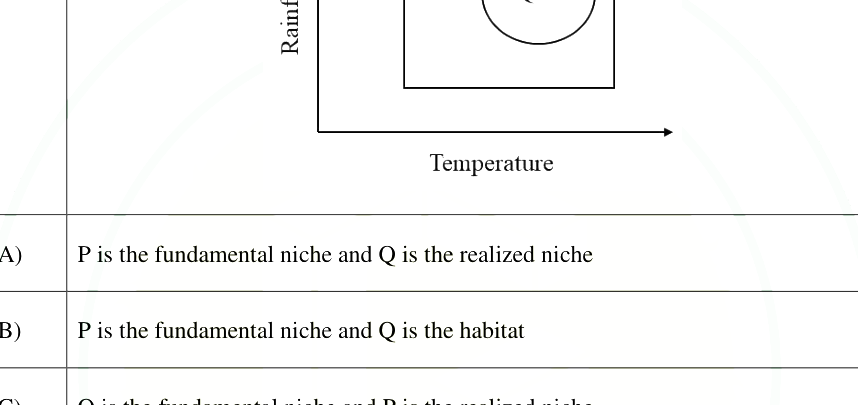
In this figure, the rectangle (P) depicts the range of temperature and rainfall in which a plant species can survive and propagate. The circle (Q) demarcates the range of temperature and rainfall in which this plant species is actually found. Which one of the following statements about P and Q is accurate for this plant species?
2025 · Ecology and Evolution · Ecology · Fundamental Concepts
Ecology and Evolution (EY) 2025
Decreasing surface area to volume ratio helps reduce heat loss in colder climates. In which one or more of the following observations does this play a role?