My Cart
Your Cart 0

    Your cart is empty.

  • Total (Amount) ₹0.00
Previous year question hub

Foraging and Reproduction - Behavioural Ecology - Ecology and Evolution Previous Year Questions

Practice Foraging and Reproduction - Behavioural Ecology - Ecology and Evolution previous year questions organised from real papers, with year-wise coverage and clear topic navigation.

10Papers
10Years
37Questions
1Topics

Foraging and Reproduction question pattern

Every graph below is calculated only from this selection.

Questions by year

Year-wise coverage for Foraging and Reproduction. Each bar uses a separate theme-derived color.

Difficulty distribution

How the classified questions are distributed by difficulty.

Medium 21 56.8%
Easy 16 43.2%

Question type distribution

MCQ, numerical, multiple-select and other formats found in these papers.

MCQ 26 70.3%
MSQ 6 16.2%
Fill in the blanks 3 8.1%
Numerical Answer Type (NAT) 2 5.4%

Subject weightage

Top subjects by unique question coverage.

Ecology and Evolution
37 Qs

Most asked topics

Top topics across the included previous year papers.

Behavioural Ecology
37 Qs

Subtopic coverage

Top subtopics inside this exact selection.

Foraging and Reproduction
37 Qs

Paper coverage

Question coverage for the most populated papers. Every active PYP paper remains listed below.

Ecology and Evolution (EY) 2025
3 Qs
Ecology and Evolution (EY) 2024
5 Qs
Ecology and Evolution (EY) 2023
3 Qs
Ecology and Evolution (EY) 2022
2 Qs
Ecology and Evolution (EY) 2021
3 Qs
Ecology and Evolution (EY) 2020
4 Qs
Ecology and Evolution (EY) 2019
3 Qs
Ecology and Evolution (EY) 2018
3 Qs
Ecology and Evolution (EY) 2016
4 Qs
Ecology and Evolution (EY) 2014
7 Qs

Included previous year papers

Newest papers appear first. Sort by year, question coverage or name.

PaperYear / sessionQuestions in this viewOpen
Ecology and Evolution (EY) 202520253View paper
Ecology and Evolution (EY) 202420245View paper
Ecology and Evolution (EY) 202320233View paper
Ecology and Evolution (EY) 202220222View paper
Ecology and Evolution (EY) 202120213View paper
Ecology and Evolution (EY) 202020204View paper
Ecology and Evolution (EY) 201920193View paper
Ecology and Evolution (EY) 201820183View paper
Ecology and Evolution (EY) 201620164View paper
Ecology and Evolution (EY) 201420147View paper

All Foraging and Reproduction previous year questions

Practice every matching question in batches of 20, with every available option.

1
2014 · Ecology and Evolution · Behavioural Ecology · Foraging and Reproduction
Ecology and Evolution (EY) 2014

Two sympatric species of fruit flies congregate on the fruit of two closely related species of trees for mating. The cue most likely to be used by these fly species to locate their mates from a long distance would be

Question diagram

Open complete paper
2
2014 · Ecology and Evolution · Behavioural Ecology · Foraging and Reproduction
Ecology and Evolution (EY) 2014

According to foraging theory, if two food items are commonly available and equally abundant, an optimal forager should choose the item that

Question diagram

Open complete paper
3
2014 · Ecology and Evolution · Behavioural Ecology · Foraging and Reproduction
Ecology and Evolution (EY) 2014

All else being equal, in a species with two sexes, which of the following is true with regard to mate choice?

Open complete paper
4
2014 · Ecology and Evolution · Behavioural Ecology · Foraging and Reproduction
Ecology and Evolution (EY) 2014
Birds that are brood parasites lay eggs in the nests of other birds. This is a successful strategy for the parasite only if
Open complete paper
5
2014 · Ecology and Evolution · Behavioural Ecology · Foraging and Reproduction
Ecology and Evolution (EY) 2014
Birds show much variation in sexual size dimorphism (body size differences between males and females), which is hypothesized to be associated with their mating system. Match the two groups below to reflect the expected pattern in mating system and sexual size dimorphism in birds.
Open complete paper
6
2014 · Ecology and Evolution · Behavioural Ecology · Foraging and Reproduction
Ecology and Evolution (EY) 2014
The figure below shows how competition among foragers in a resource patch reduces individual foraging rates. According to this figure, the expected foraging rate for a solitary individual is ______________.
Open complete paper
7
2014 · Ecology and Evolution · Behavioural Ecology · Foraging and Reproduction
Ecology and Evolution (EY) 2014
In birds that pair during the breeding season, it is hypothesized that males need to aggressively guard their mates against mating with intruder males. To test this hypothesis, a scientist presents a male dummy bird to a male bird on his territory just before the female lays her eggs. The dummy is left on the territory. The male was aggressive towards the dummy before the eggs were laid and this aggression declined after egg-laying. Which additional experiment will NOT provide further information to test this hypothesis?
Open complete paper
8
2018 · Ecology and Evolution · Behavioural Ecology · Foraging and Reproduction
Ecology and Evolution (EY) 2018

In which of the following mating systems is sperm competition likely to evolve?

Open complete paper
9
2018 · Ecology and Evolution · Behavioural Ecology · Foraging and Reproduction
Ecology and Evolution (EY) 2018

Some species of spiders add additional silk ‘decorations’ to their webs. It is hypothesized that these decorations serve either to lure flies (prey) or to decrease bird (predator) attacks on the spiders. The appropriate way to test these hypotheses would be to compare numbers of

Open complete paper
10
2018 · Ecology and Evolution · Behavioural Ecology · Foraging and Reproduction
Ecology and Evolution (EY) 2018

A fish species is sexually dimorphic: males possess ultraviolet (UV) spots on their bodies which are lacking in females. Females prefer males with larger and more intense UV spots as mates. Which of the following statements is a plausible reason for the spots being coloured ultraviolet?

Open complete paper
11
2019 · Ecology and Evolution · Behavioural Ecology · Foraging and Reproduction
Ecology and Evolution (EY) 2019

Females in many birds and mammals mate with multiple males, in addition to their paired-male. Which of the following is an INCORRECT adaptive explanation for such extra-pair mating?

Open complete paper
12
2019 · Ecology and Evolution · Behavioural Ecology · Foraging and Reproduction
Ecology and Evolution (EY) 2019
A researcher hypothesized that females of a bird species prefer to mate with long-tailed males. To test this hypothesis, she assigned male birds of similar tail lengths to one of the following four treatments:
1. Intact – tails left unmanipulated
2. Re-attached – tails cut and re-attached without any change in length
3. Shortened – tails cut, shortened and re-attached
4. Elongated – tails cut, elongated and re-attached
She measured mating success of these experimental birds and the results from this are shown below. Error bars represent 95% confidence intervals. Which of the following inferences are consistent with these results?
i. Experimental manipulation of tails decreased male mating success
ii. Females preferred to mate with males with short tails
iii. Females preferred to mate with males with long tails
Open complete paper
13
2019 · Ecology and Evolution · Behavioural Ecology · Foraging and Reproduction
Ecology and Evolution (EY) 2019
A hornbill foraging exclusively on figs in a tropical forest spends an average of 36 minutes on a tree before moving to the next tree. The density of fig trees in the forest decreases by half. In accordance with optimal foraging theory, which of following represents a possible duration (in minutes) that the hornbill may spend per tree?
Open complete paper
14
2020 · Ecology and Evolution · Behavioural Ecology · Foraging and Reproduction
Ecology and Evolution (EY) 2020

Which of the following sensory mechanisms do most frugivorous bats primarily use while foraging?

Open complete paper
15
2020 · Ecology and Evolution · Behavioural Ecology · Foraging and Reproduction
Ecology and Evolution (EY) 2020

What would an evolutionary biologist hypothesize as the ultimate cause for the presence of colourful dewlaps in lizards?

Open complete paper
16
2020 · Ecology and Evolution · Behavioural Ecology · Foraging and Reproduction
Ecology and Evolution (EY) 2020
On one side of a house, a 50 watt bulb attracts moths at a rate of 30 individuals/minute. On the other side of the house, a 15 watt bulb attracts moths at a rate of 10 individuals/minute. There are 20 bats in the area who are foraging for these moths. According to Ideal Free Distribution, the number of bats near the 15 watt bulb should be ______.
Open complete paper
17
2020 · Ecology and Evolution · Behavioural Ecology · Foraging and Reproduction
Ecology and Evolution (EY) 2020

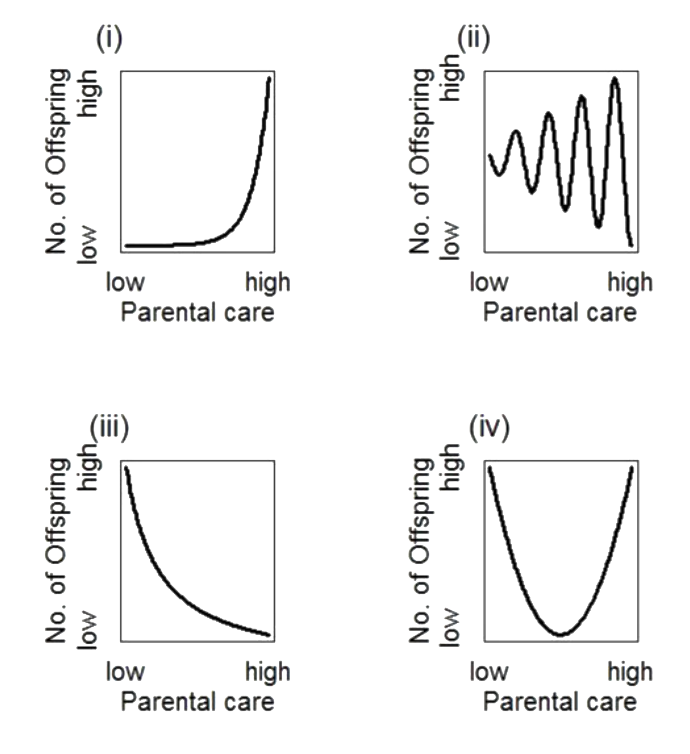
Which of the figures represents the expected relationship between parental care and the number of offspring produced across taxa?

Question diagram

Open complete paper
18
2021 · Ecology and Evolution · Behavioural Ecology · Foraging and Reproduction
Ecology and Evolution (EY) 2021
Male beetles are of two phenotypes: horned and hornless. Horned males mate with twice as many females compared with hornless males. But females mated to hornless males produce one-third more offspring. The reproductive success of a male (number of offspring fathered) is the number of females he mates with multiplied by the number of offspring each female produces. The reproductive success of horned males is __________ times that of hornless males. (Round off to one decimal place.)
Open complete paper
19
2021 · Ecology and Evolution · Behavioural Ecology · Foraging and Reproduction
Ecology and Evolution (EY) 2021
Animal species can vary in whether dispersal is more likely among male offspring (male-biased), female offspring (female-biased), or similar between the sexes. Dispersal in birds and mammals is most commonly
Open complete paper
20
2021 · Ecology and Evolution · Behavioural Ecology · Foraging and Reproduction
Ecology and Evolution (EY) 2021
The marginal value theorem in optimal foraging theory examines which one of the following foraging decisions?
Open complete paper

Showing 20 of 37 questions