Exam Details
JEE MAIN 2026 ONLINE 21ST JANUARY MORNING SHIFT
Review the key details, then start the test when you are ready. You can also open the full package to see related papers.
Questions
75
Duration
180 mins
Package
IIT-JEE Main - Previous Year Papers
Paper pattern & analysis
Filter this paper by subject, topic or subtopic. Every graph updates from the selected questions.
Topic distribution
Subtopic distribution
Difficulty distribution
75questions
Medium
52
69.3%
Easy
19
25.3%
Hard
4
5.3%
Question type distribution
75questions
Multiple Choices
60
80%
Numerical Answer Type (NAT)
15
20%
Syllabus
Full Syllabus
Sample questions from this paper
Questions are selected across the paper subjects wherever the paper contains that variety.
2026 · Physics · Mechanics · Heat And Thermodynamics
JEE MAIN 2026 ONLINE 21ST JANUARY MORNING SHIFT
10 mole of oxygen is heated at constant volume from $30^{\circ} \mathrm{C}$ to $40^{\circ} \mathrm{C}$. The change in the internal energy of the gas is $\_\_\_\_$ cal. (The molecular specific heat of oxygen at constant pressure, $C_P=7 \mathrm{cal} / \mathrm{mol} .{ }^{\circ} \mathrm{C}$ and $\left.\mathrm{R}=2 \mathrm{cal} . / \mathrm{mol} .{ }^{\circ} \mathrm{C}.\right)$
Enter a numerical response
2026 · Chemistry · Physical Chemistry · Chemical Kinetics And Nuclear Chemistry
JEE MAIN 2026 ONLINE 21ST JANUARY MORNING SHIFT
Pre-exponential factors of two different reactions of same order are identical. Let activation energy of first reaction exceeds the activation energy of second reaction by $20 \mathrm{~kJ} \mathrm{~mol}^{-1}$. If $\mathrm{k}_1$ and $\mathrm{k}_2$ are the rate constants of first and second reaction respectively at 300 K , then $\ln \frac{\mathrm{k}_2}{\mathrm{k}_1}$ will be $\_\_\_\_$ . (nearest integer) $\left[\mathrm{R}=8.3 \mathrm{~J} \mathrm{~K}^{-1} \mathrm{~mol}^{-1}\right]$
Enter a numerical response
2026 · Mathematics · Algebra · Sequences And Series
JEE MAIN 2026 ONLINE 21ST JANUARY MORNING SHIFT
Let $a_1=1$ and for $n \geqslant 1, a_{n+1}=\frac{1}{2} a_n+\frac{n^2-2 n-1}{n^2(n+1)^2}$. Then $\left|\sum_{n=1}^{\infty}\left(a_n-\frac{2}{n^2}\right)\right|$ is equal to $\_\_\_\_$ .
Enter a numerical response
2026 · Physics · Electricity · Current Electricity
JEE MAIN 2026 ONLINE 21ST JANUARY MORNING SHIFT
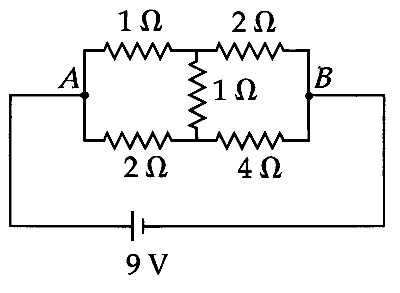
The heat generated in 1 minute between points $A$ and $B$ in the given circuit, when a battery of 9 V with internal resistance of $1 \Omega$ is connected across these points is $\_\_\_\_$ J.
Enter a numerical response
2026 · Chemistry · Physical Chemistry · Thermodynamics
JEE MAIN 2026 ONLINE 21ST JANUARY MORNING SHIFT
$$\begin{aligned} &\text { Use the following data : }\\ &\begin{array}{|c|c|c|} \hline \text { Substance } & \frac{\Delta_f \mathrm{H}^{\ominus}(500 \mathrm{~K})}{\mathrm{kJ} \mathrm{~mol}^{-1}} & \frac{\mathrm{~S}^{\ominus}(500 \mathrm{~K})}{\mathrm{JK}^{-1} \mathrm{~mol}^{-1}} \\ \hline \mathrm{AB}(\mathrm{~g}) & 32 & 222 \\ \hline \mathrm{~A}_2(\mathrm{~g}) & 6 & 146 \\ \hline \mathrm{~B}_2(\mathrm{~g}) & x & 280 \\ \hline \end{array} \end{aligned}$$
One mole each of $\mathrm{A}_2(\mathrm{~g})$ and $\mathrm{B}_2(\mathrm{~g})$ are taken in a 1 L closed flask and allowed to establish the equilibrium at 500 K .
$$\mathrm{A}_2(\mathrm{~g})+\mathrm{B}_2(\mathrm{~g}) \rightleftharpoons 2 \mathrm{AB}(\mathrm{~g})$$
The value of $x\left(\mathrm{in} \mathrm{kJ} \mathrm{mol}^{-1}\right)$ is $\_\_\_\_$ . (Nearest integer)
(Given : $\log \mathrm{K}=2.2 \quad \mathrm{R}=8.3 \mathrm{~J} \mathrm{~K}^{-1} \mathrm{~mol}^{-1}$ )
Enter a numerical response
2026 · Mathematics · Algebra · Permutations And Combinations
JEE MAIN 2026 ONLINE 21ST JANUARY MORNING SHIFT
Let $S=\{(m, n): m, n \in\{1,2,3, \ldots . ., 50\}\}$. If the number of elements $(m, n)$ in $S$ such that $6^m+9^n$ is a multiple of 5 is $p$ and the number of elements ( $m, n$ ) in $S$ such that $m+n$ is a square of a prime number is q , then $\mathrm{p}+\mathrm{q}$ is equal to $\_\_\_\_$ .
Enter a numerical response