My Cart
Your Cart 0

    Your cart is empty.

  • Total (Amount) ₹0.00
Exam Details

IIT JEE 2008 PAPER 1 OFFLINE

Review the key details, then start the test when you are ready. You can also open the full package to see related papers.

Questions 69
Duration 180 mins
Package IIT-JEE Advance - Previous Year Papers

Paper pattern & analysis

Filter this paper by subject, topic or subtopic. Every graph updates from the selected questions.

Explore previous papers
Showing all 69 questions in this paper.

Subject distribution

Physics
23 Qs
Chemistry
23 Qs
Mathematics
23 Qs

Topic distribution

Mechanics
13 Qs
Physical Chemistry
8 Qs
Algebra
8 Qs
Inorganic Chemistry
7 Qs
Coordinate Geometry
7 Qs
Calculus
7 Qs
Organic Chemistry
6 Qs
Modern Physics
5 Qs
Electricity
3 Qs
Optics
2 Qs
Organic Chemistry
2 Qs
Trigonometry
1 Qs

Subtopic distribution

P Block Elements
5 Qs
Atoms And Nuclei
4 Qs
Properties Of Matter
4 Qs
Solutions
3 Qs
Haloalkanes And Haloarenes
3 Qs
Aldehydes Ketones And Carboxylic Acids
3 Qs
Complex Numbers
3 Qs
Circle
3 Qs
Laws Of Motion
2 Qs
Impulse And Momentum
2 Qs
Gravitation
2 Qs
Current Electricity
2 Qs

Difficulty distribution

Medium 43 62.3%
Easy 16 23.2%
Hard 10 14.5%

Question type distribution

Multiple Choices 69 100%

Syllabus

Full Syllabus

Sample questions from this paper

Questions are selected across the paper subjects wherever the paper contains that variety.

1
2008 · Physics · Mechanics · Laws Of Motion
IIT JEE 2008 PAPER 1 OFFLINE

The speed of the block at point C, immediately before it leaves the second incline is

A
\(\sqrt{120}\) m/s
B
\(\sqrt{105}\) m/s
C
\(\sqrt{90}\) m/s
D
\(\sqrt{75}\) m/s
2
2008 · Chemistry · Physical Chemistry · Gaseous State
IIT JEE 2008 PAPER 1 OFFLINE

A gas described by van Der Waals equation

A
behaves similar to an ideal gas in the limit of large molar volumes.
B
behaves similar to an ideal gas in the limit of large pressures.
C
is characterized by van der Waals coefficients that are dependent on the identity of the gas but are independent of the temperature.
D
has the pressure that is lower than the pressure exerted by the same gas behaving ideally.
3
2008 · Mathematics · Algebra · Sequences And Series
IIT JEE 2008 PAPER 1 OFFLINE
Let \({S_n} = \sum\limits_{k = 1}^n {{n \over {{n^2} + kn + {k^2}}}}\) and \({T_n} = \sum\limits_{k = 0}^{n - 1} {{n \over {{n^2} + kn + {k^2}}}}\) for \(n\) \(=1, 2, 3, ............\) Then,
A
\({S_n} < {\pi \over {3\sqrt 3 }}\)
B
\({S_n} > {\pi \over {3\sqrt 3 }}\)
C
\({T_n} < {\pi \over {3\sqrt 3 }}\)
D
\({T_n} > {\pi \over {3\sqrt 3 }}\)
4
2008 · Physics · Modern Physics · Atoms And Nuclei
IIT JEE 2008 PAPER 1 OFFLINE

Assume that the nuclear binding energy per nucleon (B/A) versus mass number (A) is as shown in the figure. Use this plot to choose the correct choice(s) given below.
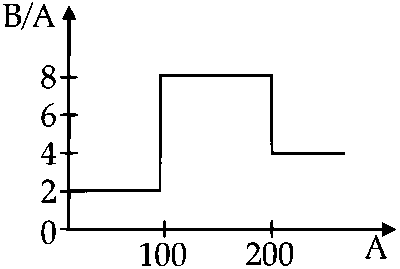
IIT-JEE 2008 Paper 1 Offline Physics - Atoms and Nuclei Question 14 English

A
Fusion of two nuclei with mass number lying in the range of 1 < A < 50 will release energy
B
Fusion of two nuclei with mass numbers lying in the range of 51 < A < 100 will release energy
C
Fission of a nucleus lying in the mass range of 100 < A < 200 will release energy when broken into two equal fragments
D
Fission of a nucleus lying in the mass range of 200 < A < 260 will release energy when broken into two equal fragments
5
2008 · Chemistry · Physical Chemistry · Chemical Equilibrium
IIT JEE 2008 PAPER 1 OFFLINE

Statement 1 : For every chemical reaction at equilibrium, standard Gibbs energy of reaction is zero.

and

Statement 2 : At constant temperature and pressure, chemical reactions are spontaneous in the direction of decreasing Gibbs energy.

A
Statement 1 is True, Statement 2 is True; Statement 2 is correct explanation for Statement 1.
B
Statement 1 is True, Statement 2 is True; Statement 2 is NOT correct explanation for Statement 1.
C
Statement 1 is True, Statement 2 is False.
D
Statement 1 is False, Statement 2 is True.
6
2008 · Mathematics · Algebra · 3D Geometry
IIT JEE 2008 PAPER 1 OFFLINE
Consider three planes \({P_1}:x - y + z = 1\) \({P_2}:x + y - z = 1\) \({P_3}:x - 3y + 3z = 2\)

Let \({L_1},\) \({L_2},\) \({L_3}\) be the lines of intersection of the planes \({P_2}\) and \({P_3},\) \({P_3}\) and \({P_1},\) \({P_1}\) and \({P_2},\) respectively.

STATEMENT - 1Z: At least two of the lines \({L_1},\) \({L_2}\) and \({L_3}\) are non-parallel and

STATEMENT - 2: The three planes doe not have a common point.

A
STATEMENT - 1 is True, STATEMENT - 2 is True; STATEMENT - 2 is a correct explanation for STATEMENT - 1
B
STATEMENT - 1 is True, STATEMENT - 2 is True; STATEMENT - 2 is NOT a correct explanation for STATEMENT - 1
C
STATEMENT - 1 is True, STATEMENT - 2 is False
D
STATEMENT - 1 is False, STATEMENT - 2 is True