Exam Details
IAT IISER 2020
Review the key details, then start the test when you are ready. You can also open the full package to see related papers.
Questions
60
Duration
180 mins
Package
IAT IISER- Previous Year Papers
Paper pattern & analysis
Filter this paper by subject, topic or subtopic. Every graph updates from the selected questions.
Topic distribution
Subtopic distribution
Difficulty distribution
60questions
Not classified
60
100%
Question type distribution
60questions
Multiple Choices
60
100%
Syllabus
Full Syllabus
Sample questions from this paper
Questions are selected across the paper subjects wherever the paper contains that variety.
2020 · Chemistry · Inorganic Chemistry · P Block Elements
IAT IISER 2020
Which among the following is NOT correct?
2020 · Physics · Mechanics · Laws Of Motion
IAT IISER 2020
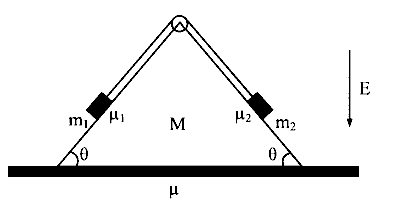
Consider a mass-pulley system as shown in the figure. There is a wedge of mass $M$ and equal wedge angles $\theta$ lying on a rigid horizontal table. The coefficient of friction between the wedge and the table is $\mu$. There are two blocks of mass $m_1$ and $m_2$ lying on the incline of the wedge. The coefficients of friction between the blocks and wedge are $\mu_1$ and $\mu_2$ as shown in the figure. Consider $m_1>m_2$ and the coefficients of friction ( $\mu, \mu_1$ and $\mu_2$ ) to be less than $\tan \theta$. Gravity is acting downwards with acceleration due to gravity $g$. What should be the value of $\frac{m_1}{m_2}$ so that the system is in equilibrium?
2020 · Mathematics · Trigonometry · Trigonometric Equations
IAT IISER 2020
If S is the set of all points $(x, y)$ satisfying the equation $\sin x=\cos y$, then which of the following statements is correct?
2020 · Biology · Botany · Cell Cycle And Cell Division
IAT IISER 2020
$$\text { Match the human cell types or (column I) to the number of chromatids (column II) }$$
| Column I | Column II | ||
|---|---|---|---|
| (a) | Col\(G_2 \text { phase cells } \) |
(i) | 46 |
| (b) | $$ G_1 \text { phase cells } $$ |
(ii) | 92 |
| (c) | Spermatogonia (pre-replication) |
(iii) | 23 |
| (d) | Ovum | ||
2020 · Chemistry · Inorganic Chemistry · Coordination Compounds
IAT IISER 2020
\(\text { The number of unpaired electron(s) in the square planar complex }[\text{Ni}(\text{CN})_4]^{2-} \text { is/are }\) :
2020 · Physics · Mechanics · Work Energy And Power
IAT IISER 2020
The potential energy of a point particle of mass $m$ undergoing rectilinear motion along the $x$-axis is given by
$$V(x)=A x+B x^2$$
What is the maximum speed attained by the particle if it starts from rest at $x=\frac{A}{B}$ ?