Exam Details
Ecology and Evolution (EY) 2026
Review the key details, then start the test when you are ready. You can also open the full package to see related papers.
Questions
65
Duration
180 mins
Package
Ecology and Evolution (EY) - Previous Year Papers
Paper pattern & analysis
Filter this paper by subject, topic or subtopic. Every graph updates from the selected questions.
Topic distribution
Subtopic distribution
Difficulty distribution
65questions
Easy
65
100%
Question type distribution
65questions
MCQ
49
75.4%
MSQ
10
15.4%
Numerical Answer Type (NAT)
6
9.2%
Sample questions from this paper
Questions are selected across the paper subjects wherever the paper contains that variety.
2026 · Unclassified
Ecology and Evolution (EY) 2026
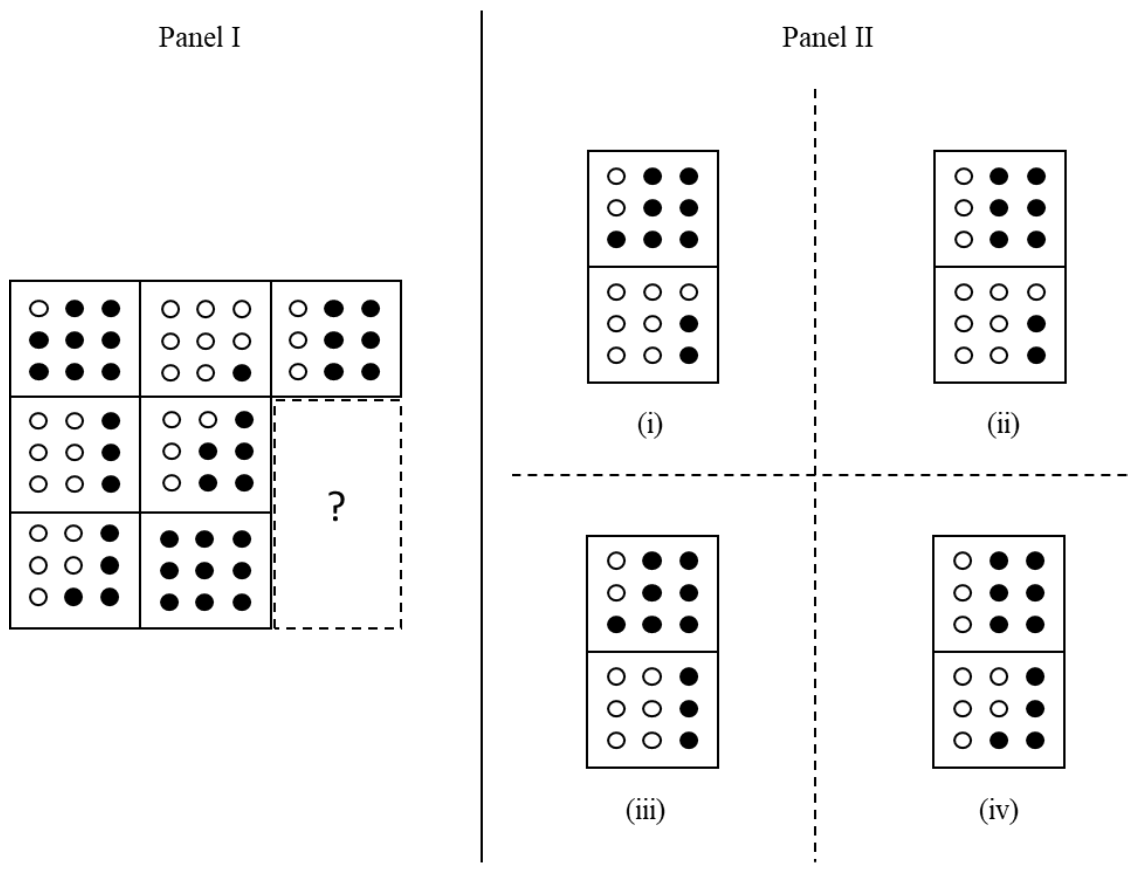
Two tiles are missing in Panel I. Which one of the options in Panel II is the appropriate choice for the missing tiles?
2026 · Unclassified
Ecology and Evolution (EY) 2026
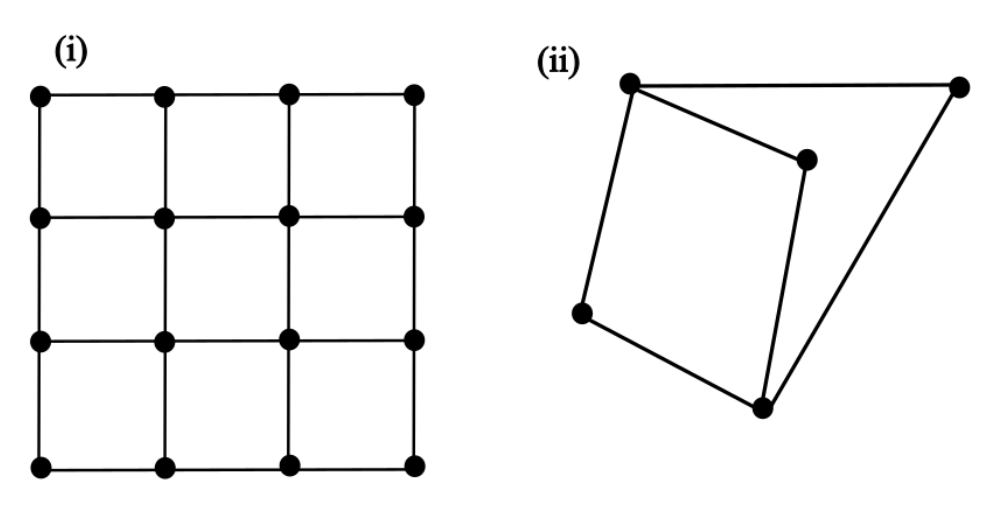
Figures (i) and (ii) represent intercity highway systems. The black dots represent cities and the line segments between them represent intercity highways. A salesperson needs to make a trip. She needs to start from a city, visit each of the remaining cities exactly once, and finally return to the same city from which she started. Which one of the following options is then true?
2026 · Unclassified
Ecology and Evolution (EY) 2026
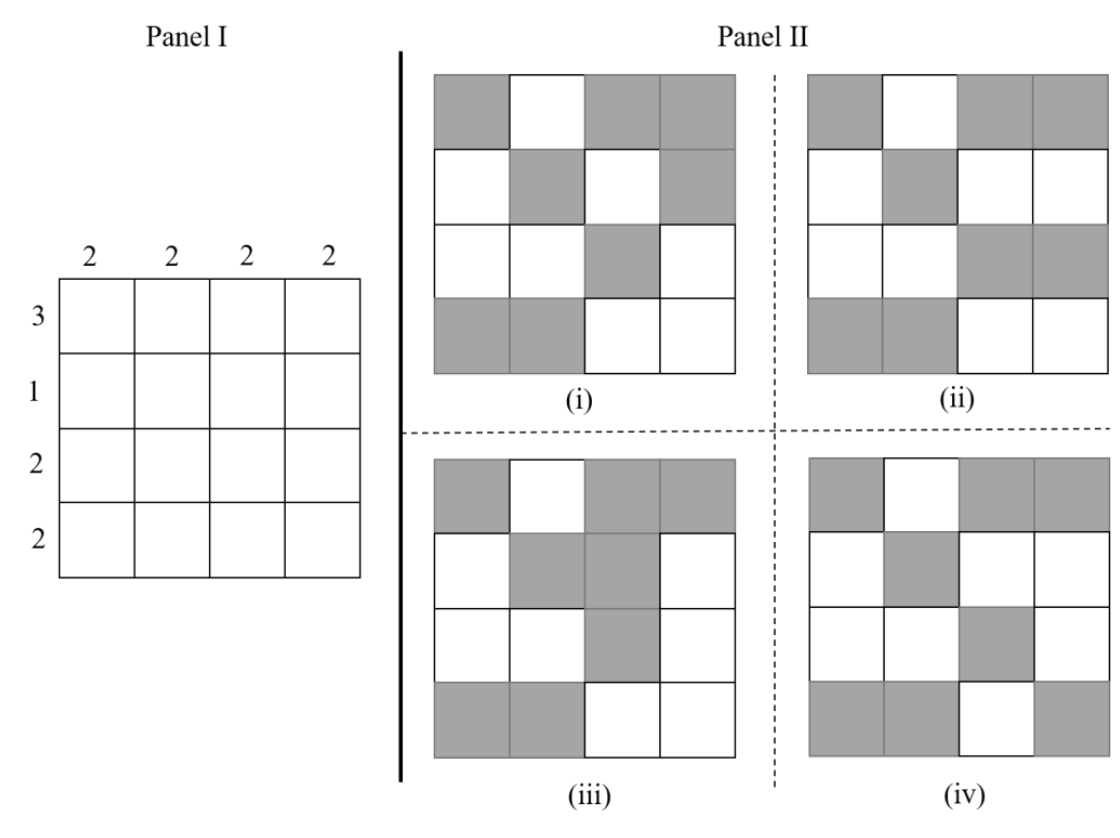
The figure in Panel I below is a grid of cells with four rows and four columns. The numbers on the top and on the left represent the number of cells that are to be shaded in that column and row, respectively. Which one of the options shown in Panel II below represents the grid shaded correctly?
2026 · Unclassified
Ecology and Evolution (EY) 2026
An unbiased six-faced dice whose faces are marked with numbers 1, 2, 3, 4, 5, and 6 is rolled twice in succession and the number on the top face is recorded each time. The probability that the sum of the two recorded numbers is a prime number is _____
2026 · Unclassified
Ecology and Evolution (EY) 2026
Two sister species, A and B, are distributed along a continuous elevational gradient in the Himalayas. Species A is distributed from the foothills to 1800 metres above sea level and species B is distributed from 1800 to 3500 metres above sea level. Which one of the following modes of speciation best explains their distribution?
2026 · Unclassified
Ecology and Evolution (EY) 2026
Which one of the following is an invasive plant species in India?