- Total number of questions: 65
- 30 questions carry one mark each
- 35 questions carry two marks each
- Negative marking: 1/3 of the marks allotted to the question
- Use of calculator is allowed
- This is a proctored examination
- All other browser applications will be automatically closed
- After three warnings, the examination window will close automatically
Exam Details
Computer Science & Information Technology (CS) 2013 [Session 4]
Review the key details, then start the test when you are ready. You can also open the full package to see related papers.
Questions
65
Duration
180 mins
Package
Computer Science & Information Technology (CS) - Previous Year Papers
Paper pattern & analysis
Filter this paper by subject, topic or subtopic. Every graph updates from the selected questions.
Topic distribution
Subtopic distribution
Difficulty distribution
65questions
Easy
65
100%
Question type distribution
65questions
Multiple Choices
65
100%
Instructions
Computer Science & Information Technology (CS) 2013 [Session 4] – Instructions
Syllabus
Full Syllabus
Sample questions from this paper
Questions are selected across the paper subjects wherever the paper contains that variety.
2013 · Unclassified
Computer Science & Information Technology (CS) 2013 [Session 4]
Q.1 – Q.25 carry one mark each.
The transport layer protocols used for real time multimedia, file transfer, DNS and email, respectively are
2013 · Unclassified
Computer Science & Information Technology (CS) 2013 [Session 4]
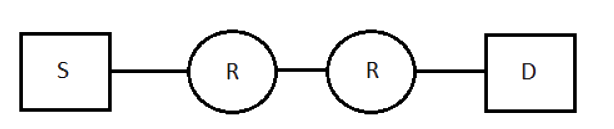
Assume that source S and destination D are connected through two intermediate routers labeled R. Determine how many times each packet has to visit the network layer and the data link layer during a transmission from S to D.
2013 · Unclassified
Computer Science & Information Technology (CS) 2013 [Session 4]
An index is clustered, if
2013 · Unclassified
Computer Science & Information Technology (CS) 2013 [Session 4]
Three concurrent processes X, Y, and Z execute three different code segments that access and update certain shared variables. Process X executes the P operation (i.e., wait) on semaphores a, b, and c; process Y executes the P operation on semaphores b, c, and d; process Z executes the P operation on semaphores c, d, and a before executing the respective code segments. After completing the execution of its code segment, each process invokes the V operation (i.e., signal) on these three semaphores. All semaphores are binary semaphores initialized to one. Which one of the following represents a deadlock-free order of invoking the P operations by the processes?
2013 · Unclassified
Computer Science & Information Technology (CS) 2013 [Session 4]
Which of the following statements is/are FALSE?
2013 · Unclassified
Computer Science & Information Technology (CS) 2013 [Session 4]
Which of the following statements are TRUE? 1. The problem of determining whether there exists a cycle in an undirected graph is in P. 2. The problem of determining whether there exists a cycle in an undirected graph is in NP. 3. If a problem A is NP-Complete, there exists a non-deterministic polynomial time algorithm to solve A.