- Total number of questions: 65
- 30 questions carry one mark each
- 35 questions carry two marks each
- Negative marking: 1/3 of the marks allotted to the question
- Use of calculator is allowed
- This is a proctored examination
- All other browser applications will be automatically closed
- After three warnings, the examination window will close automatically
Exam Details
Civil Engineering (CE) 2017 [Session 2]
Review the key details, then start the test when you are ready. You can also open the full package to see related papers.
Questions
65
Duration
180 mins
Package
Civil Engineering (CE) - Previous Year Papers
Paper pattern & analysis
Filter this paper by subject, topic or subtopic. Every graph updates from the selected questions.
Topic distribution
Subtopic distribution
Difficulty distribution
65questions
Easy
39
60%
Hard
26
40%
Question type distribution
65questions
Multiple Choices
39
60%
Fill in the blanks
26
40%
Instructions
Civil Engineering (CE) 2017 [Session 2] – Instructions
Syllabus
Full Syllabus
Sample questions from this paper
Questions are selected across the paper subjects wherever the paper contains that variety.
2017 · Unclassified
Civil Engineering (CE) 2017 [Session 2]
Q.1 – Q.5 carry one mark each.
Consider the following simultaneous equations (with c1 and c2 being constants): 3x1 + 2x2 = c1 4x1 + x2 = c2 The characteristic equation for these simultaneous equations is
2017 · Unclassified
Civil Engineering (CE) 2017 [Session 2]
Correct : 1 Wrong : -0.33
Let w = f(x, y), where x and y are functions of t. Then, according to the chain rule, dw/dt is equal to
2017 · Unclassified
Civil Engineering (CE) 2017 [Session 2]
Correct : 1 Wrong : -0.33
Given that the scope of the construction work is well-defined with all its drawings, specifications, quantities and estimates, which one of the following types of contract would be most preferred?
2017 · Unclassified
Civil Engineering (CE) 2017 [Session 2]
Correct : 1 Wrong : -0.33
Let G be the specific gravity of soil solids, w the water content in the soil sample, γt the unit weight of water, and γd the dry unit weight of the soil. The equation for the zero air voids line in a compaction test plot is
2017 · Unclassified
Civil Engineering (CE) 2017 [Session 2]
Correct : 1 Wrong : -0.33
Consider the following statements related to the pore pressure parameters, A and B:
P. A always lies between 0 and 1.0 Q. A can be less than 0 or greater than 1.0 R. B always lies between 0 and 1.0 S. B can be less than 0 or greater than 1.0
For these statements, which one of the following options is correct?
2017 · Unclassified
Civil Engineering (CE) 2017 [Session 2]
Q.6 – Q.10 carry two marks each.
Consider a rigid retaining wall with partially submerged cohesionless backfill with a surcharge. Which one of the following diagrams closely represents the Rankine’s active earth pressure distribution against this wall?
A
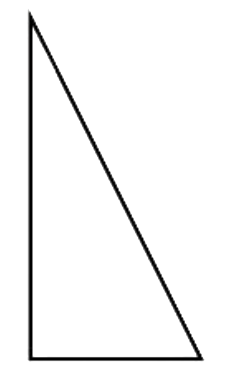
B
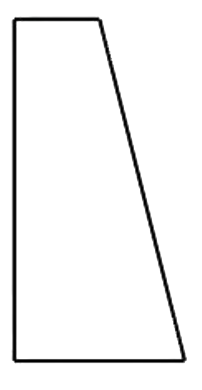
C
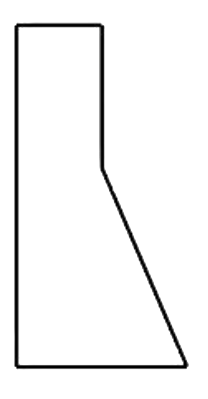
D