Which of the following is not a metal?
(a) Copper
(b) Sulphur
(c) Aluminium
(d) Iron
Soln:
Answer is (b) Sulphur
2. The substance that will be flattened on beating with a hammer is
(a) Crystal of iodine
(b) Lump of sulphur
(c) Piece of coal
(d) Zinc granule
Soln:
Answer is (d) zinc granule
Explanation:
Metals can be beaten into thin sheets whereas non-metals break into pieces on hitting; hence the answer is (d) zinc granule.
3. Boojho has learnt that non-metals on beating with a hammer are generally broken into pieces. Which of the following is a nonmetal?
(a) Iron nail
(b) Aluminium wire
(c) Copperplate
(d) Piece of coal
Soln:
Answer is (d) Piece of coal
Explanation:
Iron, Copper and aluminium are metals, whereas coal is a non-metal, and hence the answer is (d) piece of coal.
4. Materials which can be drawn into wires are called ductile. Which of the following is not a ductile material?
(a) Silver
(b) Copper
(c) Sulphur
(d) Aluminium
Soln:
Answer is (c) sulphur
Explanation:
Ductility is the property of metals. Here Sulphur is non-metal which is not have ductile property.
5. Metals are generally hard. Which of the following metals is an exception and can be cut with a knife?
(a) Iron
(b) Sodium
(c) Gold
(d) Magnesium
Soln:
Answer is (b) Sodium
Explanation:
Sodium is highly reactive metals which looks soft and can be cut into pieces by using a knife.
6. Metals are generally solid. Which of the following metals is in the liquid state at room temperature?
(a) Mercury
(b) Silver
(c) Aluminium
(d) Sodium
Soln:
Answer is (a) Mercury
7. Metals generally react with dilute acids to produce hydrogen gas. Which one of the following metals does not react with dilute hydrochloric acid?
(a) Magnesium
(b) Aluminium
(c) Iron
(d) Copper
Soln:
Answer is (d) Copper
Explanation:
Less reactive metals like Copper, gold and silver do not react with dilute HCl to produce Hydrogen gas.
8. Which of the following reacts with cold water vigorously?
(a) Carbon
(b) Sodium
(c) Magnesium
(d) Sulphur
Soln:
Answer is (b) Sodium
Explanation:
Sodium reacts vigorously with water, hence it is stored in kerosene to avoid reaction of sodium with moisture in the atmosphere and oxygen.
9. The metal which produces hydrogen gas on reaction with dilute hydrochloric acid as well as sodium hydroxide solution is
(a) Copper
(b) Iron
(c) Aluminium
(d) Sodium
Soln:
Answer is (c) Aluminium
Explanation:
Aluminium reacts with dilute HCl as well as NaOH to produce Hydrogen Gas.
10. Which of the following non-metals reacts and catches fire on exposure to air?
(a) Phosphorus
(b) Nitrogen
(c) Sulphur
(d) Hydrogen
Soln:
Answer is (a) Phosphorus
11. Generally, metallic oxides are basic and non-metallic oxides are acidic in nature. The solution of which of the following oxides in water will change the colour of blue litmus to red?
(a) Sulphur dioxide
(b) Magnesium oxide
(c) Iron oxide
(d) Copper oxide
Soln:
Answer is (a) Sulphur dioxide
Explanation:
Sulphur forms Sulphur-di-oxide which is acidic in nature and it will convert blue litmus to red.
12. Which of the following property is not responsible for copper to be used as electrical conduction wires?
(a) Ductility
(b)Colour
(c) Good conductor of electricity
(d) It is solid
Soln:
Answer is (b) Colour.
Very Short Answer Questions13. Name two soft metals which can be cut with a knife.
Soln:
(i) Sodium (ii) Potassium
14. Which non-metal is essential for our life and all living beings inhale it during breathing?
Soln:
Oxygen.
15. Name two major non-metals which are present in fertilisers and enhance the growth of plants.
Soln:
(i)Nitrogen (ii) Phosphorus
16. Which non-metal is used to disinfect water?
Soln:
Chlorine.
17. A purple coloured non-metal form a brown solution in alcohol which is applied on wounds as an antiseptic. Name the nonmetal.
Soln:
Iodine.
18. Zinc sulphate forms a colourless solution in water. Will you observe any colour on adding copper turning in it?
Soln:
There will be no change as displacement reaction will not take place.
19. Why are bells made of metals?
Soln:
Metals show the sonorous property, hence they are used in making bells.
20. Which liquid metal is used for making thermometers?
Soln:
Mercury.
21. Which of the following metals can displace the other two metals from their salt solutions?
Soln:
Zinc.
Short Answer Questions22. Paheli bought a statue made of copper. To her surprise, it acquired a dull green coating after a couple of months. Explain the reason.
Soln:
The green coating on the copper statue is the mixture of CU(OH)2 and CUCO3 which are formed due to reaction of moisture and copper.
23. In Fig 4.1 you find that the bulb glows when an iron nail is placed between two ends of the wire. Complete the following sentences on the bases of this fact.
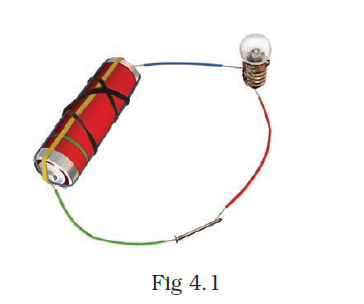
(a) __________ is a metal.
(b) Metals are good __________ of electricity.
Soln:
a) Iron is a metal.
b) Metals are good conductors of electricity.
24. If in Fig. 4.1 iron nail is replaced by a wooden stick, will the bulb glow or not? Justify your answer
Soln:
If the iron nail is replaced by a wooden stick bulb will not glow as wood is a bad conductor of electricity.
25. Paheli prepared a blue coloured solution of copper sulphate in beaker A and placed an iron nail in it. Boojho prepared a yellowish-green solution of ferrous sulphate in beaker B and placed a copper wire in it. What changes will they observe in the two beakers after an hour?
Soln:
In beaker A, a reddish-brown layer of copper will deposit on the iron nail and the blue coloured solution will become yellowish-green. On the other hand, no change is observed in beaker B.
26. A doctor prescribed a tablet to a patient suffering from iron deficiency. The tablet does not look like iron. Explain.
Soln:
Tablets are made from salts of iron, hence it does not look like iron.
27. Match the substances in Column A with their applications given in Column B.
| Column A
(Substance) |
Column B
(Application) |
| (a) oxygen | (i) for making crackers |
| (b) copper | (ii) for disinfecting water |
| (c) sulphur | (iii) all living beings inhale during breathing |
| (d) iron | (iv) for making electric wires |
| (e) chlorine | (v) for making rails |
Soln:
| Column A
(Substance) |
Column B
(Application) |
| (a) oxygen | (iii) all living beings inhale during breathing |
| (b) copper | (iv) for making electric wires |
| (c) sulphur | (i) for making crackers |
| (d) iron | (v) for making rails |
| (e) chlorine | (ii) for disinfecting water |
28. Some of the following statements are incorrect. Find the incorrect statements and correct them.
(a) The property of metals by virtue of which they can be drawn into wires is called ductility.
(b) Metals are good conductor of electricity but poor conductor of heat.
(c) Articles made of metals produce ringing sound when struck hard.
(d) Oxides of non-metals and metals are acidic in nature.
(e) A less reactive metal replaces a more reactive metal from its salt solution in water.
Soln:
Statement b) d) and e) are wrong statements
b) Metals are good conductors of electricity as well as heat.
d)Oxides of non-metals are acidic in nature and oxides of metals are basic in nature.
e) A more reactive metal replaces a less reactive metal from its salt solution in water.
29. Iron is more reactive than copper. Can you write an activity to show this?
Soln:
Take copper sulphate solution and iron sulphate solution in separate test tubes.
Take Cooper and iron nail
Place the copper wire in a solution of iron sulphate and the iron nail in a solution of copper sulphate.
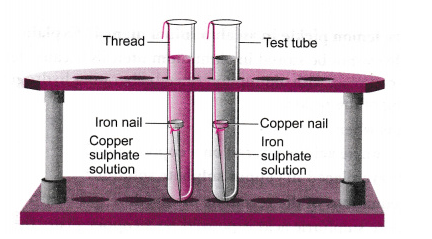
Reaction in the test tube containing iron nail and copper sulphate solution is observed. Iron takes the sulphate away from copper. You see that a reaction takes place and copper is left by itself. Now, we can say that iron has displaced copper from copper sulphate.
Copper sulphate + Iron———► Iron sulphate + Copper
In such a reaction, the more reactive metal displaces the less reactive metal. Thus, the above activity shows that iron is more reactive than copper.
30. Fill in the blanks to complete the following paragraph.
The name of the product formed in the reaction of sulphur and _____________ is sulphur dioxide gas. When sulphur dioxide is dissolved in_________________, sulphurous acid is formed. The sulphurous acid turns _____________ litmus paper to ____________. Generally oxides of __________ are acidic in nature. After completing the paragraph write two questions which you can raise on the basis of this information.
Soln:
The name of the product formed in the reaction of sulphur and Oxygen is sulphur dioxide gas. When sulphur dioxide is dissolved in water, sulphurous acid is formed. The sulphurous acid turns blue litmus paper to red. Generally oxides of nonmetals are acidic in nature. After completing the paragraph write two questions which you can raise on the basis of this information.
- When Sulphur reacts with oxygen which gas is produced?
- What happen when sulphur dioxide is dissolved in water ?
31. Find out the names of three metals and three non-metals from the box given as Fig 4.2.
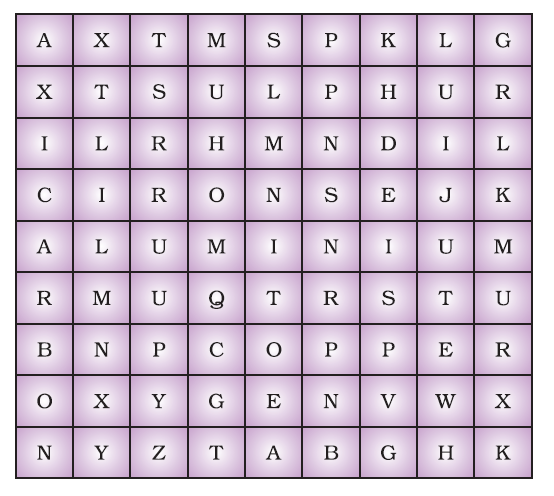
Soln:
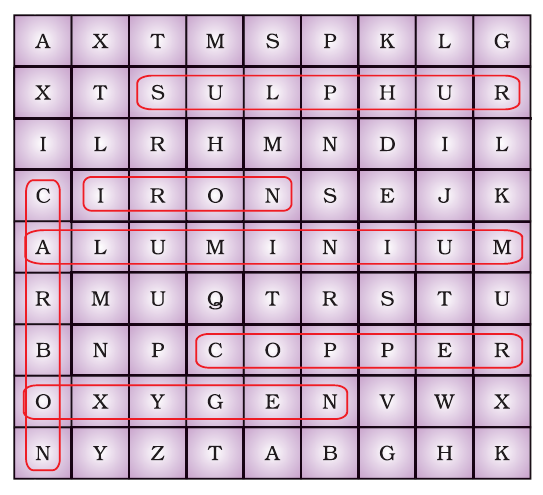
| Metals | Non-metals |
| Iron | Carbon |
| Copper | Oxygen |
| Aluminium | Sulphur |
32. Complete the crossword given in Fig. 4.3 with the help of the clues.
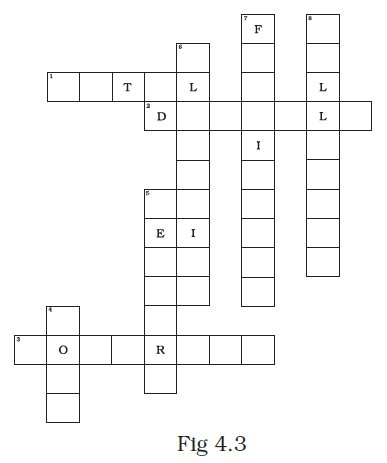
Across
1. Which is generally hard, ductile, malleable and sonorous.
2. A metal is called so it can be drawn into wires.
3. Metal bells are used because of this property.
Down
4. A metal generally used for making jewellery.
5. A metal which is liquid at room temperature.
6. A metal which reacts with acid as well as base to form hydrogen gas.
7. Substances used to enhance the growth of plants.
8. Property by virtue of which metals can be beaten into thin sheets.
Soln:
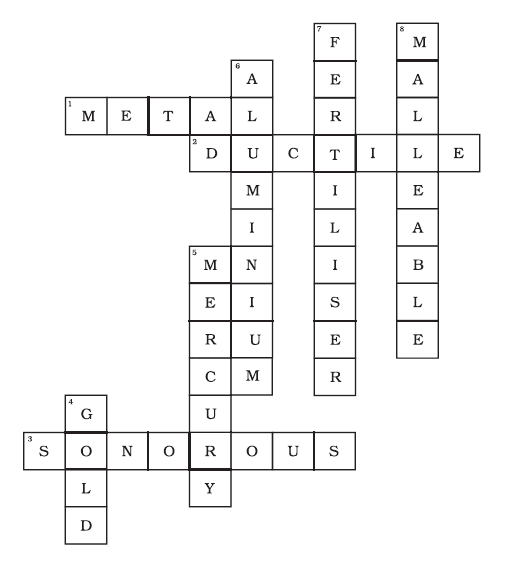
Show solutionHide solution
Solution coming soon.