Which of the following does not show water shortage?
(a) Taps running dry.
(b) Long queues for getting water.
(c) Marches and protests for the demand of water.
(d) A family gets three buckets of water per person per day.
Soln:
The answer is (d) A family gets three buckets of water per person per day.
Explanation:
United Nations recommends 50 litres of water per person per day. If a family gets three buckets of water per day, it does not show the shortage of water.
2. Seas and oceans are full of water on earth. However, a very small percentage of water present on earth is available for us. This percentage is roughly
(a) 0.006%.
(b) 0.06%.
(c) 0.6%.
(d) 6%.
Soln:
Answer is (a) 0.006%
Explanation:
About 97.4% of the total water on earth is in seas and oceans. About 2% of water is frozen in glaciers and in polar ice caps. The remaining i.e., only 0.6%, is available as freshwater in the liquid form. Even out of this, 0.59% is present as groundwater, and only 0.01% is available as fresh water on the surface of the earth.
3. Which of the following are not the liquid forms of water?
(i) Snow
(ii) Lakewater
(iii) River water
(iv) Water vapour
(v) Ice
Choose the correct combination from the options below.
(a) (i), (iv) and (v)
(b) (i) and (ii)
(c) (ii) and (iii)
(d) (iv) only
Soln:
Answer is (a) (i), (iv) and (v)
Explanation:
Snow and ice are solid forms of water, whereas water vapour is the gaseous state of water.
4. A man digging the ground near a water body found that the soil was moist. As he kept digging deeper and deeper, he reached a level where all the spaces between particles of soil and gaps between rocks were filled with water. The upper limit of this layer is called
(a) water level.
(b) water table.
(c) groundwater.
(d) water limit.
Soln:
The answer is (b) water table.
Explanation:
The upper limit of the layer where water is present between particles of soil and gaps between rocks is called water table, and water below this layer is called groundwater.
5. Which of the following is a way to use water economically?
(a) Construction of bawris
(b) Rainwater harvesting
(c) Drip irrigation
(d) Infiltration
Soln:
The answer is (c) Drip irrigation
Explanation:
In drip, irrigation water is made to fall drop by drop which directly reaches the roots of the plant. This minimises water wastage and also helps in controlling weeds.
6. On which of the following day is World Water Day observed?
(a) 22 March
(b) 14 November
(c) 2 October
(d) 21 December
Soln:
The answer is (a) 22 March
7. The amount of water recommended by the United Nations for drinking, washing, cooking and maintaining proper hygiene per person per day is a minimum of
(a) 5 litres
(b) 15 litres
(c) 30 litres
(d) 50 litres
Soln:
The answer is (d) 50 litres
Explanation:
United Nations recommends 50 litres of water per person per day for the purpose of drinking, washing and other persons.
8. “Every Drop Counts” is a slogan related to
(a) counting of drops of any liquid.
(b) counting of water drops.
(c) importance of water.
(d) importance of counting.
Soln:
The answer is (c) the importance of water.
9. Water cycle does not involve which of the following?
(a) Evaporation
(b) Condensation
(c) Formation of clouds
(d) Rainwater harvesting
Soln:
The answer is (d) Rainwater harvesting
Explanation:
Water moves to the atmosphere and will come back to earth constantly this is known as the water cycle. In the water cycle, rain evaporates from water sources to form water vapours. Water vapours condense to form clouds. Clouds get cooled, and water comes down to earth as rain.
10. Which of the following inhibits the seepage of rainwater into the ground?
(a) A pukka floor
(b) Playground
(c) Grass lawn
(d) Forest land
Soln:
The answer is (a) A pukka floor
Explanation:
A pukka floor is a cement floor which is impenetrable to water. Hence water cannot seep through the pukka floor.
Very Short Answer Questions11. State whether the following statements are True or False. If false, write the correct statement.
(a) Water vapour is the gaseous form of water.
(b) Ice is solid, whereas snow is the semi-solid form of water.
(c) Ocean water cannot be used for domestic purposes.
(d) The rapid growth of industries is one of the causes of water shortage.
Soln:
a) True
b) False-Snow is also a solid form of water
c) True
d) True
12. Some definitions are given below, which can be corrected by changing one word. Correct them.
(a) An aquifer is groundwater stored between layers of hard rock above the water table.
(b) The process of evaporation of water in the ground is called infiltration.
(c) The evaporation of water from oceans and its arrival back into oceans is called the vapour cycle.
Soln:
a) An aquifer is groundwater stored between layers of hard rock below the water table.
b) The process of seeping of water in the ground is called infiltration.
c) The evaporation of water from oceans and its arrival back into oceans is called the water cycle.
13. What is the source of water in each of the following?
(a) Wells
(b) Ground
(c) Atmosphere
Soln:
a) Groundwater
b) Rain
c) Evaporation
14. State whether the following statements are true or false. If false, give the correct statement.
(a) The process of seeping of water into the ground is called filtration.
(b) 51% of the earth’s surface is covered with water.
(c) The year 2003 was observed as the International Year of Freshwater.
(d) Snow and ice both are solid forms of water.
Soln:
a) False- It is called infiltration
b) False- 71% of the earth’s surface is covered with water.
c) True
d) True
Short Answer Questions15. Fill in the blanks in the given passage.
The rainwater and ________________ from other sources, such as rivers and ponds seep through the ______________ and fill the empty spaces and cracks deep below the ground. The process of seeping of water into the ground is called ______________.
Soln:
The rainwater and water from other sources, such as rivers and ponds, seep through the soil and fill the empty spaces and cracks deep below the ground. The process of seeping of water into the ground is called infiltration.
16. Fill in the blanks and complete the story by selecting words from the box given here.

Rajasthan is a _________ and dry place. The challenge of natural _______ of water was met by a successful experiment. A band of social ________ had transformed a _________ area into a green place. They have revived five dried-up ________ by constructing water ___________ structures.
Soln:
Rajasthan is a hot and dry place. The challenge of natural scarcity of water was met by a successful experiment. A band of social workers had transformed a dry area into a green place. They have revived five dried-up rivers by constructing water harvesting structures.
17. Place the following statements in a proper order to form a meaningful paragraph.
(a) Which in turn decreases the seepage of rainwater into the ground.
(b) This decreases the open areas like park and playgrounds.
(c) Increasing population create demand for construction of houses, shops, offices, roads and pavements.
(d) This results in depletion of the water table and creates scarcity of more water.
Soln:
(c) Increasing population create demand for construction of houses, shops, offices, roads and pavements.
(b) This decreases the open areas like park and playgrounds.
(a) Which in turn decreases the seepage of rainwater into the ground.
(d) This results in depletion of the water table and creates scarcity of more water.
18. How can you observe the three forms of water in (i) nature and (ii) at home?
Soln:
i) In nature, we can observe the water in the form of snow-solid, water-liquid and vapours-gaseous forms.
ii) At homes, we can observe the water in the form of water-liquid, ice-solid and steam-gaseous forms.
19. Complete the given table
| Form of Water | A process by which formed | Location where found |
| a) Liquid | ||
| b) Solid | ||
| c) Gaseous |
Soln:
| Form of Water | A process by which formed | Location where found |
| a) Liquid | Condensation and melting | Lakes, rivers etc |
| b) Solid | Freezing | Cold regions like High mountains, poles |
| c) Gaseous | Evaporation | Atmosphere |
20. Match Column I with Column II
| Column-I | Column-II |
| a) Groundwater | i) The solid form of water |
| b) Bawri | ii) Wastage of water |
| c) Snow | iii) Water management |
| d) Drip irrigation | iv) Small water |
| e) Leaking taps | v) Water table |
Soln:
| Column-I | Column-II |
| a) Groundwater | v) Water table |
| b) Bawri | iv) Small water |
| c) Snow | i) A solid form of water |
| d) Drip irrigation | iii) Water management |
| e) Leaking taps | ii) Wastage of water |
21. A list of jumbled words is given here. Write the correct form of each word.
(a) WASHFERRET (b) CHARREGE (c) QUIFERA (d) WOSN
Soln:
(a) freshwater
(b) recharge
(c) aquifer
(d) snow
22. From where do the following usually get water? In which form is water present in them?
(a) Clouds
(b) Plants
(c) Mountain tops
(d) Aquifer
(e) Animals
Soln:
(a) land; liquid form (droplet of water).
(b) soil; liquid form.
(c) atmosphere; solid form.
(d) rain; underground water.
(e) water bodies; liquid.
Long Answer Questions
23. Complete the following chart by writing appropriate words in the boxes marked (a) to (e).
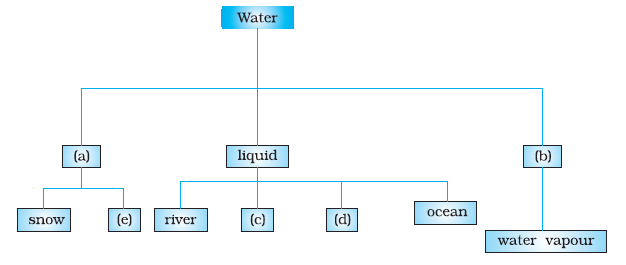
Soln:
(a) solid (b) gaseous (c) well (d) lake (e) ice
24. What is groundwater? What are the sources of water which are fed by groundwater?
Soln:
Water found below the water table is called groundwater.
Sources of Groundwater
The rainwater and water from other sources, such as rivers and ponds, seep through the soil and fill the empty spaces and cracks deep below the ground. The process of seeping of water into the ground is called infiltration. The groundwater thus gets recharged by this process. At places, the groundwater is stored between layers of hard rock below the water table. This is known as an aquifer. Water in the aquifers can be usually pumped out with the help of tube wells or hand pumps.
25. Water is very precious for all living beings. What will happen in future if we do not save water now?
Soln:
Water is essential for all living beings. There can be no life without it. If we do not save water now, we face scarcity of water and it may lead to the following consequences.
BYJU’S presents NCERT Solutions, sample papers, notes, previous years’ question papers, study materials, and NCERT textbooks for the benefit of the student. For more information, visit BYJU’S website or download BYJU’S – The Learning App for a customised learning experience.
Show solutionHide solution
Solution coming soon.