Q31Written answer
A ratio will always be more than 1.
Show solutionHide solution
Worked solution
Solution:-
False.
A ratio will be more than or less than 1
Your cart is empty.
Practice each question, then open the answer or worked solution.
A ratio will always be more than 1.
Solution:-
False.
A ratio will be more than or less than 1
A ratio can be equal to 1.
Solution:-
True.
Example: 2: 2 = 2/2 = 1
If b : a = c : d, then a, b, c, d are in proportion.
Solution:-
False
Four quantities are said to be in proportion, if the ratio of the first and the second quantities is equal to the ratio of the third and the fourth quantities. The symbol ‘::’ or ‘=’ is used to equate the two ratios.
The two terms of a ratio can be in two different units.
Solution:-
False.
For a ratio, the two quantities must be in the same unit. If they are not, they should be expressed in the same unit before the ratio is taken.
In questions 35 to 46, fill in the blanks to make the statements true.
A ratio is a form of comparison by ______.
Solution:-
A ratio is a form of comparison by division.
20m : 70m = Rs 8 : Rs ______.
Solution:-
20m : 70m = Rs 8 : Rs 28.
Let us assume the missing number be P.
Then, 20m : 70m = ₹ 8 : ₹ P
20/70 = 8/P
P = (70 × 8)/20
P = 560/20
P = 56/2
P = 28
Therefore, 20m : 70m = Rs 8 : Rs 28.
There is a number in the box [ ] such that [ ], 24, 9, 12 are in proportion. The number in the box is _____.
Solution:-
There is a number in the box [ ] such that [ ], 24, 9, 12 are in proportion. The number in the box is 18.
Let us assume the missing number be ‘P’,
Then, P, 24, 9, 12
P: 24 = 9: 12
P/24 = 9/12
9/12 is further simplified by dividing both the numerator and denominator by 3.
So, P/24 = 3/4
P = (3 × 24)/4
P = 72/4
P = 18
Therefore, the missing number is 18.
If two ratios are equal, then they are in _____.
Solution:-
If two ratios are equal, then they are in proportion.
Use Fig. 8.2 (In which each square is of unit length) for questions 39 and 40:
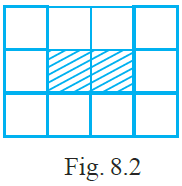
The ratio of the perimeter of the boundary of the shaded portion to the perimeter of the whole figure is _______.
Solution:-
The ratio of the perimeter of the boundary of the shaded portion to the perimeter of the whole figure is 3: 7.
From the figure, perimeter of shaded portion = 1 + 2 + 1 + 2 = 6 units
Perimeter of whole figure = 3 + 4 + 3 + 4 = 14 units
Then, the ratio of the perimeter of the boundary of the shaded portion to the perimeter of the whole figure = 6/14
= 3/7
= 3: 7
The ratio of the area of the shaded portion to that of the whole figure is ______.
Solution:-
The ratio of the area of the shaded portion to that of the whole figure is 1: 6.
Area of the shaded figure = 2 × 1
= 2 sq. units
Area of whole figure = 3 × 4 = 12 sq. units
The ratio of the area of the shaded portion to that of the whole figure is = 2: 12
= 2/12
= 1/6
= 1: 6