My Cart
Your Cart 0

    Your cart is empty.

  • Total (Amount) ₹0.00
NCERT Exemplar · Class 6 · Maths

Chapter 6: Mensuration

Practice each question, then open the answer or worked solution.

Exercise

60 questions
Q1Written answer

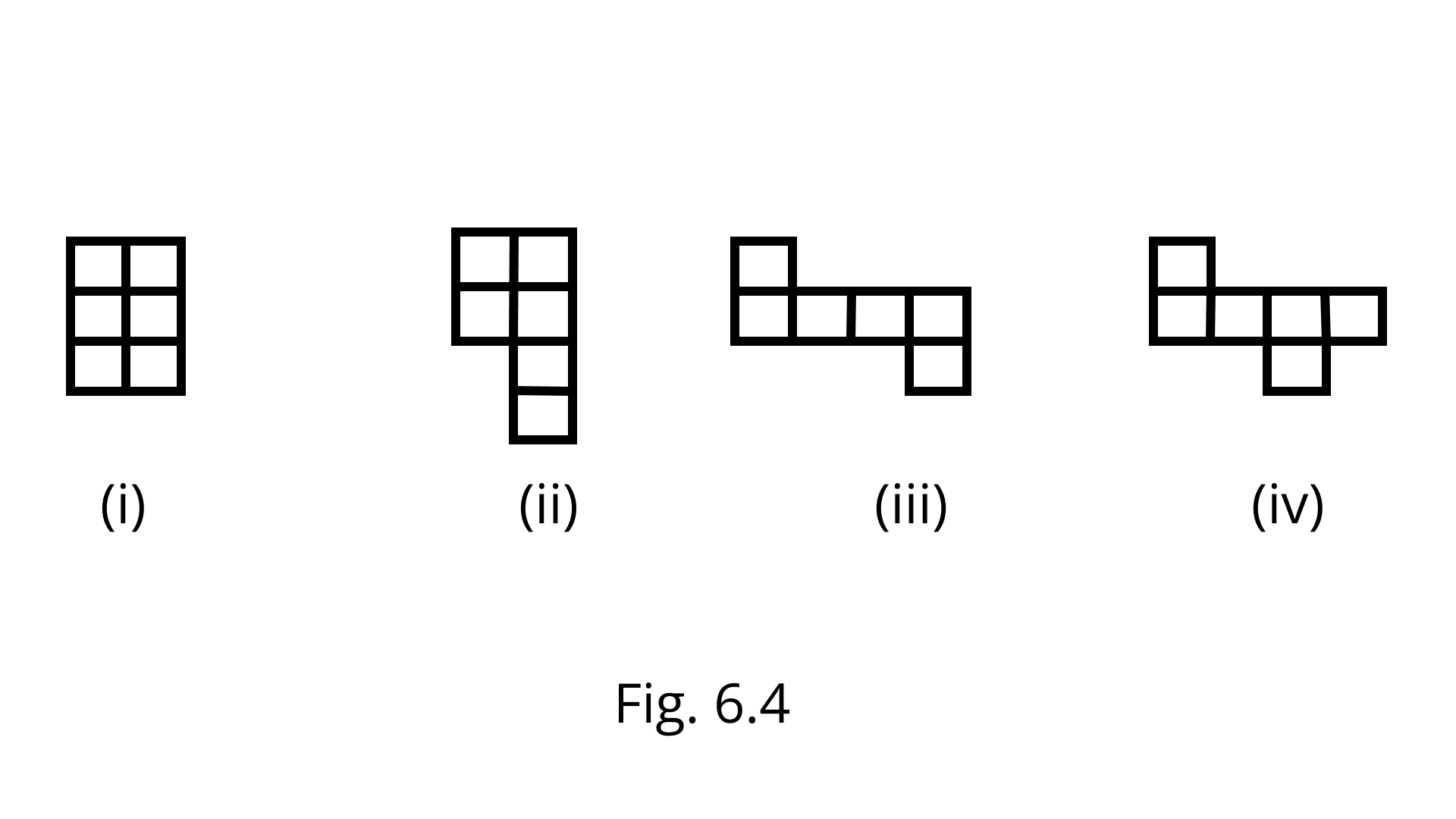
The following figures are formed by joining six-unit squares. Which figure has the smallest perimeter in Fig. 6.4
seo images


(A) (ii)

(B) (iii)

(C) (iv)

(D) (i)

Show solutionHide solution
Worked solution

Ans: Correct option - D 

Perimeter=sum of all sides

For the option (i) = 10 Units:

For the option (ii) = 12 Units

For the option (iii) = 14 Units

For the option (vi) = 14 Units

So, figure (i) has the smallest perimeter.

Q2Written answer

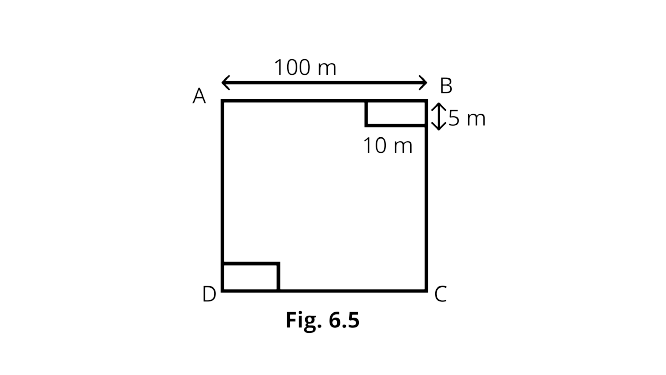
A square-shaped park ABCD of side 100m has two equal rectangular flower beds each of size 10m $\times$ 5m. Fig.6.5 Length of the boundary of the remaining park is

seo images

(A) 360m

(B) 400m

(C) 340m

(D) 460m

Show solutionHide solution
Worked solution

Ans: Correct option - B 

Given ,length =10m

Breadth = 5 m

Than remaining park’s length=90m

Breadth =95m

So, perimeter of remaining park $=90+5+10+95+90+5+10+95=400$m


Q3Written answer

The side of a square is 10cm. How many times will the new perimeter become if the side of the square is doubled?

(A) 2 times

(B) 4 times

(C) 6 times

(D) 8 times

Show solutionHide solution
Worked solution

Ans: Correct option - A

Given,side of square = 10 cm

Than perimeter of square= $4 \times$ Sides $=4\times10cm=40cm$

If the side of the square is doubled.

New side of square $=2\times10 cm = 20cm$

Perimeter of new square $=4\times \text{Sides}=4\times20cm=80cm$

So,the new perimeter has doubled from the old perimeter.


Q4Written answer

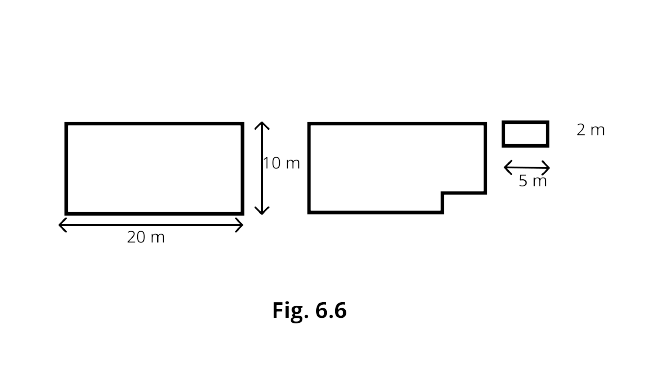
The length and breadth of a rectangular sheet of paper are 20 cm and 10 cm, respectively. A rectangular piece is cut from the sheet as shown in Fig.6.6 . Which of the following statements is correct for the remaining sheet?

seo images


(A) Perimeter remains the same but area changes.

(B) The area remains the same but the perimeter changes.

(C) Both area and perimeter are changing.

(D) Both area and perimeter remain the same.

Show solutionHide solution
Worked solution

Ans: Correct option - A 

Perimeter remains the same as the given figure but the area changes after cutting the piece.

Old perimeter $=2(L+B)=2(20+10)=60m$

New perimeter $=10+20+8+5+2+15=60m$

Old Area $=L \times B =20 \times 10=200{m}^{2}$

New Area $=(20 \times 10)-(5 \times 2)=190{m}^{2}$


Q5Written answer

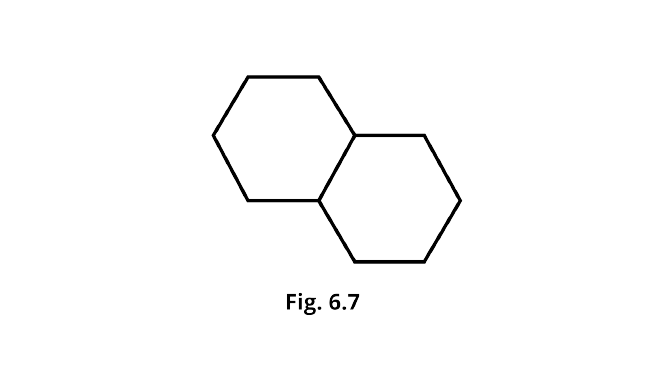
Two regular Hexagons of perimeter 30cm each are joined as shown in Fig. 6.7. The perimeter of the new figure is

seo images

(A) 65cm

(B) 60cm

(C) 55cm

(D) 50cm

Show solutionHide solution
Worked solution

Ans: Correct option - D 

Given,Perimeter of hexagon=30cm

Perimeter of hexagon $= 6 \times \text{side}$

$30= 6 \times \text{side}$

$\dfrac{30}{6}$=sides

5cm=side.

So,perimeter of given Figure=$10 \times \text{side}$

$=10\times 5cm=50cm$            $\text{[total number of sides of the new figure is 10]}$


Q6Written answer

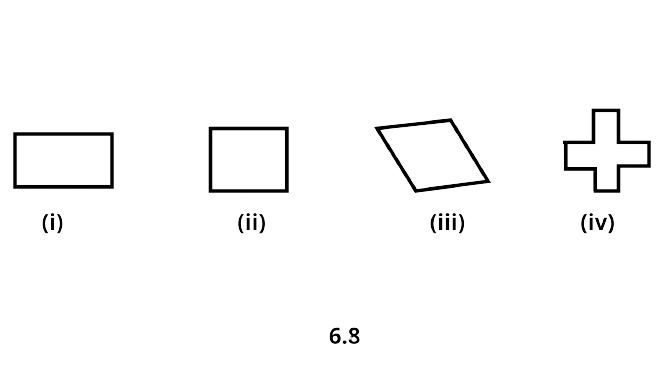
In Fig. 6.8 which of the following is a regular polygon? All have equal side except (i)

seo images


(A) (i)

(B) (ii)

(C) (iii)

(D) (iv)

Show solutionHide solution
Worked solution

Ans: Correct option - B 

Because for a regular polygon, all sides and angles must be equal. Only (ii) is satisfying this condition.


Q7Written answer

Match the shapes (each side's measures 2cm) in column I with the corresponding perimeters in column II:

Column I

Column II

(A)

(B)

(C )

(D)

(i) 16 cm   


 (ii) 20 cm


(iii) 24 cm


(iv) 28 cm


(v) 32 cm


Show solutionHide solution
Worked solution

Ans: Perimeter of Given figure = sum of all sides

Given ,each side= 2cm

(A) No. of sides=14

Perimeter =14$\times $ length of sides

$=14\times2cm = 28cm$

(B) No. of sides=8

Perimeter =$8\times$ length of sides

$=8\times2cm=16cm$

(C) No. of sides=10

Perimeter =$10\times $ length of side

$=10\times2cm = 20cm$

(D) No. of sides=12

Perimeter$=12\times$ length of sides

$=12\times2cm= 24cm$


Column I

Column II

(A)

(iv) 28 cm   


(B)

(i) 16 cm


(C )

(ii) 20 cm

(D)

(iii) 24 cm


Q8Written answer

Match the following.

Shapes

Perimeter

(A)

(i) 10


(B)


(ii) 18


(C )

(iii) 20


(D)

(iv) 25


Show solutionHide solution
Worked solution

Ans: Perimeter of Given figure = sum of all sides

(A) We know it's a rectangle.

Perimeter of rectangle$=2\times (l+b)$

$=2\times(6+4)= 2\times 10 = 20 unit$

(B)We know it's a square

Perimeter of square $= 4\times $ length of sides

$=4\times 5$unit $= 20$ unit

(C) We know it's a equilateral triangle 

Perimeter of equilateral triangle $=3\times$ length of side

$=3\times 6$unit $=18 $unit

(D)We know it's a  Isosceles triangle

Perimeter Isosceles triangle=sum of all sides

$=4+4+2= 10$ unit


Q9Written answer

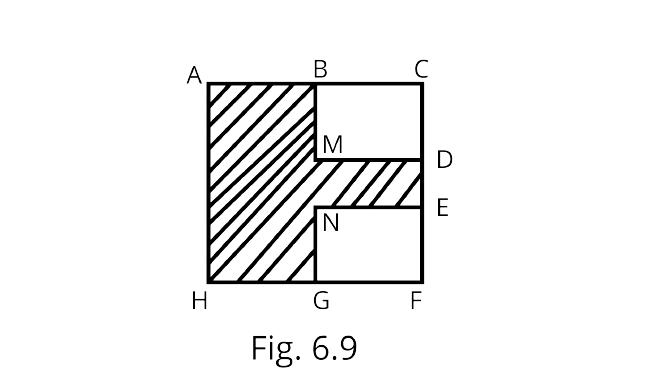
Perimeter of the shaded portion in Fig. 6.9 is

seo images


AB+_+_+_+_+_+_+HA

Show solutionHide solution
Worked solution

Ans: We know Perimeter = sum of all sides

The sides of given figure AB, BM, MD, DE, EN, NG, GH and HA

So,the perimeter of the given figure = AB + BM + MD + DE + EN + NG + GH + HA.


In questions 9 to 13, fill in the blanks to make the statements true.

Q10Written answer

The amount of region enclosed by a plane closed figure is called its……….

Show solutionHide solution
Worked solution

Ans: The amount of region enclosed by a plane closed figure is called its Area.